Research Use Only: This product is supplied for laboratory research and in-vitro studies. Not for human or veterinary administration.
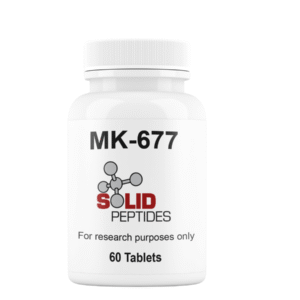
MK-677 Capsules (25mg) 60 Count
- Oral GH Secretagogue: Non-peptide ghrelin mimetic (C₂₇H₃₆N₄O₅S), >60% bioavailability
- GHS-R1a Agonist: High affinity (pKi = 8.14, EC50 = 1.3 nM), sustained GH-IGF-1 elevation
- Clinical Evidence: 30-year history, >1,000 subjects, Phase 3 development for pediatric GHD
- Mechanistic pathway studies
- In vitro receptor profiling
- HPLC verified identity and purity
Ships same-day if ordered before 2PM EST
Research Overview
MK-677 (ibutamoren, MK-0677, L-163,191, LUM-201) is a potent, orally active, non-peptide growth hormone secretagogue (GHS) that selectively agonizes the growth hormone secretagogue receptor 1a (GHS-R1a), also known as the ghrelin receptor. First developed by Merck & Co. in the mid-1990s, MK-677 has been the subject of extensive clinical and preclinical investigation spanning nearly three decades, studied in over 1,000 subjects across randomized controlled trials with more than 200 publications indexed in PubMed. Unlike peptide-based GH secretagogues that require injection, MK-677 demonstrates oral bioavailability exceeding 60% and a prolonged pharmacological half-life enabling once-daily dosing.
MK-677 functions as a high-affinity agonist of GHS-R1a with nanomolar affinity (pKi = 8.14) and potent secretagogue activity (EC50 = 1.3 nM). Cryo-EM structural analysis at 2.7 Å resolution has elucidated the molecular basis for receptor activation, revealing that ibutamoren binding induces conformational changes through an E124-R283 salt bridge mechanism and W276 toggle switch, enabling G protein coupling. The compound features a unique spirocyclic architecture linking an indoline ring system to a piperidine moiety, conferring oral bioavailability and metabolic stability not achievable with peptide GH secretagogues.
In healthy elderly subjects (ages 64-81), daily oral administration of MK-677 at 25 mg increased 24-hour mean GH concentrations by approximately 97% and restored serum IGF-1 from 141 μg/L at baseline to 265 μg/L at 4 weeks, levels comparable to young adults. Critically, MK-677 enhanced GH pulsatile secretion by amplifying pulse height without altering pulse frequency, demonstrating that physiological negative feedback mechanisms remain intact. In a two-year trial (n=65, ages 60-81), these effects were sustained without significant tachyphylaxis, with 24-hour GH increasing 1.8-fold and serum IGF-1 increasing 1.5-fold at 12 months. Lumos Pharma has licensed the compound (LUM-201) for continued clinical development in pediatric growth hormone deficiency, with Phase 2 trials completed and Phase 3 planned.
Primary Research Applications
Mechanism of Action
GHS-R1a Receptor Agonism
High-Affinity Ghrelin Mimetic — MK-677 functions as a potent, selective agonist of the growth hormone secretagogue receptor 1a (GHS-R1a/ghrelin receptor) with nanomolar affinity (pKi = 8.14) and EC50 = 1.3 nM. Upon receptor binding, MK-677 activates Gq/11 protein signaling, leading to phospholipase C (PLC) activation, inositol trisphosphate (IP3) and diacylglycerol (DAG) generation, intracellular calcium mobilization, protein kinase C (PKC) activation, and ultimately somatotroph cell depolarization and growth hormone vesicle exocytosis. Cryo-EM structural analysis at 2.7 Å resolution revealed that ibutamoren binding induces conformational changes in the E124(3.33)-R283(6.55) salt bridge, which propagate through the toggle switch residue W276(6.48) to enable G protein coupling.
Sustained GH-IGF-1 Axis Activation
Physiological Pulsatility Preserved — MK-677 produces sustained, dose-dependent activation of the somatotropic axis while preserving physiological pulsatile release patterns. In healthy elderly subjects, daily 25 mg increased 24-hour mean GH by ~97% and restored serum IGF-1 from 141 to 265 μg/L at 4 weeks. MK-677 enhanced GH pulsatile secretion by amplifying pulse height and nadir levels without altering pulse frequency, demonstrating that physiological negative feedback mechanisms involving somatostatin and IGF-1 remain intact. In a two-year trial (n=65, ages 60-81), these effects were sustained without tachyphylaxis, with 24-hour GH increasing 1.8-fold and IGF-1 increasing 1.5-fold at 12 months.
Anti-Catabolic Nitrogen-Sparing
Reverses Diet-Induced Catabolism — In a double-blind crossover study, calorically restricted subjects (18 kcal/kg/day) who received MK-677 25 mg daily for 7 days achieved positive nitrogen balance (+0.31 ± 0.21 g/day) compared to negative balance with placebo (-1.48 ± 0.21 g/day; P < 0.01). The compound produced a peak GH response of 55.9 ± 31.7 μg/L and elevated mean IGF-1 to 264 ± 31 ng/mL versus 188 ± 19 ng/mL with placebo (P < 0.01), suggesting utility in catabolic disease states.
Sleep Architecture Modulation
Enhanced Slow-Wave and REM Sleep — MK-677 (25 mg) produced an approximately 50% increase in stage IV (slow-wave) sleep duration and a >20% increase in REM sleep in young adults. The frequency of deviations from normal sleep decreased from 42% under placebo to 8% under MK-677. Older subjects demonstrated a nearly 50% increase in REM sleep with decreased REM latency, consistent with the known role of GH in sleep regulation.
“Mechanistic summaries on this page are provided for laboratory reference and should be interpreted within controlled experimental settings only.”
Preclinical Research Summary
Murphy et al. (1998) demonstrated that MK-677 reverses diet-induced protein catabolism in a double-blind crossover study (n=8, ages 24-39). Calorically restricted subjects receiving MK-677 25 mg daily for 7 days achieved positive nitrogen balance (+0.31 g/day) versus negative balance with placebo (-1.48 g/day; P < 0.01), with peak GH 55.9 μg/L and IGF-1 elevated to 264 ng/mL. Svensson et al. (1998) showed that 2-month treatment in obese males (n=24) significantly increased fat-free mass by DEXA (P < 0.01), increased IGF-1 by ~40% (P < 0.001), and transiently increased basal metabolic rate at 2 weeks (P = 0.01).
Nass et al. (2008) conducted a two-year RCT (n=65, ages 60-81) demonstrating fat-free mass increased 1.1 kg with MK-677 versus decreased 0.5 kg with placebo (P < 0.001); LDL cholesterol decreased 5.4 mg/dL (P = 0.026); effects were sustained over 24 months without tachyphylaxis. Chapman et al. (1996) showed that in healthy elderly subjects (n=32, ages 64-81), MK-677 25 mg increased GH by ~97%, restored IGF-1 to young adult levels (141 to 265 μg/L), and enhanced GH pulsatile secretion without altering pulse frequency. Chapman et al. (1997) demonstrated dose-dependent IGF-1 increases of 52% (10 mg) and 79% (50 mg) in severely GH-deficient men (n=9, ages 17-34).
Copinschi et al. (1997) found that MK-677 improved sleep quality with an ~50% increase in stage IV sleep and >20% increase in REM sleep in young subjects, and ~50% increase in REM sleep in older subjects. Jeong et al. (2018) showed that MK-0677 (5 mg/kg IP daily for 3 weeks) reduced amyloid beta burden to 30% of vehicle controls, decreased neuroinflammation (Iba-1 and GFAP), and preserved neuronal counts and synaptic density in 5XFAD transgenic mice (Alzheimer's model). Liu et al. (2021) elucidated the cryo-EM structure of ibutamoren-GHSR-Gi complex at 2.7 Å resolution, revealing the molecular basis for receptor activation.
In pediatric GHD, the OraGrowtH210 Phase 2 trial showed children receiving LUM-201 (1.6 mg/kg) achieved annualized height velocity of 8.0 cm/year versus 9.7 cm/year with injectable GH. OraGrowtH212 demonstrated 62% increase in GH secretion and 80% increase in IGF-1 after 6 months. Safety profile: The compound is generally well-tolerated. A 12-month AD trial (n=563) showed 72.9% IGF-1 elevation with no clinical benefit on AD progression. The primary adverse effect is mild insulin resistance and increased appetite. MK-677 demonstrates >60% oral bioavailability and a pharmacological half-life of ~4.7 hours with functional duration extending to ~24 hours.
Academic References
- Murphy MG et al. (1998). MK-677, an orally active growth hormone secretagogue, reverses diet-induced catabolism. Journal of Clinical Endocrinology & Metabolism.
- Svensson J et al. (1998). Two-month treatment of obese subjects with the oral growth hormone secretagogue MK-677 increases GH secretion, fat-free mass, and energy expenditure. Journal of Clinical Endocrinology & Metabolism.
- Nass R et al. (2008). Effects of an oral ghrelin mimetic on body composition and clinical outcomes in healthy older adults. Annals of Internal Medicine.
- Copinschi G et al. (1997). Prolonged oral treatment with MK-677, a novel growth hormone secretagogue, improves sleep quality in man. Neuroendocrinology.
- Chapman IM et al. (1996). Stimulation of the growth hormone-insulin-like growth factor I axis by daily oral administration of a GH secretagogue (MK-677) in healthy elderly subjects. Journal of Clinical Endocrinology & Metabolism.
- Chapman IM et al. (1997). Oral administration of growth hormone releasing peptide-mimetic MK-677 stimulates the GH/IGF-I axis in selected GH-deficient adults. Journal of Clinical Endocrinology & Metabolism.
- Jeong YO et al. (2018). MK-0677, a ghrelin agonist, alleviates amyloid beta-related pathology in 5XFAD mice, an animal model of Alzheimer's disease. International Journal of Molecular Sciences.
- Liu P et al. (2021). Structural basis of human ghrelin receptor signaling by ghrelin and the synthetic agonist ibutamoren. Nature Communications.
- Sigalos JT and Pastuszak AW (2017). The safety and efficacy of growth hormone secretagogues. Sexual Medicine Reviews.
- Yau M and Rapaport R (2021). Growth hormone deficiency and therapy in infancy and early childhood. Endocrinology and Metabolism Clinics of North America.
This product is intended exclusively for in vitro laboratory research by qualified professionals. Not for human consumption. Not approved by the FDA.
Published Research Briefs
Our research team has published evidence-checked briefs covering the science behind this compound. Each brief reviews primary sources and grades claims independently.