Research Use Only: This product is supplied for laboratory research and in-vitro studies. Not for human or veterinary administration.
Hover to zoom
Identity Verified: LC-MS
(0 Reviews)
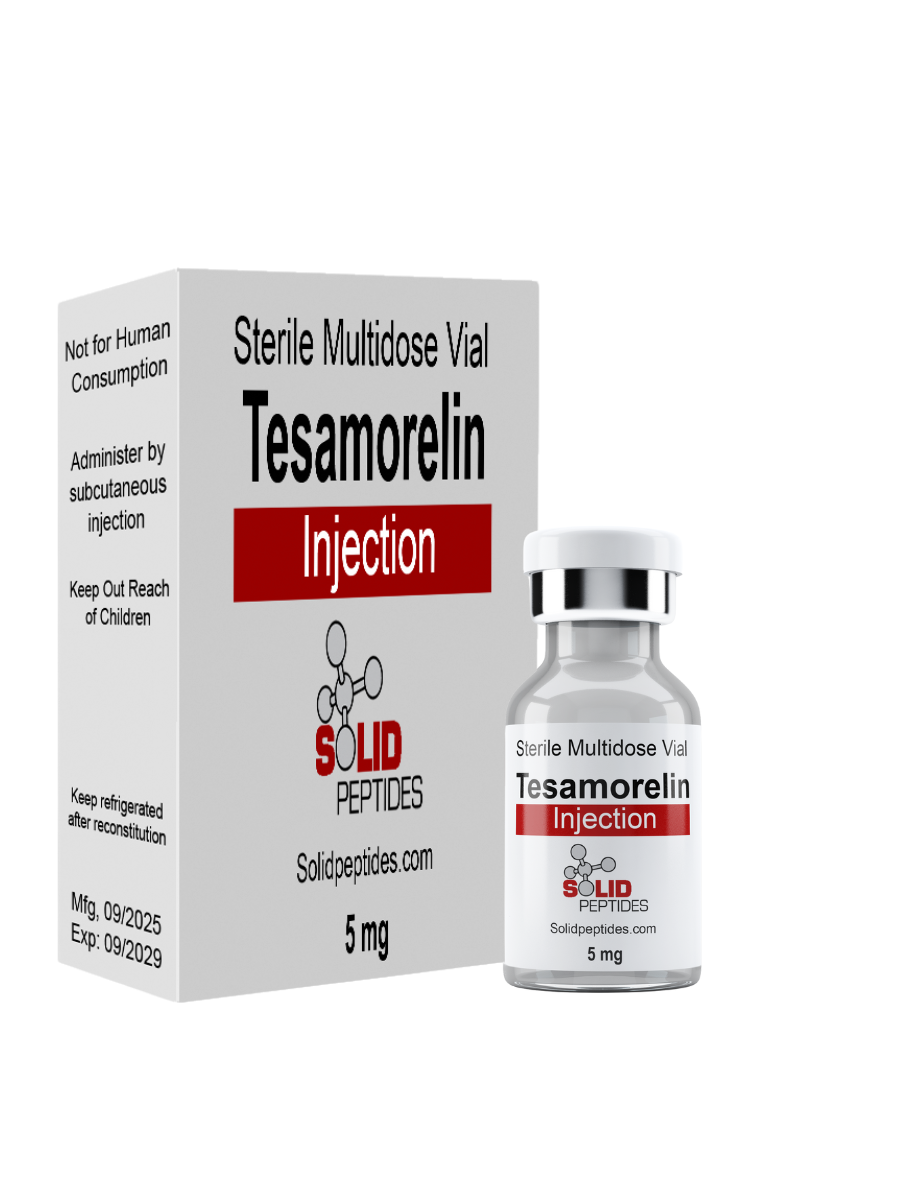
Tesamorelin (10mg)
Tesamorelin is a 44-amino acid synthetic GHRH analog with N-terminal trans-3-hexenoic acid modification conferring DPP-IV resistance and extended half-life (26-38 minutes vs. 2 minutes for native GHRH). FDA-approved (2010) as Egrifta for HIV-associated lipodystrophy. Selectively activates pituitary GHRH receptors via Gs-cAMP-PKA signaling, stimulating pulsatile GH release while preserving IGF-1 feedback regulation.
- Mechanistic pathway studies
- In vitro receptor profiling
- HPLC verified identity and purity
$70.00In Stock
Ships same-day if ordered before 2PM EST
1
Encrypted Checkout
Global Express
Research Overview
Tesamorelin is a 44-amino acid synthetic polypeptide comprising complete human GHRH(1-44) sequence with N-terminal trans-3-hexenoic acid modification attached to amino-terminal tyrosine, conferring DPP-IV resistance and extended biological half-life (26-38 minutes vs. 2 minutes for native GHRH). FDA-approved 2010 as Egrifta (trade name) for HIV-associated lipodystrophy - first medication approved specifically for reduction of excess visceral adipose tissue in this population. Selective GHRH receptor agonist activating Gs protein-coupled signaling: Gs proteins stimulate adenylyl cyclase → ATP to cAMP → PKA activation → CREB phosphorylation → increased GH gene transcription and synthesis → calcium-dependent exocytosis of GH-containing granules → pulsatile GH release. Unlike exogenous rhGH (bypasses regulation), tesamorelin-induced GH secretion remains subject to negative feedback through hepatic IGF-1 production and hypothalamic somatostatin, maintaining episodic GH release and preventing supraphysiological levels. Pharmacokinetics: Tmax 8-10 minutes post-SC administration, linear kinetics across 0.5-2mg dose range; volume of distribution 9.4±3.1 L/kg (healthy), 10.5±6.1 L/kg (HIV); elimination half-life 7.8 min (1mg), 13.2 min (2mg), 18.6-37.8 min (multiple doses, HIV patients). Trans-3-hexenoyl modification introduces hydrophobic chain providing serum protease resistance while maintaining aqueous solubility. Therapeutic profile: selectively reduces visceral adipose tissue while preserving subcutaneous fat, novel pharmacological approach to metabolic disease management.
Mechanism of Action
Tesamorelin exerts effects through multiple mechanisms: (1) GHRH Receptor Activation - selective agonist at GHRH receptors (GHRH-R), G protein-coupled receptors expressed on anterior pituitary somatotrophs; binds with high affinity comparable to native GHRH, induces receptor conformational changes activating Gs protein-coupled signaling cascade; (2) Gs-cAMP-PKA-CREB Cascade - Gs proteins dissociate and stimulate adenylyl cyclase activity at cell membrane; adenylyl cyclase catalyzes ATP conversion to cyclic AMP (cAMP); cAMP serves as second messenger activating protein kinase A (PKA); PKA phosphorylates transcription factors including CREB (cAMP response element-binding protein); phosphorylated CREB increases GH gene transcription and enhances GH synthesis; (3) Pulsatile GH Release - signaling cascade culminates in calcium-dependent exocytosis of GH-containing secretory granules, resulting in pulsatile GH release into systemic circulation; unlike exogenous rhGH (bypasses regulation), tesamorelin-induced GH secretion remains subject to negative feedback through hepatic IGF-1 production and hypothalamic somatostatin secretion; feedback architecture maintains episodic GH release patterns and prevents sustained supraphysiological GH levels; reduces risk of adverse metabolic effects associated with continuous GH elevation; (4) Visceral Adipose Tissue Reduction - GH stimulates lipolysis in visceral adipocytes via hormone-sensitive lipase activation; preferentially mobilizes visceral fat depots while preserving subcutaneous adipose tissue; improves trunk-to-limb fat ratio and reduces waist circumference; (5) Enhanced Enzymatic Stability - trans-3-hexenoic acid N-terminal modification provides significant protection against DPP-IV enzymatic cleavage (major degradation pathway for native GHRH); extends biological half-life from ~2 minutes (native GHRH) to 26-38 minutes for tesamorelin; trans-3-hexenoyl modification introduces hydrophobic chain conferring serum protease resistance while maintaining aqueous solubility; (6) Maintained Receptor Specificity - despite structural modification, retains high-affinity selective binding to GHRH receptors on anterior pituitary somatotrophs, preserving physiological specificity of native hormone.
“Mechanistic summaries on this page are provided for laboratory reference and should be interpreted within controlled experimental settings only.”
Preclinical Research Summary
FDA approval (2010): Egrifta approved for treatment of HIV-associated lipodystrophy, first medication approved specifically for reduction of excess visceral adipose tissue in this population. Clinical trials: Phase III EGRIFTA-003 (n=412, 26 weeks) demonstrated significant reduction in visceral adipose tissue (VAT) by 11.2% vs. placebo measured by CT scan; waist circumference reduced by mean 2.1 cm; trunk fat reduced relative to limb fat. Phase III EGRIFTA-004 (n=806) confirmed VAT reduction sustained over 52 weeks. Extension study (104 weeks) maintained VAT reductions with continued treatment. Pharmacokinetics: Tmax 8-10 minutes post-SC administration, linear kinetics across 0.5-2mg dose range; volume of distribution 9.4±3.1 L/kg (healthy subjects), 10.5±6.1 L/kg (HIV-infected patients); elimination half-life 7.8 min (1mg single dose), 13.2 min (2mg single dose), 18.6-37.8 min (multiple doses, HIV patients). Mechanism validation: tesamorelin-induced GH secretion maintains pulsatile pattern and IGF-1 feedback regulation vs. continuous GH elevation with rhGH. Safety profile: adverse events primarily injection site reactions, arthralgia, peripheral edema; did not increase viral load or decrease CD4+ counts in HIV patients; reversible mild hyperglycemia in small percentage. DPP-IV resistance: trans-3-hexenoyl modification extends half-life 13-19x vs. native GHRH (2 minutes). Metabolic effects: reduced visceral adipose tissue, improved trunk-to-limb fat ratio, decreased waist circumference, preserved subcutaneous fat. Trade names: Egrifta, Egrifta SV, Egrifta WR (F8 formulation).
Academic References
1. Falutz J, et al. (2010). Effects of tesamorelin (TH9507), a growth hormone-releasing factor analog, in human immunodeficiency virus-infected patients with excess abdominal fat: a pooled analysis of two multicenter, double-blind placebo-controlled phase 3 trials with safety extension data. J Clin Endocrinol Metab. 95(9):4291-4304. doi:10.1210/jc.2010-0490 [Pooled Phase III EGRIFTA-003/004: 11.2% VAT reduction, 2.1cm waist circumference reduction]
2. Falutz J, et al. (2008). Metabolic effects of a growth hormone-releasing factor in patients with HIV. N Engl J Med. 357(23):2359-2370. doi:10.1056/NEJMoa0708480 [Phase III metabolic effects, VAT reduction mechanisms]
3. Stanley TL, Grinspoon SK. (2012). GH/GHRH axis in HIV lipodystrophy. Pituitary. 15(1):59-68. doi:10.1007/s11102-011-0330-1 [Comprehensive review: GH-IGF-1 axis, lipodystrophy pathophysiology, tesamorelin mechanism]
4. Falutz J, et al. (2011). Long-term safety and effects of tesamorelin, a growth hormone-releasing factor analog, in HIV patients with abdominal fat accumulation. AIDS. 25(14):1749-1757. doi:10.1097/QAD.0b013e32834a4532 [104-week extension: sustained VAT reduction, safety profile]
5. Marizco I, et al. (2012). Tesamorelin, a growth hormone releasing factor, in the treatment of HIV-associated lipodystrophy. Drug Des Devel Ther. 6:245-252. doi:10.2147/DDDT.S28864 [Pharmacokinetics: Tmax 8-10 min, half-life 7.8-37.8 min depending on dose/regimen]
6. Koutkia P, et al. (2005). Mechanisms of visceral fat accumulation in HIV infection. Curr HIV Res. 3(3):229-234. doi:10.2174/1570162054368156 [HIV lipodystrophy mechanisms, GH-IGF-1 axis dysregulation]
7. Walker RF. (2006). Sermorelin: a better approach to management of adult-onset growth hormone insufficiency? Clin Interv Aging. 1(4):307-308. doi:10.2147/ciia.2006.1.4.307 [Comparative mechanism: GHRH analogs preserve pulsatile GH vs. rhGH]
8. Alba-Roth J, et al. (1988). Arginine stimulates growth hormone secretion by suppressing endogenous somatostatin secretion. J Clin Endocrinol Metab. 67(6):1186-1189. [GHRH-somatostatin feedback regulation]
9. Grinspoon S, et al. (2002). Effects of somatropin and dietary counseling on body composition in HIV-infected patients with abdominal fat accumulation. Am J Clin Nutr. 75(3):594-600. [rhGH comparative effects on body composition]
10. Giustina A, Veldhuis JD. (1998). Pathophysiology of the neuroregulation of growth hormone secretion in experimental animals and the human. Endocr Rev. 19(6):717-797. doi:10.1210/edrv.19.6.0353 [Comprehensive review: GHRH-somatostatin-GH axis physiology]
This product is intended exclusively for in vitro laboratory research by qualified professionals. Not for human consumption. Not approved by the FDA.
Published Research Briefs
Our research team has published evidence-checked briefs covering the science behind this compound. Each brief reviews primary sources and grades claims independently.