Research Use Only: This product is supplied for laboratory research and in-vitro studies. Not for human or veterinary administration.
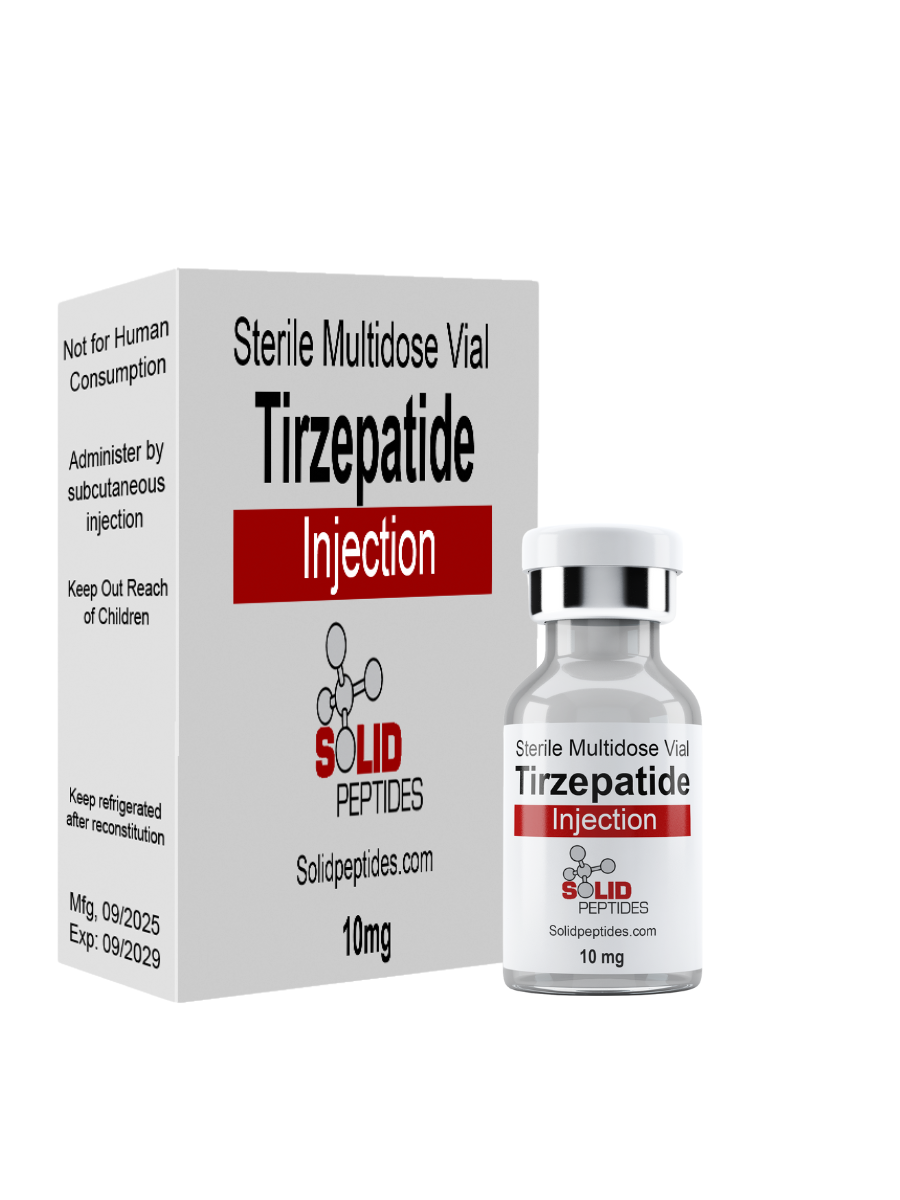
Hover to zoom
Identity Verified: LC-MS
(0 Reviews)
Tirzepatide (15mg)
Tirzepatide (LY3298176) is a first-in-class 39-amino acid dual GIP/GLP-1 receptor agonist ("twincretin") with imbalanced agonism favoring GIPR over GLP-1R. Features Aib residues at positions 2 and 13 (DPP-4 resistance), C20 fatty diacid at Lys20 (albumin binding, ~5-day half-life), and biased GLP-1R signaling favoring cAMP over beta-arrestin recruitment. FDA-approved as Mounjaro (T2D, May 2022) and Zepbound (obesity, Nov 2023).
- Mechanistic pathway studies
- In vitro receptor profiling
- HPLC verified identity and purity
$129.00In Stock
Ships same-day if ordered before 2PM EST
1
Encrypted Checkout
Global Express
Research Overview
Tirzepatide (LY3298176) is a first-in-class 39-amino acid dual glucose-dependent insulinotropic polypeptide (GIP) and glucagon-like peptide-1 (GLP-1) receptor agonist ("twincretin") developed by Eli Lilly. GIP-based peptide backbone with strategic modifications: two alpha-aminoisobutyric acid (Aib) residues at positions 2 and 13 for DPP-4 resistance; C20 unsaturated fatty diacid (eicosanedioic acid) conjugated at Lys20 via gamma-glutamic acid and dual AEEA linker enabling >99% albumin binding and ~5-day half-life (116-120 hours) for once-weekly administration. Imbalanced dual agonism: binds GIPR with affinity comparable to native GIP but engages GLP-1R with ~5-fold weaker affinity than native GLP-1 (Willard 2020). Greater GIPR engagement at clinical doses. Biased GLP-1R signaling: favors Gs-coupled cAMP generation over beta-arrestin recruitment, reduces GLP-1R internalization vs. native GLP-1 (Willard 2020). Cryo-EM structures (Sun 2022, 2.9Å GLP-1R/tirzepatide) revealed Tyr1 and C20 lipid destabilize TM5-ECL3 interactions, weakening beta-arrestin coupling. Enhanced insulin secretion (beta-arrestin-1 normally limits insulin response). Weight-independent insulin sensitization: GIPR agonism improves insulin sensitivity in GLP-1R-knockout mice, promotes glucose disposal in WAT, enhances glucose/lipid/BCAA catabolism in BAT, reduces circulating BCAA/ketoacids (Samms 2021). FDA-approved Mounjaro (T2D, May 2022) and Zepbound (obesity, Nov 2023). Clinical trials: SURPASS program (T2D), SURMOUNT program (obesity), SUMMIT (heart failure), SYNERGY-NASH (metabolic dysfunction-associated steatohepatitis), SURMOUNT-OSA (obstructive sleep apnea). >3,000 PubMed publications (2025).
Mechanism of Action
Tirzepatide exerts effects through multiple mechanisms: (1) Imbalanced Dual GIP/GLP-1 Receptor Agonism - binds GIPR with affinity comparable to native GIP but engages GLP-1R with ~5-fold weaker affinity than native GLP-1 (Willard 2020); greater engagement of GIPR than GLP-1R at clinical doses; GIPR activation enhances glucose-dependent insulin secretion and modulates adipocyte function; GLP-1R activation promotes glucose-dependent insulin release, glucagon suppression, delayed gastric emptying, and central appetite regulation; dual mechanism produces synergistic effects on insulin and glucagonostatic responses exceeding either incretin receptor agonist alone; (2) Biased GLP-1R Signaling - favors Gs-coupled cAMP generation over beta-arrestin recruitment; reduced GLP-1R internalization compared to native GLP-1 and other GLP-1 agonists; cryo-EM structure (Sun 2022, 2.9Å GLP-1R/tirzepatide) revealed Tyr1 (vs. His1 in GLP-1) and C20 lipid moiety destabilize interactions between transmembrane domain 5 (TM5) and extracellular loop 3 (ECL3), weakening receptor-effector coupling for beta-arrestin pathways; beta-arrestin-1 normally limits insulin response to GLP-1; by avoiding beta-arrestin recruitment, tirzepatide achieves enhanced insulin secretion; reduced receptor internalization sustains receptor availability at cell surface, contributing to prolonged efficacy; (3) GIPR-Mediated Weight-Independent Insulin Sensitization - improves insulin sensitivity through both weight-dependent and weight-independent mechanisms (Samms 2021); using GLP-1R-knockout mice, GIPR agonism independently enhances insulin sensitivity by promoting glucose disposal in white adipose tissue (WAT); in absence of GLP-1R-induced weight loss, GIPR agonism alone improved insulin sensitivity in obese mice; enhanced glucose, lipid, and branched-chain amino acid (BCAA) catabolism in brown adipose tissue; circulating BCAA and ketoacid levels reduced (markers of improved metabolic health); weight-independent benefits suggest greater treatment durability vs. agents relying solely on weight loss; (4) Central Appetite Regulation - both GIPR and GLP-1R expressed in brain regions regulating appetite (hypothalamus, brainstem); selectively reduces preference for high-fat foods in rodent models (dual receptor engagement in reward and satiety circuits); combination of peripheral metabolic signaling and central appetite suppression contributes to substantial body weight reductions; (5) Engineered Stability - Aib residues at positions 2 and 13 eliminate DPP-4 cleavage (native incretins have half-lives 2-7 minutes); C20 fatty diacid enables >99% reversible albumin binding, half-life ~5 days (116-120 hours) enabling once-weekly dosing; differential conformational behavior: compact conformation (radius of gyration ~6.8Å) at GIPR, extended conformation (~7.6Å) at GLP-1R (molecular dynamics simulations, Sun 2022).
“Mechanistic summaries on this page are provided for laboratory reference and should be interpreted within controlled experimental settings only.”
Preclinical Research Summary
Willard et al. (2020, JCI Insight): tirzepatide exhibits imbalanced dual agonism favoring GIPR over GLP-1R (~5-fold weaker GLP-1R affinity vs. native GLP-1); biased GLP-1R signaling favors cAMP over beta-arrestin recruitment; enhanced insulin secretion in primary islets. Sun et al. (2022, Cell Res): cryo-EM structures at 2.9Å (GLP-1R/tirzepatide) and 3.0Å (GIPR/tirzepatide); Tyr1 and C20 lipid destabilize TM5-ECL3 interactions weakening beta-arrestin coupling; C20 fatty diacid shows differential conformation (compact at GIPR ~6.8Å radius of gyration, extended at GLP-1R ~7.6Å). Samms et al. (2021, JCI): in GLP-1R-knockout mice, GIPR agonism independently improves insulin sensitivity (weight-independent); promotes glucose disposal in WAT; enhances glucose/lipid/BCAA catabolism in BAT; reduces circulating BCAA/ketoacids. Pharmacokinetics: half-life ~116-120 hours (~5 days), >99% albumin bound, once-weekly dosing. FDA approval: Mounjaro (T2D, May 2022), Zepbound (obesity, Nov 2023). Clinical trials: SURPASS-2 (n=1,879, 52 weeks): tirzepatide 5mg, 10mg, 15mg vs. semaglutide 1mg; HbA1c reductions -2.01%, -2.24%, -2.30% vs. -1.86% for semaglutide; weight loss -7.6kg, -9.3kg, -11.2kg vs. -5.7kg. SURMOUNT-1 (n=2,539, 72 weeks, obesity): 5mg, 10mg, 15mg vs. placebo; weight loss -15.0%, -19.5%, -20.9% vs. -3.1%. SUMMIT trial (heart failure with preserved ejection fraction): improved 6-minute walk distance, Kansas City Cardiomyopathy Questionnaire scores, reduced NT-proBNP. SYNERGY-NASH: 72% resolution of NASH without worsening fibrosis at 52 weeks. SURMOUNT-OSA: reduced Apnea-Hypopnea Index by 25-30 events/hour. >3,000 PubMed publications as of 2025.
Academic References
1. Willard FS, et al. (2020). Tirzepatide is an imbalanced and biased dual GIP and GLP-1 receptor agonist. JCI Insight. 5(17):e140532. doi:10.1172/jci.insight.140532 [Imbalanced dual agonism, biased cAMP signaling, enhanced insulin secretion]
2. Sun B, et al. (2022). Crystal structures of the GIP, GLP-1, and glucagon receptors in complex with human Gs proteins and their pharmacological implications. Cell Res. 32(4):355-365. doi:10.1038/s41422-022-00632-x [Cryo-EM 2.9Å GLP-1R/tirzepatide, 3.0Å GIPR/tirzepatide, Tyr1 and C20 lipid destabilize TM5-ECL3]
3. Samms RJ, et al. (2021). GIPR agonism mediates weight-independent insulin sensitization by tirzepatide in obese mice. J Clin Invest. 131(12):e146353. doi:10.1172/JCI146353 [Weight-independent insulin sensitization, GIPR-mediated glucose disposal in WAT, BCAA catabolism]
4. Frías JP, et al. (2021). Tirzepatide versus Semaglutide Once Weekly in Patients with Type 2 Diabetes. N Engl J Med. 385(6):503-515. doi:10.1056/NEJMoa2107519 [SURPASS-2: superior HbA1c reduction and weight loss vs. semaglutide 1mg]
5. Jastreboff AM, et al. (2022). Tirzepatide Once Weekly for the Treatment of Obesity. N Engl J Med. 387(3):205-216. doi:10.1056/NEJMoa2206038 [SURMOUNT-1: 20.9% weight loss at 72 weeks with 15mg dose]
6. Kosiborod MN, et al. (2024). Tirzepatide in Patients with Heart Failure with Preserved Ejection Fraction and Obesity. N Engl J Med. doi:10.1056/NEJMoa2410378 [SUMMIT: improved 6-minute walk, KCCQ scores, reduced NT-proBNP]
7. Loomba R, et al. (2024). Tirzepatide for Metabolic Dysfunction-Associated Steatohepatitis with Liver Fibrosis. N Engl J Med. 391(4):299-310. doi:10.1056/NEJMoa2401943 [SYNERGY-NASH: 72% NASH resolution without worsening fibrosis]
8. Malhotra A, et al. (2024). Tirzepatide for the Treatment of Obstructive Sleep Apnea and Obesity. N Engl J Med. 391(13):1193-1205. doi:10.1056/NEJMoa2404881 [SURMOUNT-OSA: reduced AHI by 25-30 events/hour]
9. Galindo RJ, et al. (2026). Tirzepatide: A Comprehensive Review of Its Mechanism of Action, Clinical Efficacy, and Safety Profile. Diabetes Ther. 17(1):1-28. [Comprehensive review: dual incretin mechanism, central appetite regulation, clinical trial summary]
10. Thomas MK, et al. (2021). Tirzepatide, a dual GIP and GLP-1 receptor agonist, improves markers of beta-cell function and insulin sensitivity in type 2 diabetes. J Clin Endocrinol Metab. 106(2):388-396. doi:10.1210/clinem/dgaa863 [Beta-cell function improvement, HOMA-IR reduction, insulin sensitivity markers]
This product is intended exclusively for in vitro laboratory research by qualified professionals. Not for human consumption. Not approved by the FDA.
Published Research Briefs
Our research team has published evidence-checked briefs covering the science behind this compound. Each brief reviews primary sources and grades claims independently.