Research Use Only: This product is supplied for laboratory research and in-vitro studies. Not for human or veterinary administration.
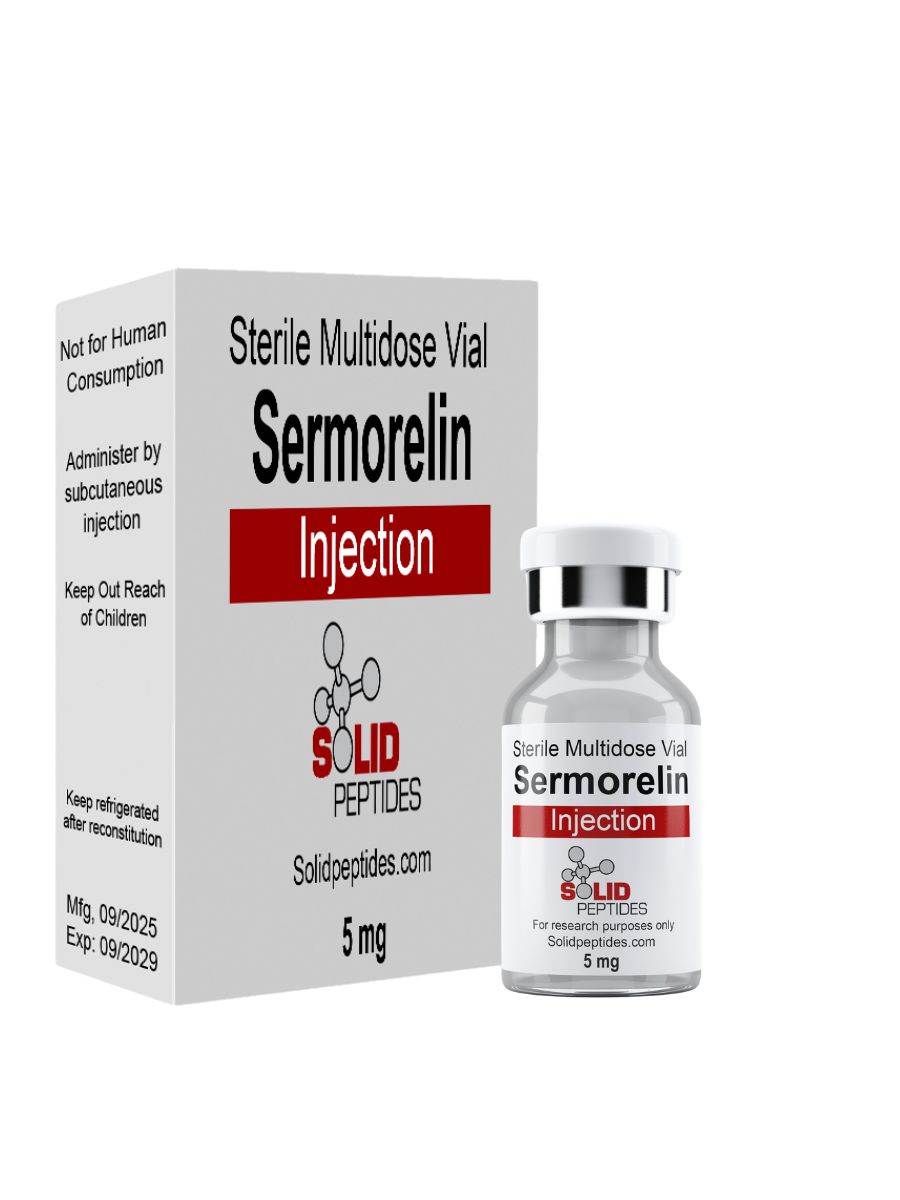
Hover to zoom
Identity Verified: LC-MS
(0 Reviews)
Sermorelin (5 mg)
Sermorelin (GHRH(1-29)-NH₂) is a 29-amino acid synthetic fragment of human growth hormone-releasing hormone with C-terminal amidation. FDA-approved (1991 diagnostic, 1997 therapeutic), it activates pituitary GHRH-R via Gs-cAMP-PKA signaling while preserving physiological pulsatile GH secretion and somatostatin feedback regulation.
- Mechanistic pathway studies
- In vitro receptor profiling
- HPLC verified identity and purity
$35.00In Stock
Ships same-day if ordered before 2PM EST
1
Encrypted Checkout
Global Express
Research Overview
Sermorelin (GHRH(1-29)-NH₂) is a 29-amino acid synthetic peptide representing the biologically active N-terminal fragment of human growth hormone-releasing hormone. FDA-approved in 1991 (diagnostic) and 1997 (therapeutic) for GH deficiency; commercial product (Geref) discontinued 2008 due to manufacturing issues unrelated to safety. Retains complete GHRH-R binding affinity and biological activity with improved pharmaceutical characteristics. C-terminal amidation (-NH₂) at Arg29 provides carboxypeptidase protection; plasma half-life ~11-12 minutes, subcutaneous bioavailability ~6%. Activates pituitary GHRH-R (class B GPCR) → Gs-cAMP-PKA-CREB transcriptional cascade → upregulates GH gene transcription and Pit-1 auto-amplification loop. Triggers calcium mobilization via voltage-gated Ca²⁺ channels and PLC-IP3 signaling → rapid GH exocytosis. Preserves physiological pulsatile GH secretion via somatostatin and IGF-1 negative feedback, preventing supraphysiological GH levels (unlike rhGH). Clinical trials: Thorner 1996 (JCEM) - 8.0 cm/yr height velocity, 74% response rate in GH-deficient children (n=86). Khorram 1997 (JCEM) - increased nocturnal GH, IGF-1, IGFBP-3, skin thickness, lean body mass in adults 55-71 (16 weeks). Friedman 2013 (JAMA Neurology) - increased brain GABA levels in MCI and healthy aging (n=30, 20 weeks). Chang 2021 (Ann Transl Med) - top candidate from 4,865 FDA-approved drugs for recurrent gliomas via transcriptome screening (n=1,018 patients).
Mechanism of Action
Sermorelin exerts effects through multiple mechanisms: (1) GHRH-R Activation - highly specific binding to growth hormone-releasing hormone receptor (class B GPCR) on anterior pituitary somatotroph cells activates associated heterotrimeric Gs protein complex, stimulates adenylyl cyclase, elevates intracellular cAMP; (2) cAMP-PKA-CREB Transcriptional Cascade - elevated cAMP binds PKA regulatory subunits causing dissociation and activation of catalytic subunits, which translocate to nucleus and phosphorylate CREB transcription factor; phosphorylated CREB with coactivators p300/CBP enhances GH gene transcription via cAMP-response elements (CREs), upregulates GH mRNA levels, replenishes cellular GH stores; upregulates pituitary-specific Pit-1 transcription factor in auto-amplification loop (Pit-1 transcriptionally activates GH1, GHRHR, and Pit-1 genes); (3) Calcium-Dependent GH Exocytosis - cAMP-mediated opening of voltage-gated Ca²⁺ channels permits extracellular calcium influx triggering fusion of GH-containing secretory granules with plasma membrane; GHRH-R activation stimulates phospholipase C (PLC) generating IP3, which induces Ca²⁺ release from endoplasmic reticulum stores, further elevating cytosolic calcium; acute rapid GH release occurs within minutes; (4) Preserved Pulsatile GH Release - sermorelin-induced GH secretion is regulated by negative feedback through hypothalamic somatostatin (secreted in alternation with endogenous GHRH), making it "difficult if not impossible to achieve supraphysiological GH levels"; released GH stimulates hepatic IGF-1 production, which exerts further negative feedback on hypothalamic GHRH secretion and pituitary GH release; preserves episodic (pulsatile) GH pattern, avoids non-physiological "square wave" pharmacokinetics of rhGH injection, reduces tachyphylaxis risk; (5) Additional Pathways - MAPK/ERK pathway contributes to somatotroph proliferation and differentiation; PI3K/Akt pathway supports cell survival and metabolic responses; chronic trophic effects on somatotroph cell number and pituitary reserve capacity; (6) Structural Basis - N-terminal Tyr1 critical for receptor binding/activation (truncation abolishes activity); hydrophobic core (Ile5, Phe6, Tyr10) contributes to amphipathic alpha-helical structure for receptor recognition; C-terminal amidation (-NH₂) at Arg29 protects against carboxypeptidase degradation, extends plasma half-life to ~11-12 minutes.
“Mechanistic summaries on this page are provided for laboratory reference and should be interpreted within controlled experimental settings only.”
Preclinical Research Summary
Thorner et al. (1996, JCEM): multicenter open-label trial in 110 prepubertal GH-deficient children (86 eligible for efficacy analysis); daily subcutaneous GHRH(1-29) at 30 mcg/kg at bedtime for up to one year; mean height velocity increased from 4.1±0.9 cm/yr baseline to 8.0±1.5 cm/yr (6 months) and 7.2±1.3 cm/yr (12 months); 74% favorable treatment response at six months; bone age progression proportional to height gain. Khorram et al. (1997, JCEM): single-blind, randomized, placebo-controlled trial in 19 participants aged 55-71 years, treated nightly for 16 weeks; GHRH analog induced significant increases in nocturnal GH levels in both genders; elevated serum IGF-1 and IGFBP-3 within 2 weeks; significant increase in skin thickness in both genders; increased lean body mass and improved insulin sensitivity in men; transient hyperlipidemia was only adverse effect. Friedman et al. (2013, JAMA Neurology): randomized, double-blind, placebo-controlled trial in 30 adults (17 MCI, 13 cognitively normal) aged 55-87, treated with daily subcutaneous tesamorelin (GHRH analog) for 20 weeks; GABA levels increased in all brain regions (dorsolateral frontal, posterior cingulate, posterior parietal; P<0.04); myo-inositol decreased in posterior cingulate (P=0.002); first evidence that somatotropic supplementation modulates inhibitory neurotransmitter levels; favorable cognitive improvements paralleled neurochemical changes. Chang et al. (2021, Ann Transl Med): high-throughput screening of 4,865 FDA-approved drugs using CGGA transcriptome data from 1,018 glioma patients; sermorelin had lowest p-value and maximum difference value for recurrent vs. primary gliomas, suggesting therapeutic potential. Pharmacokinetics: plasma half-life ~11-12 minutes (IV or SC), clearance 2.4-2.8 L/min in adults, mean absolute subcutaneous bioavailability ~6%. Stability: lyophilized form stable 24+ months at -20°C to -80°C; reconstituted solutions stable 7-14 days at 2-8°C (pH 5.0-7.0). FDA approval: 1991 (diagnostic for GH deficiency assessment), 1997 (therapeutic for idiopathic GH deficiency in children); commercial product (Geref) voluntarily discontinued 2008 due to manufacturing difficulties unrelated to safety/efficacy.
Academic References
1. Thorner MO, et al. (1996). Once daily subcutaneous growth hormone-releasing hormone therapy accelerates growth in growth hormone-deficient children during the first year of therapy. J Clin Endocrinol Metab. 81(3):1189-1196. doi:10.1210/jcem.81.3.8772599 [Multicenter trial: 8.0 cm/yr height velocity, 74% response rate]
2. Khorram O, et al. (1997). Endocrine and metabolic effects of long-term administration of [Nle27]growth hormone-releasing hormone-(1-29)-NH2 in age-advanced men and women. J Clin Endocrinol Metab. 82(5):1472-1479. doi:10.1210/jcem.82.5.3946 [16-week trial: increased GH, IGF-1, lean mass, skin thickness]
3. Friedman SD, et al. (2013). Growth Hormone-Releasing Hormone Effects on Brain gamma-Aminobutyric Acid Levels in Mild Cognitive Impairment and Healthy Aging. JAMA Neurology. 70(7):883-890. doi:10.1001/jamaneurol.2013.1425 [20-week trial: increased brain GABA in MCI and healthy aging]
4. Chang C, et al. (2021). A potentially effective drug for patients with recurrent glioma: sermorelin. Ann Transl Med. 9(5):406. doi:10.21037/atm-20-6987 [Transcriptome screening: top candidate from 4,865 drugs for recurrent gliomas]
5. Walker RF. (2006). Sermorelin: a better approach to management of adult-onset growth hormone insufficiency? Clin Interv Aging. 1(4):307-308. doi:10.2147/ciia.2006.1.4.307 [Mechanism review: preserves pulsatile GH, prevents supraphysiological levels]
6. Pombo M, et al. (2001). The growth hormone axis in pregnancy and lactation. Growth Horm IGF Res. 11 Suppl A:S35-38. doi:10.1016/s1096-6374(01)80007-0 [GHRH receptor signaling review]
7. Campbell RM, et al. (1996). Pharmacokinetics of GHRH and its analogs. J Pediatr Endocrinol Metab. 9 Suppl 3:333-338. doi:10.1515/jpem.1996.9.s3.333 [Pharmacokinetics: half-life 11-12 min, bioavailability ~6%]
8. Corpas E, et al. (1993). Human growth hormone and human aging. Endocr Rev. 14(1):20-39. doi:10.1210/edrv-14-1-20 [Age-related GH decline and somatopause mechanisms]
9. Mayo KE, et al. (2000). Regulation of the pituitary somatotroph cell by GHRH and its receptor. Recent Prog Horm Res. 55:237-266. [Comprehensive GHRH-R signal transduction review]
10. Giustina A, Veldhuis JD. (1998). Pathophysiology of the neuroregulation of growth hormone secretion in experimental animals and the human. Endocr Rev. 19(6):717-797. doi:10.1210/edrv.19.6.0353 [Somatostatin-GHRH feedback regulation]
This product is intended exclusively for in vitro laboratory research by qualified professionals. Not for human consumption. Not approved by the FDA.
Published Research Briefs
Our research team has published evidence-checked briefs covering the science behind this compound. Each brief reviews primary sources and grades claims independently.