Research Use Only: This product is supplied for laboratory research and in-vitro studies. Not for human or veterinary administration.
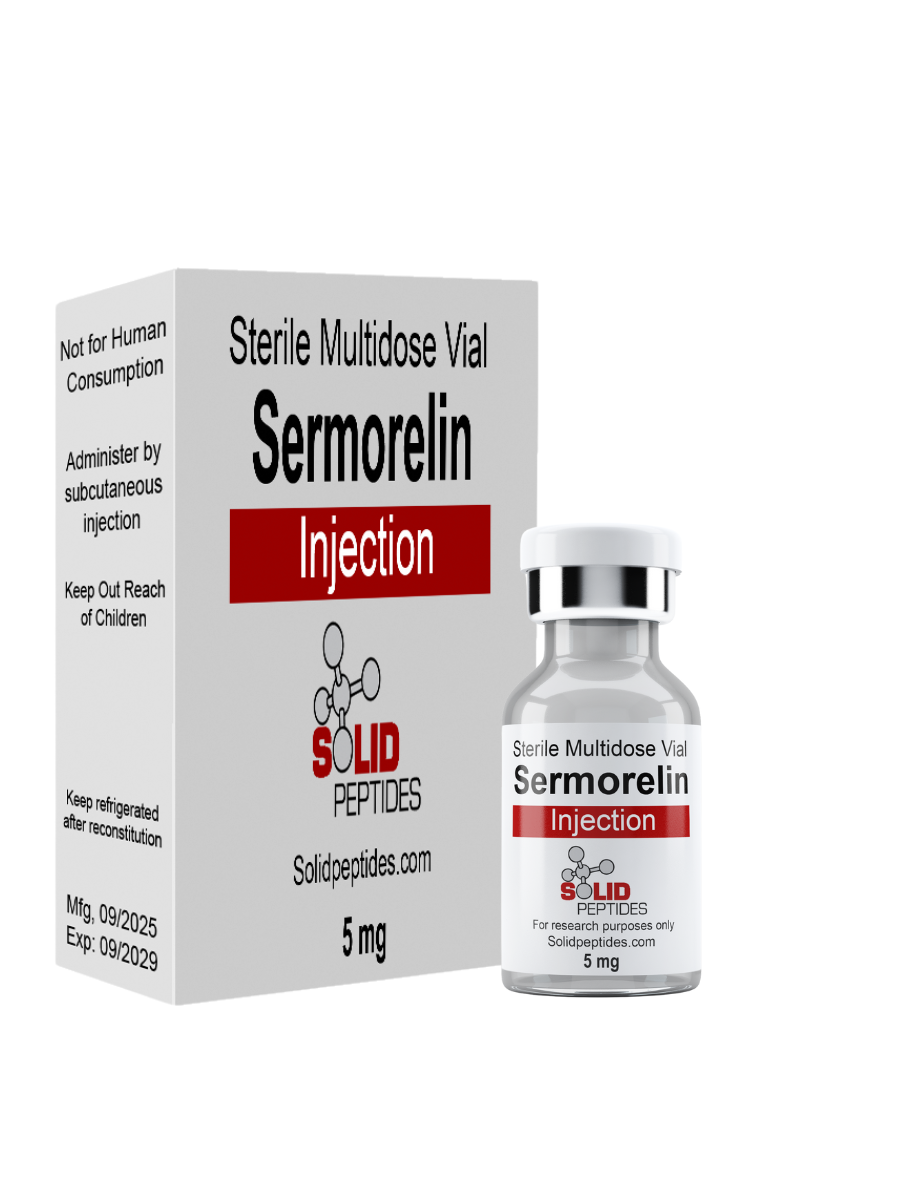
Sermorelin (2 mg)
- 29-amino acid synthetic polypeptide representing biologically active N-terminal fragment of human GHRH
- FDA-approved 1990 (diagnostic) and 1997 (therapeutic) for pediatric GH deficiency; stimulates physiological pulsatile GH release via GHRH-R Gs-cAMP-PKA signaling
- Extensively validated in clinical trials spanning growth disorders, aging research, cognitive function, and body composition management
- Mechanistic pathway studies
- In vitro receptor profiling
- HPLC verified identity and purity
Ships same-day if ordered before 2PM EST
Research Overview
Sermorelin has been extensively validated across multiple clinical and preclinical research domains:
- GHRH-R Signaling: Binds to GHRH receptor (class B-III GPCR) on pituitary somatotroph cells, activating Gsα → adenylyl cyclase → cAMP elevation → PKA activation → CREB phosphorylation → GH gene transcription. Mayo et al. (2000, Recent Progress in Hormone Research) demonstrated GHRH-R potently activates MAPK pathway contributing to somatotroph proliferation and differentiation
- Calcium Mobilization: GHRH-R activation stimulates calcium influx through voltage-gated L-type calcium channels, triggering exocytosis of preformed GH from secretory granules. Additionally engages phospholipase C (PLC), generating IP₃ and DAG. IP₃ mobilizes intracellular calcium from endoplasmic reticulum, further augmenting cytosolic calcium necessary for vesicle fusion and GH release
- Pulsatile GH Release: Distinguishing feature is capacity to stimulate physiological pulsatile GH release rather than sustained supraphysiological elevation. Effects remain subject to negative feedback regulation by somatostatin, making GH overdoses difficult to achieve. Walker (2006) noted released GH stimulates IGF-1 production, which inhibits both hypothalamic GHRH secretion and pituitary GH release, completing regulatory loop
- Pediatric Growth Acceleration: Thorner et al. (1996, JCEM) enrolled 110 prepubertal children with GH deficiency receiving 30 mcg/kg GHRH daily at bedtime for 12 months. Height velocity increased from 4.1±0.9 cm/yr baseline to 8.0±1.5 and 7.2±1.3 cm/yr after 6 and 12 months; approximately 74% demonstrated favorable growth responses
- Aging and Body Composition: Khorram, Laughlin & Yen (1997, JCEM) 5-month randomized placebo-controlled trial in 19 participants aged 55-71 years showed significant increases in nocturnal GH, serum IGF-1, and IGFBP-3 levels; increased lean body mass and skin thickness in men; improved insulin sensitivity and quality of life in male subjects
- Cognitive Function: Friedman et al. (2013, JAMA Neurology) after 20 weeks of GHRH administration, GABA levels increased in all examined brain regions (dorsolateral frontal, posterior cingulate, posterior parietal); myo-inositol decreased in posterior cingulate cortex (marker potentially linked to reduced Alzheimer disease pathology); favorable treatment effect on cognition observed
- Oncology Research: Chang et al. (2021, Annals of Translational Medicine) high-throughput screening of 4,865 drugs identified sermorelin as most promising candidate for recurrent gliomas. Gene ontology analysis indicated sermorelin may inhibit tumor cell proliferation through cell cycle arrest; negative correlation with immune checkpoint expression and M0 macrophage infiltration
- Diagnostic Utility: Prakash & Goa (1999) comprehensive review established sermorelin at 1 mcg/kg IV as rapid and relatively specific diagnostic test for GH deficiency with fewer false-positive results than traditional provocative tests. Documented once-daily subcutaneous sermorelin 30 mcg/kg at bedtime induced catch-up growth in majority of GH-deficient children
Pharmacokinetics: Plasma half-life approximately 8-12 minutes following subcutaneous or IV administration; rapid clearance 2.4-2.8 L/min in adults; mean absolute bioavailability ~6% after subcutaneous administration; peak plasma concentrations reached in 5-20 minutes post-injection.
Primary Research Applications
Mechanism of Action
Sermorelin exerts its biological effects through highly specific binding to the growth hormone-releasing hormone receptor (GHRH-R), a class B-III G protein-coupled receptor expressed predominantly on pituitary somatotroph cells.
1. GHRH Receptor Binding and Gs-cAMP-PKA Signaling:
The GHRH-R belongs to the secretin receptor family and is regulated by the pituitary-specific transcription factor Pit-1. Upon sermorelin binding, the receptor activates the stimulatory G-protein alpha subunit (Gsα), which stimulates adenylyl cyclase and elevates intracellular cyclic adenosine monophosphate (cAMP) concentrations. Elevated cAMP activates protein kinase A (PKA), which phosphorylates the cAMP response element-binding protein (CREB), driving transcription of the growth hormone gene (Mayo et al., 2000). This Gs-cAMP-PKA-CREB pathway constitutes the principal signaling cascade through which sermorelin stimulates both GH gene transcription and GH secretion from somatotroph cells.
2. Calcium Mobilization and GH Exocytosis:
Beyond cAMP-dependent signaling, sermorelin-induced GHRH-R activation stimulates calcium influx through voltage-gated L-type calcium channels, directly triggering exocytosis of preformed GH from cytoplasmic secretory granules. Additionally, GHRH-R activation engages phospholipase C (PLC), generating inositol triphosphate (IP₃) and diacylglycerol (DAG). IP₃ mobilizes intracellular calcium from endoplasmic reticulum stores, further augmenting cytosolic calcium concentrations necessary for vesicle fusion and GH release. This dual calcium signaling mechanism — extracellular influx and intracellular mobilization — ensures rapid and robust GH secretion in response to GHRH-R stimulation.
3. MAPK Pathway and Somatotroph Proliferation:
Research demonstrates the GHRH receptor potently activates the mitogen-activated protein kinase (MAPK) pathway in pituitary somatotroph cells, contributing to somatotroph proliferation and differentiation during pituitary development. This pathway is critical for maintaining somatotroph cell populations and replenishing GH-producing capacity. Evidence from animal models confirms this role: the dwarf little mouse (lit/lit), carrying an inactivating GHRH-R mutation, exhibits severe anterior pituitary hypoplasia and somatotroph underdevelopment, while transgenic mice overexpressing GHRH show corresponding somatotroph hyperplasia (Mayo et al., 2000).
4. Pulsatile GH Release and Somatostatin Feedback:
A distinguishing feature of sermorelin's mechanism is its capacity to stimulate physiological pulsatile GH release rather than sustained supraphysiological elevation. This pulsatility is maintained because sermorelin's effects remain subject to negative feedback regulation by somatostatin, the hypothalamic inhibitory neurohormone that alternates with GHRH to generate the characteristic episodic pattern of GH secretion. As Walker (2006) described, this feedback regulation makes overdoses of endogenous GH difficult if not impossible to achieve with sermorelin, as the released GH stimulates IGF-1 production, which in turn inhibits both hypothalamic GHRH secretion and pituitary GH release, completing the regulatory loop.
Structural Features Supporting Activity:
- N-terminal tyrosine (Tyr1): Critical for receptor binding and activation; N-terminal modifications substantially reduce biological potency
- Hydrophobic core (residues 4-8, Ala-Ile-Phe-Thr-Asn): Contributes to receptor recognition through hydrophobic interactions essential for high-affinity binding
- C-terminal amidation (-NH₂): Protects against carboxypeptidase degradation, enhancing metabolic stability compared to free acid form
- Basic residues (Arg11, Lys12, Arg20, Lys21, Arg29): Facilitate electrostatic interactions with acidic residues on GHRH-R extracellular domain
“Mechanistic summaries on this page are provided for laboratory reference and should be interpreted within controlled experimental settings only.”
Preclinical Research Summary
Sermorelin has been extensively validated through FDA-approved clinical use and hundreds of peer-reviewed publications:
- FDA Approval and Clinical Use: Approved 1990 as diagnostic agent (Geref Diagnostic) for evaluating GH deficiency in children; approved 1997 for therapeutic treatment of idiopathic GH deficiency in pediatric patients. Multiple Phase III trials conducted under FDA oversight in prepubertal children (30 mcg/kg SC daily). Commercial production discontinued 2008 for manufacturing reasons, not safety concerns
- Pediatric Growth Studies: Thorner et al. (1996) Phase III trial: 110 prepubertal children receiving 30 mcg/kg daily at bedtime for 12 months showed height velocity increase from 4.1±0.9 cm/yr baseline to 8.0±1.5 cm/yr (6 months) and 7.2±1.3 cm/yr (12 months); 74% demonstrated favorable growth responses. Prakash & Goa (1999) review documented catch-up growth in majority of GH-deficient children, though height velocity improvements less than somatropin
- Aging and Body Composition: Khorram et al. (1997) 5-month randomized placebo-controlled trial in 19 participants aged 55-71: significant increases in nocturnal GH, serum IGF-1, and IGFBP-3 levels; increased lean body mass and skin thickness in men; improved insulin sensitivity and quality of life in male subjects. Gender-specific differences observed with more pronounced metabolic benefits in males
- Cognitive Function and Neurobiology: Friedman et al. (2013, JAMA Neurology) 20-week GHRH administration: GABA levels increased in all examined brain regions (dorsolateral frontal, posterior cingulate, posterior parietal cortex); myo-inositol decreased in posterior cingulate cortex (marker potentially linked to reduced Alzheimer disease pathology); favorable treatment effect on cognition. Vitiello et al. (2001) documented improvements in sleep quality and cognitive parameters in aging populations
- Somatotroph Biology: Mayo et al. (2000) established GHRH-R signals predominantly through cAMP-dependent pathways and potently activates MAPK in somatotrophs; glucocorticoids identified as potent positive regulators of GHRH-R gene expression; alternative RNA splicing produces dominant-negative receptor variant. Dwarf little mouse (lit/lit) with inactivating GHRH-R mutation exhibits severe anterior pituitary hypoplasia, confirming critical role in somatotroph development
- Diagnostic Utility: Spoudeas et al. (1994) dose-response study established sermorelin at 1 mcg/kg IV as rapid and relatively specific diagnostic test for GH deficiency with fewer false-positive results than traditional provocative tests (insulin tolerance test, arginine stimulation). Combination protocols (sermorelin + arginine) further enhanced diagnostic specificity
- Oncology Research: Chang et al. (2021) high-throughput screening of 4,865 drugs identified sermorelin as most promising candidate for recurrent gliomas. Gene ontology analysis indicated potential inhibition of tumor cell proliferation through cell cycle arrest; negative correlation with immune checkpoint expression and M0 macrophage infiltration observed in computational models
- Safety Profile (Clinical Studies): Most common treatment-related event: local injection site reaction (pain, swelling, redness) in ~1 in 6 patients. Other reported events: headache, flushing, dizziness, transient urticaria (each <1%). Clinical studies reported 6.5% incidence of hypothyroidism during therapy; thyroid function monitoring recommended. Anti-GRF antibodies develop in some patients but do not affect growth response. Transient hyperlipidemia observed but resolved by study completion. No significant changes in fasting glucose in pediatric populations
Pharmacokinetics: Elimination half-life 8-12 minutes; absolute bioavailability ~6% after subcutaneous administration; rapid clearance 2.4-2.8 L/min in adults; peak plasma concentrations in 5-20 minutes post-injection. Limited overdose potential due to somatostatin feedback regulation.
Academic References
- Thorner, M. O., Rochiccioli, P., Colle, M., Lanes, R., Grunt, J., Galazka, A., ... & Malozowski, S. (1996). Once daily subcutaneous growth hormone-releasing hormone therapy accelerates growth in growth hormone-deficient children during the first year of therapy. Journal of Clinical Endocrinology & Metabolism, 81(3), 1189-96. PMID: 8772599
- Khorram, O., Laughlin, G. A., & Yen, S. S. (1997). Endocrine and metabolic effects of long-term administration of [Nle27]growth hormone-releasing hormone-(1-29)-NH2 in age-advanced men and women. Journal of Clinical Endocrinology & Metabolism, 82(5), 1472-1479. PMID: 9141536
- Friedman, J. I., Wallenstein, S., Moshier, E., Parrella, M., White, L., Bowler, S., ... & Harvey, P. D. (2013). Growth Hormone-Releasing Hormone Effects on Brain γ-Aminobutyric Acid Levels in Mild Cognitive Impairment and Healthy Aging. JAMA Neurology, 70(7), 883-890. PMC3764915
- Mayo, K. E., Miller, T., DeAlmeida, V., Zheng, J., & Godfrey, P. A. (2000). Regulation of the pituitary somatotroph cell by GHRH and its receptor. Recent Progress in Hormone Research, 55, 237-266. PMID: 11036940
- Prakash, A., & Goa, K. L. (1999). Sermorelin: a review of its use in the diagnosis and treatment of children with idiopathic growth hormone deficiency. BioDrugs, 12(2), 139-157. PMID: 18031173
- Chang, Y., Xu, Z., Ma, M., Lin, Z., Sun, J., & Zhou, Y. (2021). A potentially effective drug for patients with recurrent glioma: sermorelin. Annals of Translational Medicine, 9(5), 406. PMC8033379
This product is intended exclusively for in vitro laboratory research by qualified professionals. Not for human consumption. Not approved by the FDA.
Published Research Briefs
Our research team has published evidence-checked briefs covering the science behind this compound. Each brief reviews primary sources and grades claims independently.