Research Use Only: This product is supplied for laboratory research and in-vitro studies. Not for human or veterinary administration.
Hover to zoom
Identity Verified: LC-MS
(0 Reviews)
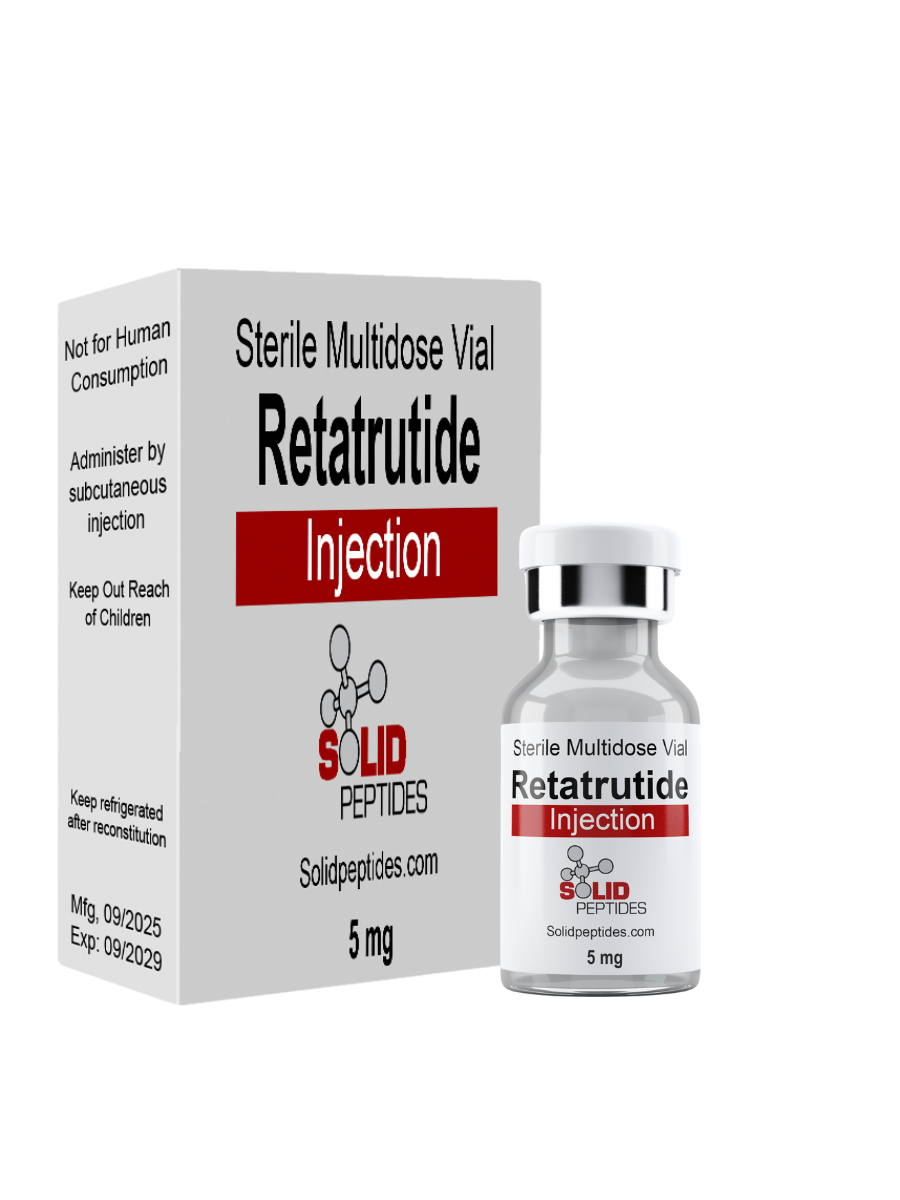
Retatrutide (40mg)
Retatrutide (LY3437943) is a first-in-class 39-amino acid triple agonist of GIPR, GLP-1R, and GCGR. Research demonstrates up to 24.2% mean body weight reduction in Phase 2 obesity trials, superior to single and dual agonists. Phase 2 data shows 86% liver fat reduction in MASLD and -2.02% HbA1c reduction in type 2 diabetes.
- Mechanistic pathway studies
- In vitro receptor profiling
- HPLC verified identity and purity
$329.00In Stock
Ships same-day if ordered before 2PM EST
1
Encrypted Checkout
Global Express
Research Overview
Retatrutide (LY3437943) is a first-in-class 39-amino acid synthetic peptide functioning as a triple agonist of GIPR (EC₅₀ 0.064 nM), GLP-1R (EC₅₀ 0.775 nM), and GCGR (EC₅₀ 5.79 nM). Developed by Eli Lilly on a GIP backbone with C20 fatty diacid conjugation, retatrutide enables once-weekly dosing with ~6-day half-life. Research (>100 publications spanning Phase 1-3 trials) demonstrates the highest weight loss efficacy of any single pharmaceutical agent: Phase 2 obesity trial (NEJM 2023) achieved 24.2% mean body weight reduction at 48 weeks with 83% of participants achieving ≥15% weight loss. Phase 2 MASLD substudy (Nature Medicine 2024) showed 82.4% liver fat reduction with 86% achieving normal liver fat (<5%). Phase 2 T2D trial (Lancet 2023) demonstrated -2.02% HbA1c reduction with 16.94% weight loss. Cryo-EM structures (2.68-3.26 Å) reveal continuous alpha-helical conformation with receptor-specific ECL1 interactions. Triple agonism creates synergistic effects: GLP-1R-mediated appetite suppression, GCGR-mediated thermogenesis/energy expenditure, GIPR-mediated nutrient partitioning.
Mechanism of Action
Retatrutide exerts effects through triple receptor agonism: (1) GLP-1R Activation (EC₅₀ 0.775 nM) - stimulates glucose-dependent insulin secretion via cAMP/PKA in pancreatic beta-cells, suppresses glucagon release, delays gastric emptying, reduces food intake through central appetite suppression in hypothalamus; (2) GIPR Activation (EC₅₀ 0.064 nM, highest potency) - potentiates glucose-dependent insulin secretion synergistically with GLP-1R, enhances glucose tolerance, promotes adipose tissue nutrient partitioning, stimulates lipolysis, supports healthy adipose remodeling; (3) GCGR Activation (EC₅₀ 5.79 nM, distinguishing feature) - increases resting energy expenditure via thermogenic gene expression, activates brown adipose tissue (BAT) and promotes WAT browning, enhances hepatic fatty acid oxidation, decreases de novo lipogenesis, upregulates UCP1 and mitochondrial biogenesis, shifts substrate oxidation toward lipid utilization; (4) Synergistic Integration - combined effects exceed sum of individual receptors: GLP-1R reduces caloric intake, GCGR increases energy expenditure, GIPR optimizes metabolic substrate handling; glucose-dependent mechanisms minimize hypoglycemia risk; (5) Structural Basis (Cryo-EM 2.68-3.26 Å) - adopts single continuous alpha-helical conformation when receptor-bound, N-terminal (residues 1-13) penetrates transmembrane core, C-terminal (residues 14-30) interacts with extracellular domain, receptor-specific ECL1 conformations enable selective triple engagement; (6) Engineered Stability - Aib substitutions (positions 2, 20, 23) confer DPP-4 resistance, alpha-methyl leucine (position 13) provides proteolytic stability, C20 fatty diacid conjugation at lysine-17 promotes albumin binding with ~6-day half-life enabling once-weekly dosing.
“Mechanistic summaries on this page are provided for laboratory reference and should be interpreted within controlled experimental settings only.”
Preclinical Research Summary
Phase 2 obesity trial (NEJM 2023, n=338): weight loss at 48 weeks: 8.7% (1mg), 17.1% (4mg), 22.8% (8mg), 24.2% (12mg) vs 2.1% placebo; 83% of 12mg participants achieved ≥15% weight loss; weight plateau not reached at study end. Phase 2 T2D trial (Lancet 2023, n=281): HbA1c reduction -2.02% (12mg) vs -0.01% placebo and -1.41% dulaglutide 1.5mg; weight loss 16.94% (12mg) vs 3.00% placebo at 36 weeks. Phase 2 MASLD substudy (Nature Medicine 2024, n=98): liver fat reduction 42.9% (1mg) to 82.4% (12mg) vs +0.3% placebo at 24 weeks; 86% of 12mg participants achieved normal liver fat (<5%) at 24 weeks, 93% at 48 weeks. Phase 1b trial (Lancet 2022, n=72): dose-proportional pharmacokinetics, half-life ~6 days, Tmax 12-72 hours, HbA1c reduction -1.4% to -1.6%, weight loss up to -8.96kg at 12 weeks. Gastric emptying substudy: significant delays with greatest effect after first dose, attenuation upon subsequent dosing despite dose escalation. Preclinical mouse studies: superior weight loss vs semaglutide attributable to GCGR-driven energy expenditure increases. Cryo-EM structures (Cell Discovery 2024): GLP-1R-Gs (2.68Å), GIPR-Gs (3.26Å), GCGR-Gs (2.84Å) complexes reveal continuous alpha-helix with receptor-specific ECL1 interactions. Receptor potency profile engineered as GIPR >> GLP-1R >> GCGR to maximize efficacy while maintaining tolerability.
Academic References
1. Jastreboff AM, et al. (2023). Triple-Hormone-Receptor Agonist Retatrutide for Obesity - A Phase 2 Trial. N Engl J Med. 389(6):514-526. doi:10.1056/NEJMoa2301972 [24.2% weight loss at 48 weeks, 83% achieved ≥15% loss]
2. Rosenstock J, et al. (2023). Retatrutide, a GIP, GLP-1 and glucagon receptor agonist, for people with type 2 diabetes: a randomised, double-blind, placebo and active-controlled, parallel-group, phase 2 trial. Lancet. 402(10401):529-544. doi:10.1016/S0140-6736(23)01053-X [HbA1c -2.02%, weight loss 16.94%]
3. Sanyal AJ, et al. (2024). Triple hormone receptor agonist retatrutide for metabolic dysfunction-associated steatotic liver disease: a randomized phase 2a trial. Nat Med. 30:2037-2048. doi:10.1038/s41591-024-03118-w [82.4% liver fat reduction, 86% achieved <5% liver fat]
4. Urva S, et al. (2022). LY3437943, a novel triple GIP, GLP-1, and glucagon receptor agonist in people with type 2 diabetes: a phase 1b trial. Lancet. 400(10366):1869-1881. doi:10.1016/S0140-6736(22)01945-1 [Phase 1b pharmacokinetics, half-life ~6 days]
5. Li W, et al. (2024). Structural insights into the triple agonism at GLP-1R, GIPR and GCGR manifested by retatrutide. Cell Discov. 10:73. doi:10.1038/s41421-024-00696-z [Cryo-EM structures 2.68-3.26Å resolution]
6. Coskun T, et al. (2022). LY3437943, a novel triple glucagon, GIP, and GLP-1 receptor agonist for glycemic control and weight loss: From discovery to clinical proof of concept. Cell Metab. 34(10):1560-1575. doi:10.1016/j.cmet.2022.09.013 [Discovery, pharmacology, potency characterization]
7. Goldney J, et al. (2025). Retatrutide for obesity: a systematic review and meta-analysis. Lancet Diabetes Endocrinol. doi:10.1016/S2213-8587(24)00343-6 [GCGR-mediated hepatic oxidation, thermogenesis]
8. Katsi V, et al. (2025). Retatrutide: a new era for obesity and metabolic syndrome management. Hormones (Athens). doi:10.1007/s42000-024-00606-4 [Synergistic triple receptor integration]
9. Jakubowska J, et al. (2024). Retatrutide - a triple agonist of GIP, GLP-1 and glucagon receptors: a promising approach in the treatment of obesity and metabolic syndrome. Front Endocrinol. 15:1396801. doi:10.3389/fendo.2024.1396801 [Synergistic effects exceed sum of individual receptors]
10. Karagiannis T, et al. (2023). Safety of retatrutide in patients with type 2 diabetes or obesity: a systematic review and meta-analysis of randomized controlled trials. Diabetes Obes Metab. 26(2):461-473. doi:10.1111/dom.15332 [Safety profile meta-analysis]
This product is intended exclusively for in vitro laboratory research by qualified professionals. Not for human consumption. Not approved by the FDA.
Published Research Briefs
Our research team has published evidence-checked briefs covering the science behind this compound. Each brief reviews primary sources and grades claims independently.