From Mono to Tri-Agonist: How Retatrutide Is Pushing Peptide Science Forward
An evidence-checked research brief reviewing the NEJM phase 2 trial of retatrutide, the first triple-hormone-receptor agonist tested for obesity, which produced up to 24.2% weight loss at 48 weeks.
RiboCore products are supplied strictly for laboratory and in-vitro research. This page is educational and should not be read as medical advice, a diagnosis, or a recommendation for human use.
What the trial found
These are the primary findings as reported by the investigators. This is a summary, not an endorsement of off-label use.
- At the highest dose (12 mg), participants lost a mean of 24.2% of body weight over 48 weeks — exceeding results from both semaglutide (STEP 1) and tirzepatide (SURMOUNT-1).
- The trial enrolled 338 adults with obesity or overweight across multiple sites. Response was dose-dependent, with the 12 mg group showing the most pronounced metabolic improvements.
- Among prediabetic participants at baseline, 72% in the highest-dose group reverted to normoglycemia by week 48.
- Gastrointestinal adverse events (nausea, diarrhea, vomiting) were the most common side effects, consistent with the incretin drug class, and were mostly mild to moderate.
Related Research Compounds
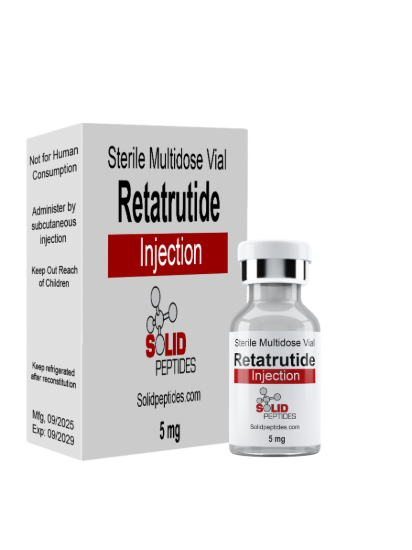
These compounds are discussed in the research above and are available in our catalog for qualified researchers.
Evidence snapshot
This phase 2 trial represents the first human efficacy data for a peptide that simultaneously activates three metabolic receptors.
Triple-receptor agonism adds glucagon signaling
Unlike semaglutide (GLP-1 only) or tirzepatide (GIP + GLP-1), retatrutide also activates the glucagon receptor. Glucagon signaling increases energy expenditure and promotes hepatic fat oxidation, potentially explaining the additive weight loss.
Weight loss exceeded both predecessors
The 24.2% mean reduction at 48 weeks surpassed semaglutide’s 14.9% at 68 weeks (STEP 1) and tirzepatide’s 22.5% at 72 weeks (SURMOUNT-1), though cross-trial comparisons require caution due to different designs.
Liver fat reduction was substantial
A companion imaging sub-study showed retatrutide reduced hepatic steatosis significantly, consistent with the glucagon receptor’s role in hepatic lipid metabolism. This suggests potential application beyond weight loss.
Claim review
A useful way to read health content is to grade each major claim independently instead of accepting the whole narrative as a package.
“Retatrutide is the most effective weight-loss drug ever tested.”
While 24.2% mean weight loss is the highest reported in a phase 2 obesity trial, this was a relatively small study (338 participants, 48 weeks). Phase 3 results with larger populations and longer duration will determine where retatrutide truly ranks.
“Triple agonism is better than dual agonism.”
The biological rationale is sound: adding glucagon receptor activation to GIP/GLP-1 signaling addresses energy expenditure and hepatic fat metabolism — pathways not strongly engaged by dual agonists. The phase 2 data is consistent with this hypothesis.
“Retatrutide could replace bariatric surgery.”
While the weight loss magnitude approaches surgical outcomes (25–35%), durability, lean mass preservation, complication profiles, and long-term metabolic outcomes differ fundamentally. Head-to-head surgical comparisons have not been conducted.
Important considerations
- This is phase 2 data with 338 participants. Phase 3 trials with larger populations and longer follow-up are ongoing and will provide the definitive efficacy and safety profile.
- Cross-trial weight loss comparisons (vs. semaglutide or tirzepatide) are unreliable because trial populations, durations, and designs differ.
- Retatrutide is an investigational compound. It is not approved by any regulatory agency for any indication.
- The glucagon receptor component raises theoretical concerns about blood glucose in non-diabetic populations that require longer-term monitoring.
Research questions worth tracking
- Will phase 3 data confirm the magnitude of weight loss seen in phase 2?
- How does the glucagon receptor component affect lean mass preservation compared to GLP-1-only or dual-agonist approaches?
- What is the long-term hepatic safety profile of sustained glucagon receptor activation?
- Can retatrutide demonstrate cardiovascular outcomes benefits similar to those seen with semaglutide in SELECT?
Primary sources
These references anchor the claims in this brief to peer-reviewed literature and authoritative guidance.
Research-use note
Nothing on this page should be used to diagnose, treat, or self-manage any medical condition. If a reader needs clinical guidance, the right next step is a licensed clinician and guideline-based care, not a research brief or a product listing.