MOTS-c: The Mitochondrial Peptide That Mimics Exercise
An evidence-checked research brief reviewing the Cell Metabolism discovery of MOTS-c, a mitochondrial-derived peptide that promotes metabolic homeostasis and reduces obesity and insulin resistance in preclinical models.
RiboCore products are supplied strictly for laboratory and in-vitro research. This page is educational and should not be read as medical advice, a diagnosis, or a recommendation for human use.
What the paper reports
These findings summarize the authors’ conclusions. Independent replication status is noted in the claim review below.
- MOTS-c is a 16-amino-acid peptide encoded within the mitochondrial 12S rRNA gene — one of the first signaling molecules discovered to originate from mitochondrial DNA rather than nuclear DNA.
- In mouse models, MOTS-c prevented age-dependent and high-fat-diet-induced insulin resistance and obesity when administered systemically.
- The peptide activates AMPK (AMP-activated protein kinase) in skeletal muscle, the same master metabolic switch activated by physical exercise.
- Circulating MOTS-c levels decline with age, suggesting it may function as a mitochondrial hormone whose loss contributes to age-related metabolic dysfunction.
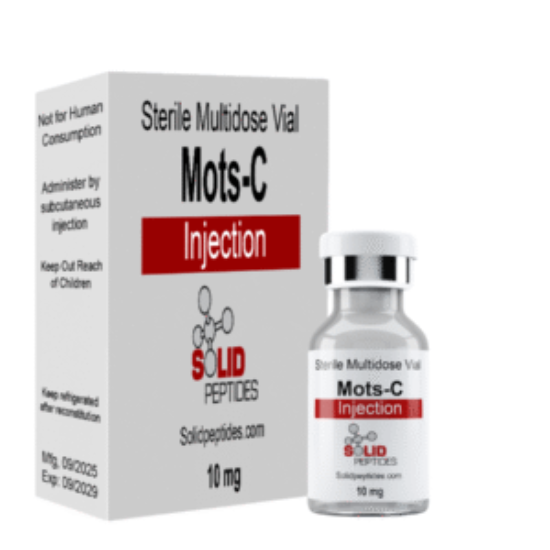
Related Research Compounds
These compounds are discussed in the research above and are available in our catalog for qualified researchers.
Evidence snapshot
The discovery of MOTS-c opened an entirely new category of signaling molecules — mitochondrial-derived peptides — that may reshape our understanding of metabolic regulation and aging.
Mitochondria communicate with the rest of the body
MOTS-c demonstrated that mitochondrial DNA encodes bioactive peptides that circulate systemically and regulate metabolism in distant tissues. This established mitochondria as endocrine-like organelles, not merely cellular power plants.
AMPK activation mimics exercise signaling
MOTS-c activates AMPK in skeletal muscle, which enhances glucose uptake, fatty acid oxidation, and mitochondrial biogenesis — the same pathway activated by physical exercise. This positions MOTS-c as a potential exercise mimetic.
Age-related decline suggests therapeutic relevance
Circulating MOTS-c levels fall with age in both mice and humans. Subsequent research showed that exercise increases MOTS-c levels, suggesting a feedback loop between physical activity, mitochondrial signaling, and metabolic health.
Claim review
A useful way to read health content is to grade each major claim independently instead of accepting the whole narrative as a package.
“MOTS-c is an exercise pill.”
MOTS-c activates one key exercise pathway (AMPK) and produces some metabolic effects that overlap with exercise. However, physical exercise engages hundreds of molecular pathways simultaneously. Calling any single molecule an “exercise pill” overstates the biology.
“MOTS-c is a mitochondrial hormone.”
This framing is accurate. MOTS-c is encoded by mitochondrial DNA, secreted into circulation, and acts on distant target tissues to regulate metabolism. It meets the functional definition of a hormone.
“MOTS-c can reverse aging.”
MOTS-c prevented age-dependent insulin resistance in mouse models, which is meaningful. But “reversing aging” is a much broader claim that extends far beyond metabolic improvements in rodents.
Important considerations
- The discovery paper and most subsequent MOTS-c research is preclinical (cell and animal models). Human clinical trials are limited.
- Mouse metabolic models do not always translate to human outcomes. Dose, pharmacokinetics, and tissue distribution may differ significantly.
- MOTS-c is one of several mitochondrial-derived peptides (humanin, SHLP1-6). Its effects may be part of a larger signaling network not yet fully characterized.
- Exercise remains the most robustly validated intervention for metabolic health. No peptide has replicated the full spectrum of exercise benefits.
Research questions worth tracking
- Do circulating MOTS-c levels predict metabolic disease risk independently of traditional biomarkers?
- What is the optimal dosing, route, and frequency for MOTS-c in human metabolic studies?
- How does MOTS-c interact with other mitochondrial-derived peptides (humanin, SHLP) in systemic signaling?
- Can MOTS-c supplementation improve exercise capacity or metabolic outcomes in sedentary aging populations?
Primary sources
These references anchor the claims in this brief to peer-reviewed literature and authoritative guidance.
Research-use note
Nothing on this page should be used to diagnose, treat, or self-manage any medical condition. If a reader needs clinical guidance, the right next step is a licensed clinician and guideline-based care, not a research brief or a product listing.