Epithalon: The Tetrapeptide That Activates Telomerase — What 25 Years of Research Shows
An evidence-checked research brief reviewing 25 years of research on Epithalon (AEDG), a synthetic tetrapeptide that activates telomerase and elongates telomeres in human somatic cells.
RiboCore products are supplied strictly for laboratory and in-vitro research. This page is educational and should not be read as medical advice, a diagnosis, or a recommendation for human use.
What the paper reports
These findings summarize the authors’ conclusions. Independent replication status is noted in the claim review below.
- Epithalon (AEDG) is a synthetic tetrapeptide that activated telomerase and increased telomere length in human fetal fibroblast and adult endothelial cell cultures.
- The peptide was developed by Vladimir Khavinson at the St. Petersburg Institute of Bioregulation and Gerontology, where it has been studied for over 25 years.
- Follow-up studies reported that Epithalon extended the lifespan of laboratory mice and Drosophila, reduced tumor incidence in aging animals, and restored circadian melatonin production in aged primates.
- A 2025 IJMS review confirmed that Epithalon research has been reproduced across multiple cell types and model organisms over the 25-year period.
Related Research Compounds
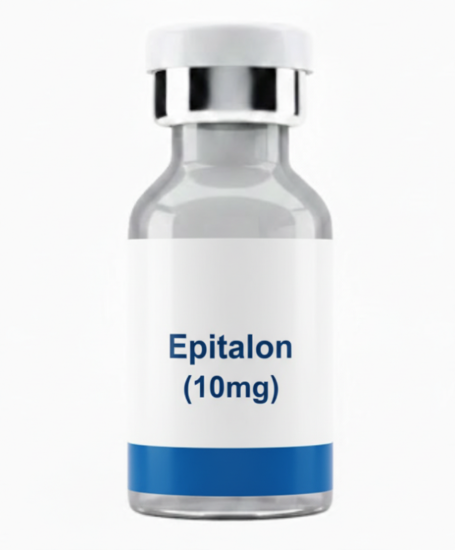
These compounds are discussed in the research above and are available in our catalog for qualified researchers.
Evidence snapshot
Epithalon research spans over two decades but remains predominantly from a single research group. The telomerase activation mechanism is biologically plausible, but the evidence base has important limitations.
Telomere biology is well-established aging science
Telomeres are protective caps on chromosome ends that shorten with each cell division. When critically short, cells enter senescence or apoptosis. Telomerase rebuilds telomeres, and its activation in somatic cells is a logical aging target.
Epithalon activates telomerase in vitro
The 2003 paper demonstrated that Epithalon increased telomerase activity and telomere length in two human cell types. This finding has been reproduced in subsequent studies with additional cell types.
Animal lifespan extension was reported
Studies from Khavinson’s group reported that Epithalon-treated mice lived longer than controls, with reduced tumor incidence. However, these are single-laboratory findings not yet independently replicated.
Claim review
A useful way to read health content is to grade each major claim independently instead of accepting the whole narrative as a package.
“Epithalon can extend human lifespan.”
Mouse lifespan extension has been reported by the primary research group, but no human longevity data exists. Translating cell culture and mouse findings to human lifespan extension requires clinical evidence that does not yet exist.
“Epithalon activates telomerase.”
Telomerase activation by Epithalon has been demonstrated in multiple cell types across studies from the primary research group, and the 2025 IJMS review confirmed reproduction of this finding.
“Telomerase activation is always beneficial.”
Telomerase activation in cancer cells drives immortal proliferation — it is a feature of most cancers. Any telomerase-activating intervention must demonstrate that it does not promote malignant growth.
Important considerations
- The vast majority of Epithalon research comes from a single laboratory (Khavinson, St. Petersburg). Independent replication is essential.
- The original publication is in a modest-impact journal. Higher-impact replication would substantially strengthen the evidence.
- Telomerase activation carries theoretical oncogenesis risk. While studies report reduced tumor incidence, long-term human safety data is absent.
- Epithalon is not approved by any regulatory agency for any indication.
Research questions worth tracking
- Can independent laboratories reproduce Epithalon’s telomerase activation and lifespan extension findings?
- What is the mechanism by which a four-amino-acid peptide activates telomerase gene expression?
- Does Epithalon-mediated telomerase activation increase cancer risk in any model system?
- How does Epithalon compare to other telomerase activators (TA-65, cycloastragenol) in standardized assays?
Primary sources
These references anchor the claims in this brief to peer-reviewed literature and authoritative guidance.
Research-use note
Nothing on this page should be used to diagnose, treat, or self-manage any medical condition. If a reader needs clinical guidance, the right next step is a licensed clinician and guideline-based care, not a research brief or a product listing.