Research Use Only: This product is supplied for laboratory research and in-vitro studies. Not for human or veterinary administration.
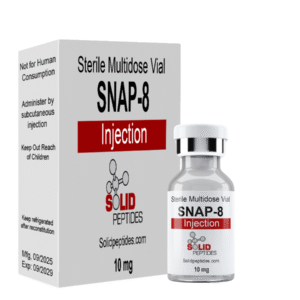
Hover to zoom
Identity Verified: LC-MS
(0 Reviews)
SNAP-8 (10mg)
SNAP-8 (Acetyl Octapeptide-3) is an 8-amino acid biomimetic peptide (Ac-EEMQRRAD-NH2) that competitively inhibits SNAP-25 incorporation into the SNARE complex, achieving ~43% inhibition of glutamate release. Developed as a topical alternative to botulinum toxin, it provides muscle relaxation (not paralysis) with reversible, dose-dependent modulation of neurotransmitter release.
- Mechanistic pathway studies
- In vitro receptor profiling
- HPLC verified identity and purity
$33.00In Stock
Ships same-day if ordered before 2PM EST
1
Encrypted Checkout
Global Express
Research Overview
SNAP-8 (Acetyl Octapeptide-3, Acetyl Glutamyl Heptapeptide-3) is an 8-amino acid synthetic biomimetic peptide (Ac-Glu-Glu-Met-Gln-Arg-Arg-Ala-Asp-NH2) developed by Lipotec S.A. (acquired by Lubrizol 2012) as a topical alternative to botulinum neurotoxin. Structural elongation of Argireline (Ac-EEMQRR-NH2) with two additional C-terminal residues (Ala-Asp) conferring ~30% greater anti-wrinkle activity. N-terminal acetyl cap and C-terminal amide enhance metabolic stability and reduce aminopeptidase/carboxypeptidase degradation. Amphiphilic character (two Glu, one Asp, two Arg residues) influences solubility and membrane interaction. Named for biomimetic relationship with SNAP-25 (Synaptosomal Associated Protein of 25 kDa), critical component of SNARE complex (Soluble N-ethylmaleimide-sensitive factor Attachment protein REceptor) responsible for calcium-dependent vesicle fusion and neurotransmitter release. Acts as biomimetic fragment of N-terminal SNARE motif of SNAP-25, competitively inhibiting endogenous SNAP-25 incorporation into ternary SNARE complex (VAMP/synaptobrevin, syntaxin-1, SNAP-25). At 1.5 mM achieves ~43% inhibition of glutamate release in vitro (Errante 2020). Partial, dose-dependent, reversible modulation produces muscle relaxation (not paralysis) - fundamentally distinct from botulinum toxin type A which enzymatically cleaves SNAP-25 causing complete irreversible blockade. Synergistic with Leuphasyl (Pentapeptide-18): 0.75 mM SNAP-8 alone = 38% inhibition, Leuphasyl alone = 7%, combined = 47% (exceeds additive, independent mechanisms). Hydrophilic character (LogP <0) presents stratum corneum permeation challenge, driving research into microneedle patches, liposomal encapsulation, penetration enhancers. Stable pH 4.0-7.0, lyophilized form stable at -20°C, oxidation-sensitive methionine at position 3.
Mechanism of Action
SNAP-8 exerts effects through multiple mechanisms: (1) SNARE Complex Competitive Inhibition - acts as biomimetic fragment of N-terminal SNARE motif of SNAP-25 (Synaptosomal Associated Protein 25 kDa); competitively inhibits endogenous SNAP-25 incorporation into ternary SNARE complex consisting of VAMP/synaptobrevin (vesicle membrane), syntaxin-1 (plasma membrane), and SNAP-25 (plasma membrane-associated); SNARE proteins assemble into coiled-coil four-helix bundle functioning as molecular "zipper" that draws vesicle and plasma membranes into proximity for membrane fusion and neurotransmitter exocytosis; at 1.5 mM concentration achieves ~43% inhibition of glutamate release in vitro (Errante 2020); partial, dose-dependent inhibition produces muscle relaxation rather than paralysis; (2) Neuromuscular Junction Modulation - reduces efficiency of acetylcholine exocytosis via SNARE complex modulation at neuromuscular junction; attenuates strength and frequency of facial muscle contractions without eliminating them; particularly relevant for expression lines where repeated contraction contributes to wrinkle formation; Apland 2003 demonstrated truncated SNAP-25 products inhibited depolarization-dependent glutamate release from hippocampal cultures and depressed synaptic transmission in Aplysia buccal ganglion cells; (3) Reversible Modulation - fundamentally distinct from botulinum toxin type A which enzymatically cleaves SNAP-25 via zinc-dependent metalloprotease activity causing complete, irreversible blockade lasting 3-6 months; SNAP-8 provides graded, titratable response proportional to concentration, reversible upon treatment cessation; (4) Synergistic Interaction with Leuphasyl - at equimolar 0.75 mM: SNAP-8 alone = 38% inhibition, Leuphasyl alone = 7%, combined = 47% (exceeds additive prediction); synergy arises from independent mechanisms: SNAP-8 targets SNARE complex assembly (presynaptic vesicle fusion machinery), Leuphasyl operates through opioid receptor-mediated presynaptic inhibition (enkephalin-mimetic); (5) Structural Basis - N-terminal acetyl cap and C-terminal amide enhance metabolic stability, reduce aminopeptidase/carboxypeptidase degradation; amphiphilic character from two Glu, one Asp, two Arg residues influences solubility and membrane interaction; single Met at position 3 confers oxidation sensitivity (methionine sulfoxide byproduct reduces activity).
“Mechanistic summaries on this page are provided for laboratory reference and should be interpreted within controlled experimental settings only.”
Preclinical Research Summary
Blanes-Mira et al. (2002, Int J Cosmet Sci): established foundational mechanism for SNAP-25 mimetic peptides; hexapeptide Ac-EEMQRR-NH2 (Argireline) inhibited calcium-dependent catecholamine release from permeabilized chromaffin cells by interfering with SNARE complex formation. Errante et al. (2020, Biomolecules): at 1.5 mM SNAP-8 achieved ~43% inhibition of glutamate release in vitro; demonstrated synergistic activity with Leuphasyl (0.75 mM SNAP-8 alone = 38%, Leuphasyl alone = 7%, combined = 47%). Apland et al. (2003, Toxicology): truncated SNAP-25 products inhibited depolarization-dependent glutamate release from hippocampal cultures and depressed synaptic transmission in Aplysia buccal ganglion cells. Lee et al. (2019, Ann Dermatol): elastase inhibitory activity and anti-wrinkle effect correlate to SNAP-8 concentration; demonstrates collagen/elastin protective mechanisms beyond SNARE inhibition. Zhang et al. (2023, J Anal Sci Technol): LC-MS/MS method development for SNAP-8 quantification; retention time 4.76 min, LOD 0.0018 μg/mL, LOQ 0.0036 μg/mL. Barros et al. (2022, Front Chem): SNAP-8-loaded polymeric nanoparticles with chitosan coating demonstrated sustained release profile, improved skin permeation, non-cytotoxic to HaCaT cells. Pharmacokinetics: hydrophilic character (LogP <0) presents stratum corneum permeation barrier; topically applied with minimal systemic absorption; reversible effects upon treatment cessation. Stability: optimal pH 4.0-7.0, lyophilized form stable at -20°C, oxidation-sensitive methionine at position 3 requires protection from light, moisture, oxidizing agents. Comparative mechanism: botulinum toxin type A cleaves SNAP-25 via metalloprotease causing complete irreversible blockade lasting 3-6 months with paralysis; SNAP-8 competitively inhibits SNAP-25 incorporation providing partial, dose-dependent, reversible relaxation without paralysis.
Academic References
1. Blanes-Mira C, et al. (2002). A synthetic hexapeptide (Argireline) with antiwrinkle activity. Int J Cosmet Sci. 24(5):303-310. doi:10.1046/j.1467-2494.2002.00153.x [Foundational mechanism: Ac-EEMQRR-NH2 inhibits SNARE complex]
2. Errante F, et al. (2020). Cosmeceutical Peptides in the Framework of Sustainable Wellness Economy. Biomolecules. 10(7):1056. doi:10.3390/biom10071056 [SNAP-8: 43% glutamate release inhibition at 1.5mM, synergistic with Leuphasyl]
3. Apland JP, et al. (2003). Inhibition of neurotransmitter release by peptides that mimic the N-terminal domain of SNAP-25. Toxicology. 190(3):251-261. doi:10.1016/s0300-483x(03)00172-9 [Truncated SNAP-25 products inhibit glutamate release, depress synaptic transmission]
4. Lee SH, et al. (2019). Elastase Inhibitory Activity and Antiwrinkle Effect of Cosmetics Containing Saussurea Involucrata Extract. Ann Dermatol. 31(Suppl):S29-S33. doi:10.5021/ad.2019.31.S.S29 [SNAP-8 concentration-dependent elastase inhibition, collagen/elastin protection]
5. Zhang W, et al. (2023). Quantitative analysis of acetyl octapeptide-3 in cosmetics using liquid chromatography-tandem mass spectrometry. J Anal Sci Technol. 14:25. doi:10.1186/s40543-023-00392-3 [LC-MS/MS method: RT 4.76 min, LOD 0.0018 μg/mL]
6. Barros RC, et al. (2022). Acetyl Octapeptide-3-Loaded Polymeric Nanoparticles: Proof of Concept of Topical Application. Front Chem. 10:833141. doi:10.3389/fchem.2022.833141 [Chitosan-coated nanoparticles: sustained release, improved permeation, non-cytotoxic]
7. Wang Y, et al. (2013). Effect of Argireline on ASICs and MMPs: new insight into the anti-wrinkle mechanism of anti-aging cosmetics. Int J Cosmet Sci. 35(6):621-628. doi:10.1111/ics.12087 [Argireline (hexapeptide precursor) mechanism review]
8. Maia Campos PM, et al. (2014). Skin moisturizing effects of peptides: a comparative study. Int J Cosmet Sci. 36(5):434-439. doi:10.1111/ics.12141 [Peptide moisturizing mechanisms in cosmeceutical applications]
9. Lupo MP, Cole AL. (2007). Cosmeceutical peptides. Dermatol Ther. 20(5):343-349. doi:10.1111/j.1529-8019.2007.00148.x [Comprehensive review of cosmeceutical peptides including SNAP-8]
10. Jahn R, Scheller RH. (2006). SNAREs--engines for membrane fusion. Nat Rev Mol Cell Biol. 7(9):631-643. doi:10.1038/nrm2002 [Comprehensive SNARE complex molecular biology review]
This product is intended exclusively for in vitro laboratory research by qualified professionals. Not for human consumption. Not approved by the FDA.