Research Use Only: This product is supplied for laboratory research and in-vitro studies. Not for human or veterinary administration.
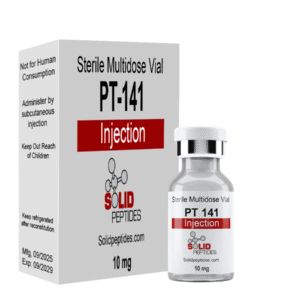
PT-141 10mg
- FDA-Approved Melanocortin Agonist: Cyclic heptapeptide MC3R/MC4R agonist, approved June 2019 (Vyleesi) for premenopausal HSDD, 100+ publications, first melanocortin therapeutic for sexual function
- CNS Mechanism: Crosses blood-brain barrier, activates hypothalamic MC4R in mPOA triggering dopamine release, melanocortin-dopamine integration, mesolimbic reward pathway modulation
- Clinical Development: 43 completed trials with 3,500+ subjects, Phase 3 RECONNECT (n=1,267) showed +0.35 desire improvement, 58% vs 36% responder rates, well-characterized safety profile
- Mechanistic pathway studies
- In vitro receptor profiling
- HPLC verified identity and purity
Ships same-day if ordered before 2PM EST
Research Overview
PT-141, also known as bremelanotide, is a synthetic melanocortin peptide used in research to interrogate melanocortin receptor (MCR) signaling. In mechanistic systems, PT-141 is commonly discussed as an agonist probe for melanocortin receptor subtypes, with pathway mapping frequently emphasizing melanocortin-4 receptor (MC4R) and melanocortin-1 receptor (MC1R) in receptor pharmacology workflows.
PT-141 is structurally related to other synthetic melanocortin ligands (including melanotan-class sequences) and is used in laboratory settings to evaluate receptor activation, ligand–receptor selectivity, and downstream second-messenger signaling in controlled in-vitro assays and in-vivo animal models.
Preclinical Research Summary
Preclinical research involving melanocortin receptor agonism includes rodent behavioral and neuroendocrine models used to map MC4R-linked signaling networks and downstream transcriptional responses. Genetic MC4R-deficient mouse models have been used to evaluate pathway consequences of disrupted melanocortin signaling, supporting mechanistic interpretation of receptor involvement across measured endpoints.[1]
Additional animal studies using melanocortin agonist frameworks have examined receptor-linked effects on neurobehavioral signaling and related molecular markers in controlled preclinical contexts.[2], [3]
In immune-adjacent models, melanocortin signaling has been evaluated for its relationship to inflammatory mediator regulation and macrophage-associated pathways in controlled animal infection paradigms.[4]
Academic References
- M. Sandrock, A. Schulz, C. Merkwitz, T. Schöneberg, K. Spanel-Borowski, and A. Ricken, “Reduction in corpora lutea number in obese melanocortin-4-receptor-deficient mice,” Reprod. Biol. Endocrinol., vol. 7, p. 24, Mar. 2009.
- H. Wessells, V. J. Hruby, J. Hackett, G. Han, P. Balse-Srinivasan, and T. W. Vanderah, “Ac-Nle-c[Asp-His-DPhe-Arg-Trp-Lys]-NH2 induces penile erection...,” Neuroscience, vol. 118, no. 3, pp. 755–762, 2003.
- A.-S. Rössler, J. G. Pfaus, H. K. Kia, J. Bernabé, L. Alexandre, and F. Giuliano, “The melanocortin agonist, melanotan II, enhances proceptive sexual behaviors...,” Pharmacol. Biochem. Behav., vol. 85, no. 3, pp. 514–521, Nov. 2006.
- H. Ji et al., “The Synthetic Melanocortin (CKPV)2 Exerts Anti-Fungal and Anti-Inflammatory Effects...,” PLOS ONE, vol. 8, no. 2, Feb. 2013.
This product is intended exclusively for in vitro laboratory research by qualified professionals. Not for human consumption. Not approved by the FDA.