Research Use Only: This product is supplied for laboratory research and in-vitro studies. Not for human or veterinary administration.
1 of 2
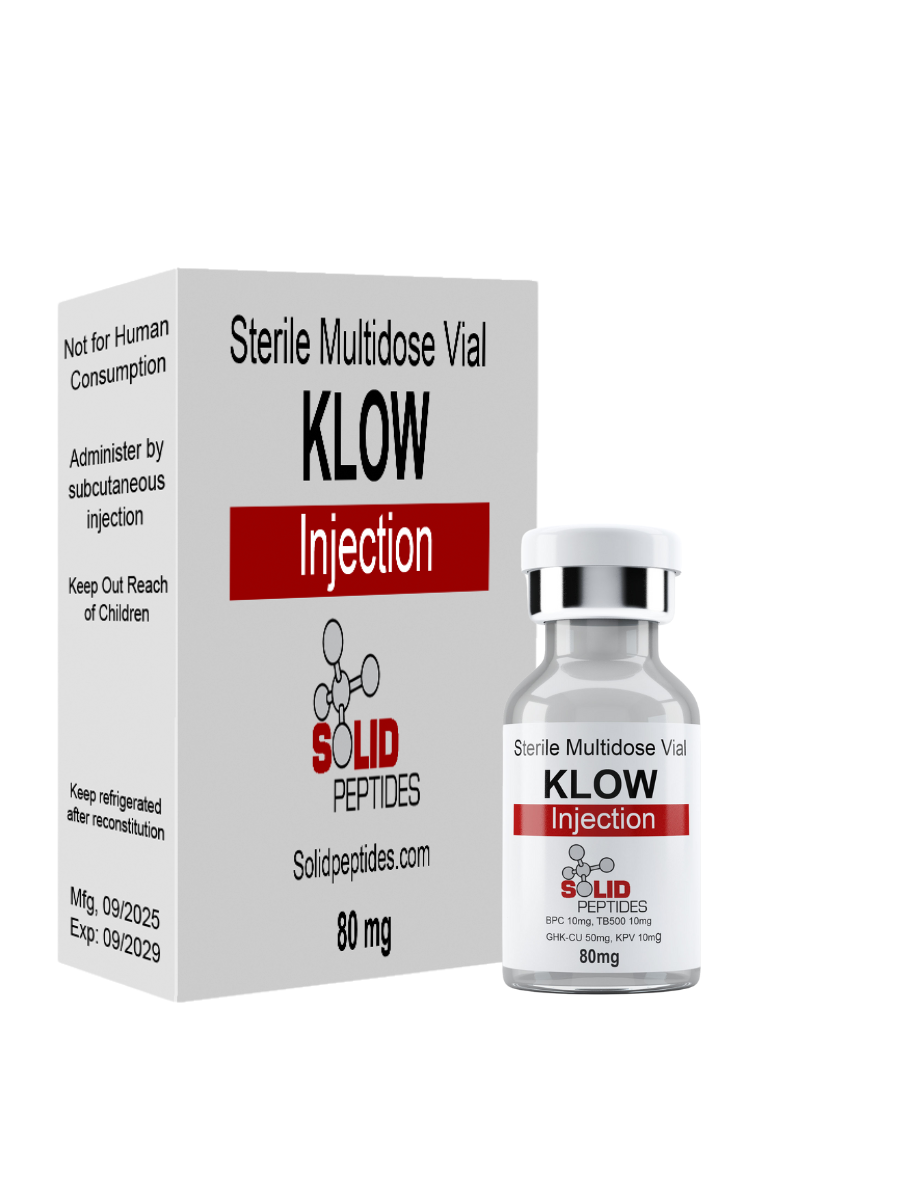
KLOW (80mg)
- Quad-Peptide Blend: BPC-157 10mg + TB-500 10mg + GHK-Cu 50mg + KPV 10mg (80mg total)
- Enhanced Anti-Inflammatory: KPV addition for NF-κB pathway inhibition and cytokine control
- Comprehensive Regeneration: Cytoprotection, angiogenesis, collagen synthesis, and inflammation modulation
- Mechanistic pathway studies
- In vitro receptor profiling
- HPLC verified identity and purity
Ships same-day if ordered before 2PM EST
Research Overview
The KLOW Blend is an advanced quad-peptide research formulation comprising BPC-157 (10mg), TB-500 (10mg), GHK-Cu (50mg), and KPV (10mg) for a total of 80mg per vial. This formulation extends the GLOW Blend by adding KPV (Lysine-Proline-Valine), a potent anti-inflammatory tripeptide derived from the C-terminal sequence of alpha-melanocyte stimulating hormone (α-MSH, positions 11-13). KPV provides targeted inflammation control through NF-κB pathway inhibition without the melanotropic effects of full-length α-MSH, making it valuable for research requiring inflammation modulation in tissue repair models.
The scientific rationale for KLOW integrates four complementary mechanisms: BPC-157 provides cytoprotection and vascular stabilization through Src-Caveolin-1-eNOS and VEGFR2-Akt-eNOS pathways; TB-500 promotes cell migration and angiogenesis via G-actin sequestration and VEGF upregulation; GHK-Cu drives collagen synthesis, matrix remodeling, and modulates over 4,000 genes; and KPV specifically inhibits NF-κB signaling, reducing pro-inflammatory cytokines (TNF-α, IL-1β, IL-6) while maintaining anti-inflammatory balance. Unlike full-length α-MSH, KPV lacks the His-Phe-Arg-Trp melanocortin core sequence required for MC1R activation, eliminating melanogenic effects while preserving anti-inflammatory activity.
Comparative research suggests KLOW may offer advantages over the three-peptide GLOW formulation in applications where inflammation control is critical. Studies have demonstrated KPV's efficacy in inflammatory bowel disease models, dermatitis research, and chronic inflammatory conditions through NF-κB inhibition mechanisms. The quad-peptide combination addresses all phases of tissue repair: inflammation (KPV, BPC-157), proliferation (TB-500, BPC-157, GHK-Cu), migration and angiogenesis (TB-500, BPC-157, GHK-Cu), and remodeling (GHK-Cu, KPV), potentially minimizing scar formation while maintaining protective regenerative responses.
Primary Research Applications
Mechanism of Action
NF-κB Pathway Inhibition (KPV)
Inflammation Control — KPV inhibits the NF-κB (Nuclear Factor kappa-light-chain-enhancer of activated B cells) pathway, a master regulator of inflammatory responses. KPV prevents IκB kinase (IKK) activation, stabilizes IκB proteins, and retains NF-κB in the cytoplasm, blocking its translocation to the nucleus. This cascade reduces transcription of pro-inflammatory genes encoding TNF-α, IL-1β, and IL-6 while maintaining anti-inflammatory IL-10 balance. Critically, KPV lacks the His-Phe-Arg-Trp melanocortin core sequence of full-length α-MSH, eliminating MC1R-mediated melanogenesis while preserving anti-inflammatory signaling through alternative pathways.
VEGFR2 and Nitric Oxide Signaling (BPC-157)
Vascular Protection — BPC-157 activates the VEGFR2-Akt-eNOS pathway, promoting endothelial nitric oxide synthase (eNOS) phosphorylation and NO production. Simultaneously, BPC-157 modulates the Src-Caveolin-1-eNOS pathway, where it disrupts the inhibitory caveolin-1 interaction with eNOS, enhancing NO bioavailability. These dual pathways support vascular stability, angiogenic signaling, and cytoprotection through FAK-paxillin-mediated cell migration and survival signaling.
G-Actin Sequestration and VEGF Upregulation (TB-500)
Cell Migration — TB-500 (Thymosin Beta-4) binds globular actin (G-actin) with high affinity (Kd ~0.5-0.7 μM), sequestering the intracellular actin monomer pool and preventing premature polymerization. This maintains a reservoir of readily available actin for rapid cytoskeletal reorganization during cell migration. TB-500 concurrently upregulates VEGF expression and promotes endothelial cell migration, contributing to new blood vessel formation. Anti-fibrotic activity is mediated through modulation of TGF-β signaling and ECM remodeling.
Collagen Synthesis and Gene Modulation (GHK-Cu)
Matrix Remodeling — GHK-Cu acts as a copper chaperone, delivering Cu²⁺ ions to lysyl oxidase and other copper-dependent enzymes critical for collagen cross-linking. The tripeptide-copper complex stimulates synthesis of collagen types I and III, regulates matrix metalloproteinases (MMPs) for organized ECM turnover, and induces antioxidant enzymes (superoxide dismutase, catalase). Genomic profiling reveals GHK-Cu modulates over 4,000 genes involved in tissue repair, inflammation resolution, and cellular metabolism.
Synergistic Quad-Peptide Integration
Multi-Phase Repair — The KLOW formulation addresses tissue repair sequentially: Phase 1 (Inflammation) - KPV inhibits NF-κB and reduces cytokine storm while BPC-157 provides cytoprotection; Phase 2 (Proliferation) - TB-500 drives cell migration, BPC-157 initiates angiogenesis, and GHK-Cu activates fibroblasts; Phase 3 (Angiogenesis) - TB-500 and BPC-157 synergize for VEGF-mediated vessel formation with GHK-Cu supporting vessel maturation; Phase 4 (Remodeling) - GHK-Cu synthesizes organized collagen matrix while KPV controls residual inflammation to minimize scarring. This comprehensive approach may offer superior outcomes compared to three-peptide GLOW in inflammation-intensive repair models.
“Mechanistic summaries on this page are provided for laboratory reference and should be interpreted within controlled experimental settings only.”
Preclinical Research Summary
KPV's anti-inflammatory mechanisms have been extensively characterized in preclinical models. In a murine inflammatory bowel disease study by Kannengiesser et al. (2008) published in Inflammatory Bowel Diseases, KPV administration significantly reduced disease activity indices through NF-κB pathway inhibition. The study demonstrated decreased expression of pro-inflammatory cytokines (TNF-α, IL-1β) and reduced mucosal damage compared to vehicle controls. Importantly, KPV achieved these anti-inflammatory effects without activating melanocortin receptors (MC1R), confirming the tripeptide's selective anti-inflammatory activity independent of melanogenesis. A comprehensive review by Brzoska et al. (2008) in Endocrine Reviews established that α-MSH-derived tripeptides like KPV retain anti-inflammatory potency while lacking the His-Phe-Arg-Trp core sequence required for melanotropic effects.
The synergistic effects of BPC-157, TB-500, and GHK-Cu have been documented in separate preclinical studies. Seiwerth et al. (2018) demonstrated BPC-157's angiogenic and cytoprotective properties through VEGFR2 and eNOS pathway activation in vascular injury models. Bock-Marquette et al. (2023) reviewed thymosin beta-4's role in promoting cell migration and tissue regeneration through G-actin sequestration. Pickart and Margolina (2018) documented GHK-Cu's multi-modal regenerative actions, including collagen synthesis stimulation and genomic modulation of over 4,000 genes involved in tissue repair and inflammation resolution. While these studies examined individual components, the KLOW formulation's combined effects on inflammation-modulated tissue repair represent a novel research application requiring further investigation. The addition of KPV to the GLOW foundation specifically addresses the inflammatory phase, potentially reducing excessive scar formation while maintaining protective repair responses in preclinical wound healing models.
Academic References
- Kannengiesser K et al. (2008). Melanocortin-derived tripeptide KPV has anti-inflammatory potential in murine models of inflammatory bowel disease. Inflammatory Bowel Diseases.
- Brzoska T et al. (2008). α-Melanocyte-Stimulating Hormone and Related Tripeptides: Biochemistry, Antiinflammatory and Protective Effects. Endocrine Reviews.
- Luger TA et al. (2003). The role of α-MSH as a modulator of cutaneous inflammation. Annals of the New York Academy of Sciences.
- Seiwerth S et al. (2018). BPC 157 and angiogenic growth factors comparison. Current Pharmaceutical Design.
- Hsieh MJ et al. (2020). Src-Caveolin-1-eNOS pathway elucidation in BPC-157 research. Scientific Reports.
- Bock-Marquette I et al. (2023). Thymosin beta-4 in regenerative therapies. International Immunopharmacology.
- Pickart L, Margolina A (2018). Regenerative and Protective Actions of the GHK-Cu Peptide. International Journal of Molecular Sciences.
This product is intended exclusively for in vitro laboratory research by qualified professionals. Not for human consumption. Not approved by the FDA.