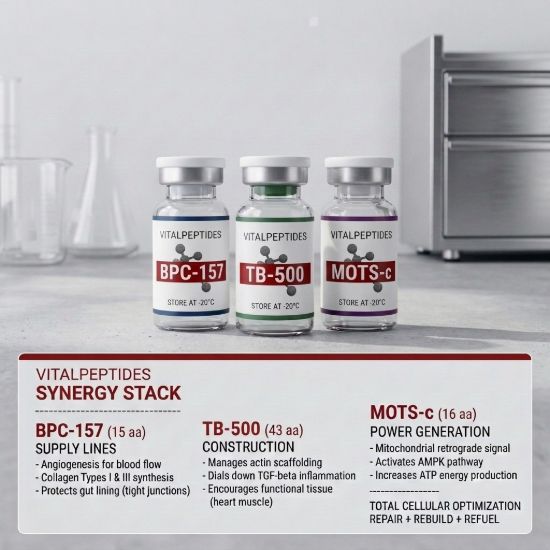
Inflammation Defense Protocol
BPC-157, TB-500, and MOTS-c bundled together for comprehensive recovery research.
You save $50.00 when buying as a package
All 3 products are added to your cart in a single click
What's Included(3 products)
| Product | Retail | Discount | Price |
|---|---|---|---|
 BPC-157 RC-BPC-157-10MG-4-PACK | $200.00 | −$50.00(25%) | $150.00 |
 TB-500 (Thymosin Beta-4) (43aa) RC-TB-500-5MG | $36.40 | — | $36.40 |
 MOTS-c (40mg) RP-MOTS-40MG | $110.00 | — | $110.00 |
| Package Total | −$50.00 | $296.40$346.40 | |
Research Overview
Inflammation Defense Protocol combines 3 extensively studied peptides — BPC-157, TB-500 (Thymosin Beta-4) (43aa), MOTS-c (40mg) — selected for their complementary regenerative, anti-inflammatory, and metabolic signaling pathways. Each compound targets distinct biological mechanisms, making this combination a tool for investigating multi-pathway tissue repair, cellular energy optimization, and systemic recovery.
BPC-157 is a 15-amino acid gastric pentadecapeptide whose primary mechanism operates through the VEGFR2 receptor pathway, accelerating angiogenesis — the formation of new blood vessels — and directing nutrient-rich, oxygen-rich blood flow to damaged tissue. It upregulates type I and type III collagen synthesis at the fibroblast level and protects the gut lining by increasing expression of protective peptides while tightening intestinal junction proteins, keeping lipopolysaccharides (LPS) and bacterial fragments out of the vascular system.
TB-500 is a 43-amino acid peptide representing the active fragment of Thymosin Beta-4. It functions as a master regulator of cell-building proteins, specifically actin — the scaffolding of every cell in the body. TB-500 directs cell migration, structural organization, and replication while modulating key inflammatory cytokines such as TGF-beta. It reduces scar tissue formation, promotes regenerative healing, and resolves myocardial fibrosis — fibrotic tissue in the heart — by repairing the myocardium.
MOTS-c is a 16-amino acid peptide encoded in the mitochondrial genome (not nuclear DNA). Under metabolic stress, it translocates to the nucleus as a retrograde signal and reshapes metabolic gene expression. It enhances insulin sensitivity by activating the AMPK pathway (the cellular energy sensor), optimizes fatty acid oxidation, and boosts mitochondrial biogenesis — driving the body to create more mitochondria and increase ATP (adenosine triphosphate) yield, the currency of all cellular function.
Primary Research Applications
This product is intended exclusively for in vitro laboratory research by qualified professionals. Not for human consumption. Not approved by the FDA.