Research Use Only: This product is supplied for laboratory research and in-vitro studies. Not for human or veterinary administration.
1 of 2
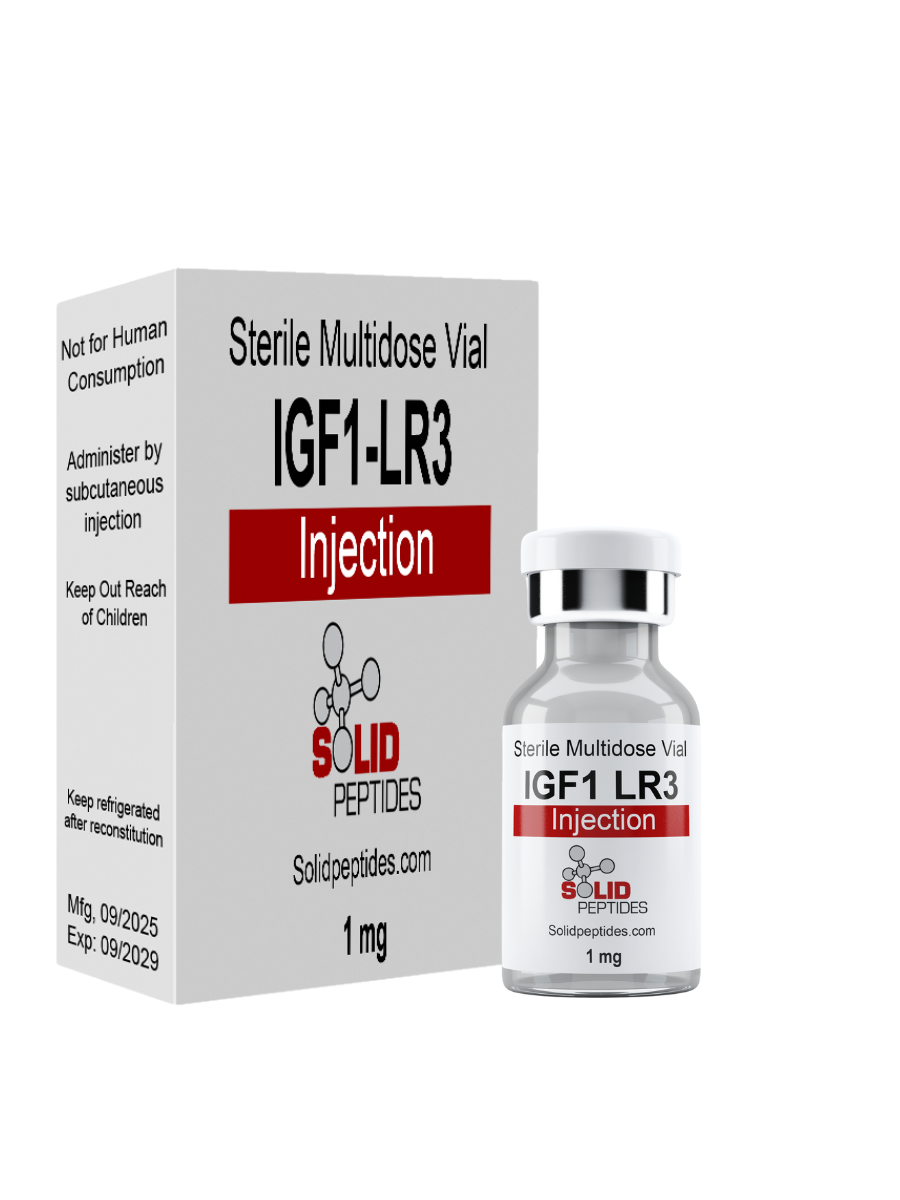
IGF-1 LR3 (1mg)
- 83-amino acid analog with enhanced potency (~3x native IGF-1) and extended half-life (20-30 hours)
- Engineered for reduced IGFBP binding, allowing sustained IGF-1R activation without sequestration
- Validated in 22+ publications across cardiovascular, fetal growth, gastrointestinal, and cell culture research
- Mechanistic pathway studies
- In vitro receptor profiling
- HPLC verified identity and purity
Ships same-day if ordered before 2PM EST
Research Overview
IGF-1 LR3 has been the subject of research across multiple domains including cell culture bioprocessing, cardiovascular biology, fetal growth physiology, gastrointestinal development, neurodegenerative disease, metabolic signaling, stem cell biology, and anti-doping science. Key validated mechanisms and findings include:
- Enhanced IGF-1R Activation: Reduced IGFBP affinity allows sustained IGF-1R signaling; native IGF-1 is 70-80% bound in ternary complexes with IGFBP-3/ALS, while LR3 largely avoids sequestration
- PI3K/Akt/mTOR Signaling: Promotes protein synthesis, inhibits protein degradation (FOXO/MuRF1/atrogin-1), and provides anti-apoptotic effects (BAD/Caspase-9 inactivation)
- MAPK/ERK Proliferative Signaling: Stimulates cell proliferation in cardiomyocytes (3-5 fold BrdU uptake increase), skeletal myoblasts (11% increase in EdU-positive cells), and smooth muscle cells
- Organ-Specific Growth Promotion: One-week infusion in fetal sheep increased heart weight by 34%, adrenals by 31%, spleen by 100%, with no proportional body weight increase
- Gastrointestinal Trophic Effects: Stimulated gut weight increases up to 60%, gut length up to 32%, and kidney weights up to 85% in suckling rats; more potent than native IGF-1 for all growth parameters
- Cardiovascular Applications: Reduced atherosclerotic stenosis, doubled cap/core ratio in early plaques, increased vSMC content 2-fold in advanced plaques, and reduced intraplaque hemorrhage from 16% to 4% in ApoE-knockout mice
- Metabolic Feedback: Suppresses plasma GH concentrations by 23% (mean) with 60% reduction in GH secretory peak area; reduces circulating amino acids, insulin, and endogenous IGF-1 levels
All published research has been conducted in animal models (sheep, rats, mice, pigs, guinea pigs) or in vitro cell systems. No human clinical trials have been registered or conducted for IGF-1 LR3.
Primary Research Applications
Mechanism of Action
IGF-1 LR3 exerts its biological effects through the same receptor as native IGF-1 -- the type 1 insulin-like growth factor receptor (IGF-1R), a transmembrane receptor tyrosine kinase. The critical pharmacological distinction of LR3 is its near-elimination of IGFBP binding: native IGF-1 bioavailability is tightly controlled by six IGFBPs whose affinity for IGF-1 exceeds that of the IGF-1R itself, such that less than 5% of circulating native IGF-1 is in free form. LR3 IGF-1 largely bypasses this regulatory layer, resulting in sustained IGF-1R activation.
Molecular modifications enabling reduced IGFBP binding:
- N-Terminal Extension (13 residues: MFPAMPLSSLFVN): Dramatically reduces binding affinity to all six IGFBPs, liberating the peptide from sequestration mechanisms that regulate native IGF-1 bioavailability
- Arginine-3 Substitution: Replacement of negatively charged glutamic acid at position 3 with positively charged arginine further disrupts the IGFBP binding interface without impairing IGF-1R affinity
- Conserved Disulfide Architecture: Retains three intramolecular disulfide bonds (Cys6-Cys48, Cys18-Cys61, Cys47-Cys52) essential for tertiary structure and IGF-1R binding
Downstream signaling cascades:
- PI3K/Akt/mTOR Pathway: IGF-1R autophosphorylation recruits IRS-1, activating PI3K → PIP3 → PDK1/mTORC2 → Akt phosphorylation. Activated Akt phosphorylates: (a) mTORC1 (stimulates p70S6K/4E-BP1 → protein synthesis), (b) GSK3-β (inhibits protein degradation), (c) FOXO (suppresses E3 ubiquitin ligases atrogin-1/MuRF1), (d) BAD/Caspase-9 (anti-apoptotic signaling)
- MAPK/ERK Pathway: IGF-1R phosphorylates SHC → Grb2/SOS → Ras → Raf-MEK-ERK cascade, regulating cell proliferation, differentiation, and gene expression. Studies in fetal cardiomyocytes demonstrated that blockade of either ERK or PI3K completely abolished LR3 IGF-1-stimulated proliferation, establishing dual-pathway requirement
- Metabolic Feedback: Activates negative feedback on hypothalamic-pituitary axis, suppressing GH secretion (23% reduction in pigs) and reducing endogenous IGF-1, IGFBP-3, and insulin concentrations
“Mechanistic summaries on this page are provided for laboratory reference and should be interpreted within controlled experimental settings only.”
Preclinical Research Summary
IGF-1 LR3 has been validated in over 22 peer-reviewed publications spanning four decades of research:
- Cell Culture: LR3 IGF-1 supports CHO/HEK293 cell growth at 200-fold lower concentrations than insulin, with superior viability maintenance under production conditions (Morris & Schmid, 2000); HEK293 cells showed dose-dependent activation of both IGF-1R and insulin receptor (Voorhamme & Yandell, 2006)
- Cardiomyocyte Proliferation: In fetal sheep cardiomyocytes, LR3 stimulated BrdU uptake 3-5 fold; proliferative response was hyperplastic (cell division) requiring both ERK and PI3K pathways (Sundgren et al., 2003)
- Atherosclerotic Plaque Stabilization: In ApoE-knockout mice, 4-week subcutaneous LR3 infusion (0.25 μg/hour) reduced stenosis, doubled cap/core ratio in early plaques, increased vSMC content 2-fold in advanced plaques, and reduced intraplaque hemorrhage from 16% to 4% (von der Thusen et al., 2011)
- Fetal Organ Growth: One-week IV infusion in late-gestation fetal sheep increased heart weight by 34%, adrenal weight by 31%, and spleen weight by 100%; mechanism was not increased placental nutrient transfer; skeletal muscle myoblast proliferation elevated but myofiber hypertrophy absent (Stremming et al., 2021)
- Gastrointestinal Trophic Effects: 6.5-day infusion in suckling rats increased kidney weights up to 85%, spleen up to 76%, gut weight up to 60%, gut length up to 32%; LR3 more potent than native IGF-1 for all parameters; proximal gut demonstrated greatest responsiveness with increased crypt cell proliferative activity (Steeb et al., 1997)
- Alzheimer's Disease Model: Intranasal LR3 reduced filamentous plaques and increased inert plaques in 5XFAD mouse cortex (D54D2+ fluorescence p<0.01); however, treatment did not preserve cognitive function in Y-maze, box maze, or open field tests (Engel et al., 2025)
- Metabolic/Endocrine Effects: In pigs, 180 μg/kg/day LR3 suppressed plasma GH by 23%, reduced GH secretory peak area by 60%, and decreased endogenous IGF-1, IGFBP-3, and insulin concentrations (Dunaiski et al., 1997); in fetal sheep, acute 90-minute infusion reduced plasma insulin by 48% and glucose-stimulated insulin secretion by 66% (White et al., 2023)
- Safety Concerns: In tumor-bearing rats, LR3 alone increased tumor growth while reducing muscle protein synthesis; co-infusion with insulin partially mitigated effects (Tomas et al., 1994); in growth-restricted fetal sheep, LR3 failed to promote growth and significantly reduced amino acid concentrations (White et al., 2025)
No human clinical trials have been conducted. All data derive from short-term (days to weeks) animal or cell culture experiments.
Academic References
- Sundgren, N. C., Giraud, G. D., Schultz, J. M., Lasarev, M. R., Stork, P. J., & Thornburg, K. L. (2003). Extracellular signal-regulated kinase and phosphoinositol-3 kinase mediate IGF-1 induced proliferation of fetal sheep cardiomyocytes. American Journal of Physiology - Regulatory, Integrative and Comparative Physiology, 285(6), R1481-9. PMID: 12947030
- von der Thusen, J. H., Borensztajn, K. S., Moimas, S., van Heiningen, S., Teeling, P., van Berkel, T. J., & Biessen, E. A. (2011). IGF-1 has plaque-stabilizing effects in atherosclerosis by altering vascular smooth muscle cell phenotype. American Journal of Pathology, 178(2), 924-934. PMC3069834
- Stremming, J., Heard, S., White, A., Louey, S., Rozance, P. J., Jonker, S. S., & Brown, L. D. (2021). IGF-1 infusion to fetal sheep increases organ growth but not by stimulating nutrient transfer to the fetus. American Journal of Physiology - Endocrinology and Metabolism, 320(3), E527-E538. PMC7988781
- Engel, M. G., Narayan, S., Cui, M. H., Vargas, H. C., & Moreno-Gonzalez, I. (2025). Intranasal long R3 insulin-like growth factor-1 treatment promotes amyloid plaque remodeling in cerebral cortex but fails to preserve cognitive function in male 5XFAD mice. Journal of Alzheimer's Disease, 103(1), 113-126. PMID: 39610283
- Steeb, C. B., Shoubridge, C. A., Tivey, D. R., & Read, L. C. (1997). Systemic infusion of IGF-I or LR(3)IGF-I stimulates visceral organ growth and proliferation of gut tissues in suckling rats. American Journal of Physiology - Gastrointestinal and Liver Physiology, 272(3 Pt 1), G522-G533. PMID: 9124573
- Bailes, J., & Soloviev, M. (2021). Insulin-Like Growth Factor-1 (IGF-1) and Its Monitoring in Medical Diagnostic and in Sports. Biomolecules, 11(2), 217. PMC7913862
This product is intended exclusively for in vitro laboratory research by qualified professionals. Not for human consumption. Not approved by the FDA.