Research Use Only: This product is supplied for laboratory research and in-vitro studies. Not for human or veterinary administration.
Hover to zoom
Identity Verified: LC-MS
(0 Reviews)
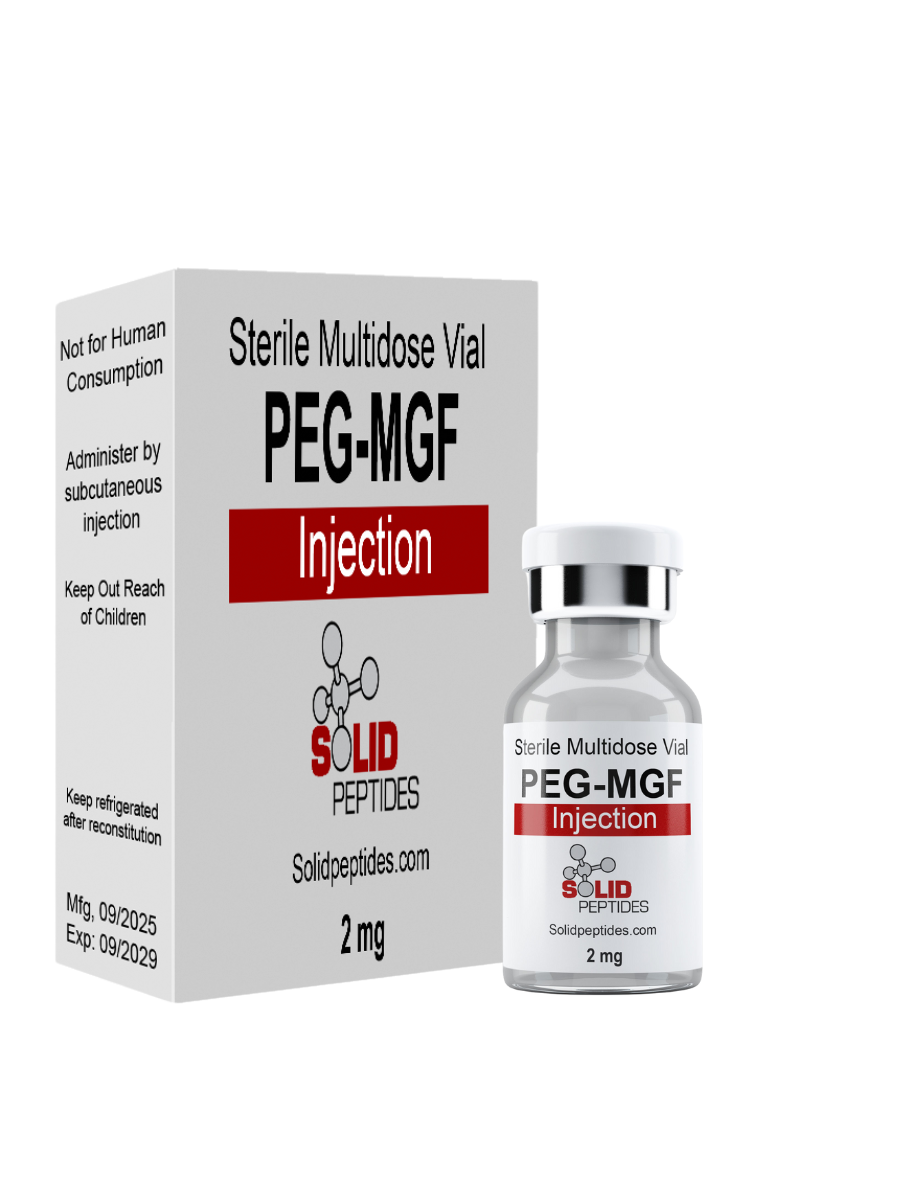
PEG-MGF (2mg)
PEG-MGF (PEGylated Mechano Growth Factor) is a synthetic, stabilized form of the 24-amino acid MGF E-domain peptide derived from the IGF-1Ec splice variant. Research shows it activates satellite cells, promotes myoblast proliferation via MAPK-ERK1/2 signaling, and demonstrates neuroprotective effects through PKCε/Nrf2/HO-1 pathways.
- Mechanistic pathway studies
- In vitro receptor profiling
- HPLC verified identity and purity
$39.00In Stock
Ships same-day if ordered before 2PM EST
1
Encrypted Checkout
Global Express
Research Overview
PEG-MGF (PEGylated Mechano Growth Factor) is a synthetic, stabilized form of the 24-amino acid C-terminal E-domain peptide derived from the IGF-1Ec splice variant. First identified in the mid-1990s following mechanical stress-induced IGF-1 mRNA expression in skeletal muscle, MGF arises from alternative splicing that produces a unique C-terminal sequence distinct from systemic IGF-1Ea. Research (>80 publications) demonstrates MGF signals through MAPK-ERK1/2 pathways independently of IGF-1R, activating muscle satellite cells and promoting myoblast proliferation while inhibiting terminal differentiation. Studies show neuroprotective effects via PKCε/Nrf2/HO-1 signaling in dopaminergic neurons, cardiac repair through 14-3-3 protein interactions, and immunomodulatory functions in muscle injury. PEGylation extends biological half-life from minutes to hours through protease resistance and reduced renal clearance. Critical 2010 review notes no stable endogenous 24-amino acid MGF peptide has been definitively isolated from biological tissues; research focuses on synthetic peptide constructs.
Mechanism of Action
PEG-MGF exerts biological effects through multiple mechanisms: (1) MAPK-ERK1/2 Activation (IGF-1R-Independent) - activates ERK1/2 phosphorylation and nuclear translocation without IGF-1R engagement, promoting cell proliferation while inhibiting terminal differentiation (distinct from mature IGF-1 which signals through IGF-1R/PI3K/Akt); (2) Satellite Cell Activation - activates quiescent muscle satellite (stem) cells, increases proliferative lifespan, delays senescence, enhances activation/proliferation/fusion potential; down-regulates myogenic transcription factors (MyoD, Myogenin, MEF2A) and cell-cycle inhibitor p21 to maintain proliferative state; (3) PKCε/Nrf2/HO-1 Neuroprotection - activates protein kinase C-epsilon (PKCε), induces Nrf2 nuclear translocation, upregulates heme oxygenase-1 (HO-1), protects dopaminergic neurons from oxidative stress-induced apoptosis (IGF-1R-independent); (4) 14-3-3 Protein Interactions - phosphorylation at Ser18 creates 14-3-3 binding motif, modulates cardiac contractile function through interactions with myosin binding protein C and phospholamban; (5) ERK5 Activation in Smooth Muscle - activates ERK5 phosphorylation and nuclear translocation, drives smooth muscle hypertrophy via MEF2C transcription factor; (6) Inflammatory Modulation - modulates TNF-α, IL-10, IL-1β expression, inhibits chondrocyte apoptosis via Bcl-2 upregulation and caspase-3 downregulation.
“Mechanistic summaries on this page are provided for laboratory reference and should be interpreted within controlled experimental settings only.”
Preclinical Research Summary
Mouse studies demonstrate MGF enhances myogenic precursor cell transplantation success in SCID mice, significantly promoting engraftment while delaying differentiation. Satellite cell studies show MGF increases proliferative lifespan and delays senescence in cells from neonatal and young adult human muscle, though effectiveness diminishes in aged cells. Porcine satellite cell studies confirm MGF promotes proliferation by down-regulating MyoD, Myogenin, MEF2A, cyclin B1, and p21. Gerbil transient brain ischemia model shows synthetic MGF provides significant hippocampal neuroprotection as potent as full-length IGF-1 with longer-lasting effects. SH-SY5Y neuroblastoma cells exposed to 6-hydroxydopamine show MGF activates PKCε/Nrf2/HO-1 neuroprotective cascade. Mouse myocardial infarction model demonstrates Ser18 phosphorylation-dependent 14-3-3γ binding modulates cardiac contractility. Osteoblast studies show MGF-Ct24E induces cell cycle arrest in S/G2M phases via ERK1/2 activation, upregulating proliferation ~1.4-fold vs IGF-1. Cardiotoxin-induced muscle injury shows MGF overexpression modulates inflammatory cytokines (TNF-α, IL-10, CD86) and delays macrophage resolution. Temporal expression: MGF rapidly upregulated within 24-48 hours post-muscle damage (Phase 1, satellite cell activation), while systemic IGF-1Ea increases days 5-10 (Phase 2, differentiation). PEGylation extends half-life from minutes to hours through protease resistance.
Academic References
1. Yang SY, Goldspink G. (2002). Different roles of the IGF-I Ec peptide (MGF) and mature IGF-I in myoblast proliferation and differentiation. FEBS Lett. 522(1-3):156-160. doi:10.1016/s0014-5793(02)02918-6 [MGF inhibits differentiation, increases proliferation via IGF-1R-independent mechanism]
2. Matheny RW Jr, et al. (2010). Minireview: Mechano-growth factor: a putative product of IGF-I gene expression involved in tissue repair and regeneration. Endocrinology. 151(3):865-875. doi:10.1210/en.2009-1217 [Critical review - no stable endogenous 24aa MGF peptide definitively isolated]
3. Dluzniewska J, et al. (2005). A strong neuroprotective effect of the autonomous C-terminal peptide of IGF-1 Ec (MGF) in brain ischemia. FASEB J. 19(13):1896-1898. doi:10.1096/fj.05-3786fje [Hippocampal neuroprotection in gerbil ischemia model]
4. Kandalla PK, et al. (2011). Mechano Growth Factor E Peptide (MGF-E), derived from an isoform of IGF-1, activates human muscle progenitor cells and induces an increase in their fusion potential at different ages. Mech Ageing Dev. 132(4):154-162. doi:10.1016/j.mad.2011.02.007 [Satellite cell activation and fusion potential]
5. Quesada A, et al. (2011). The IGF-I system protects dopaminergic neurons through the PKCε-Nrf2-HO-1 pathway. Neurotox Res. 20(1):83-92. doi:10.1007/s12640-010-9232-5 [PKCε/Nrf2/HO-1 neuroprotective signaling cascade]
6. Solis AG, et al. (2022). Mechano Growth Factor E Peptide (MGF-E), Derived From an Isoform of IGF-1, Activates Human Muscle Progenitor Cells. Front Physiol. 13:1028345. doi:10.3389/fphys.2022.1028345 [14-3-3 protein interactions and cardiac contractility]
7. Deng M, et al. (2010). MGF E peptide promotes an osteogenic phenotype and the differentiation of C3H10T1/2 cells via the ERK pathway. Mol Med Rep. 3(6):965-971. doi:10.3892/mmr.2010.371 [ERK1/2 activation in osteoblasts]
8. Mills P, et al. (2007). A synthetic mechano growth factor E Peptide enhances myogenic precursor cell transplantation success. Am J Transplant. 7(10):2247-2259. doi:10.1111/j.1600-6143.2007.01927.x [Enhanced myogenic cell engraftment in SCID mice]
9. Qin L, et al. (2012). Mechano growth factor (MGF) promotes proliferation and inhibits differentiation of porcine satellite cells (PSCs) by down-regulation of key myogenic transcriptional factors. Mol Cell Biochem. 370(1-2):221-230. doi:10.1007/s11010-012-1413-9 [MyoD, Myogenin, MEF2A down-regulation]
10. Zablocka B, et al. (2012). The role of mechano-growth factor (MGF) in skin wound healing. Acta Biochim Pol. 59(4):631-635. [Biphasic temporal expression: MGF Phase 1, IGF-1Ea Phase 2]
This product is intended exclusively for in vitro laboratory research by qualified professionals. Not for human consumption. Not approved by the FDA.