Research Use Only: This product is supplied for laboratory research and in-vitro studies. Not for human or veterinary administration.
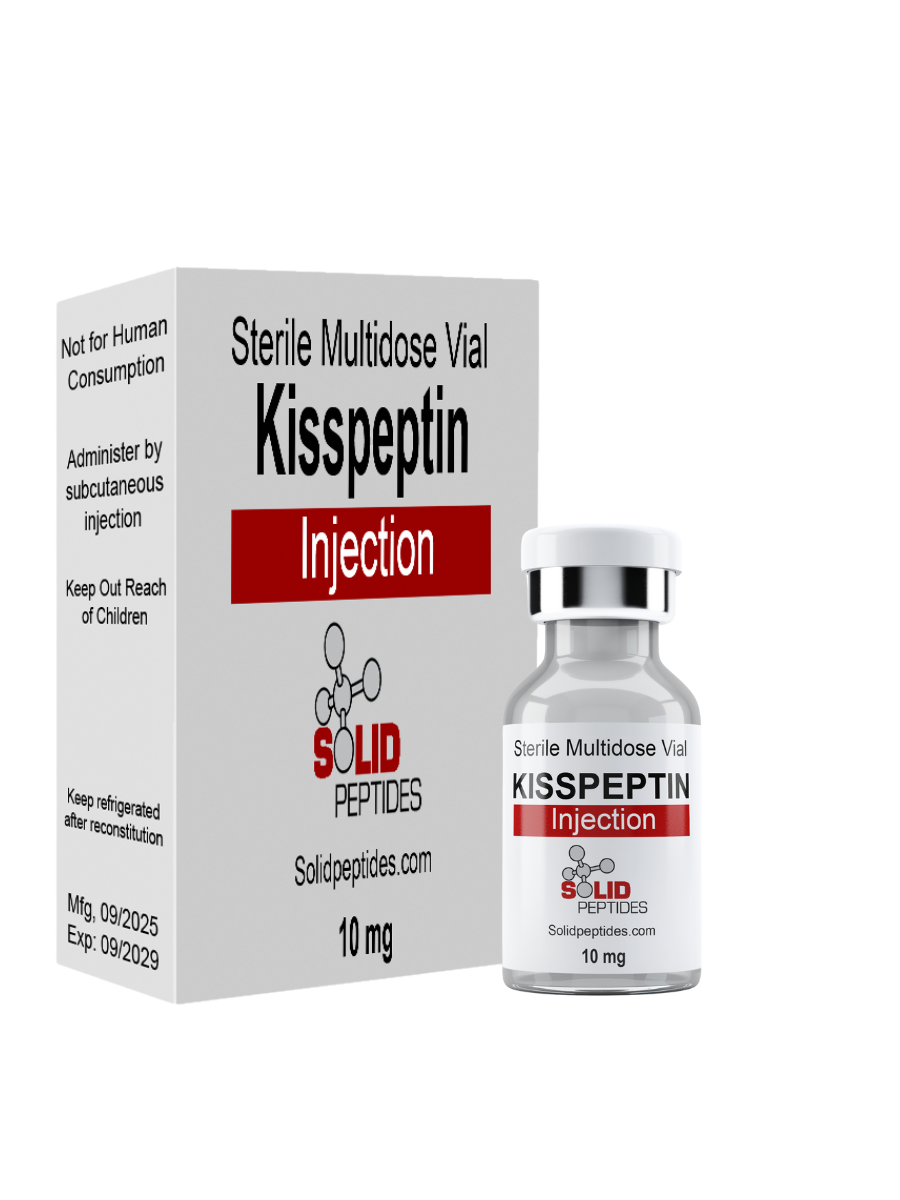
KISSPEPTIN (10mg)
- Master Reproductive Regulator: C-terminal decapeptide (YNWNSFGLRF-NH2), ≥95% purity
- KISS1R/GPR54 Agonist: 8-fold higher receptor affinity than kisspeptin-54 (Ki = 0.042 nM)
- GnRH Pulse Generator: Most potent GnRH neuron stimulator, 4-minute human plasma half-life
- Mechanistic pathway studies
- In vitro receptor profiling
- HPLC verified identity and purity
Ships same-day if ordered before 2PM EST
Research Overview
Kisspeptin-10 (KP-10, Metastin 45-54) is a biologically active decapeptide derived from the C-terminal region of the KISS1 gene product, representing the minimal structural fragment required for full agonist activity at the KISS1R (GPR54) receptor. Since the landmark 2003 discovery that loss-of-function mutations in GPR54 cause idiopathic hypogonadotropic hypogonadism in humans, kisspeptin has been recognized as a master regulator of mammalian reproduction and "an indisputable gatekeeper of normal reproductive function." More than 5,000 peer-reviewed publications in PubMed reference the kisspeptin system, spanning reproductive neuroendocrinology, fertility, puberty, metabolic regulation, and emerging applications in oncology, cerebrovascular research, immunology, and sexual medicine.
Kisspeptin-10 exhibits approximately 8-fold higher binding affinity for KISS1R compared to the full-length kisspeptin-54 peptide (Ki = 0.042 nM versus 0.34 nM), making it a preferred pharmacological tool for investigating KISS1R signaling pathways. Clinical studies have demonstrated that intravenous bolus kisspeptin-10 potently stimulates luteinizing hormone (LH) secretion in men and preovulatory women, with continuous infusion increasing LH pulse frequency, pulse amplitude, and serum testosterone. The peptide's short plasma half-life (approximately 4 minutes in humans) enables precise temporal control in experimental paradigms.
Recent advances include the first demonstration of intranasal kisspeptin delivery as a non-invasive route to robustly stimulate gonadotropins in humans (Mills et al., 2025), as well as clinical evidence for kisspeptin's therapeutic potential in hypoactive sexual desire disorder. The C-terminal amidation (-NH2) on the Phe10 residue is essential for biological activity at KISS1R, and the Trp3 and Phe6/Phe10 residues form the hydrophobic pharmacophore critical for receptor recognition. All endogenous kisspeptin fragments share this identical C-terminal decapeptide sequence, which constitutes the complete pharmacophore responsible for KISS1R activation.
Primary Research Applications
Mechanism of Action
KISS1R (GPR54) Receptor Activation
Gq/11 Signaling Cascade — Kisspeptin-10 exerts its primary biological effects through binding and activation of KISS1R (GPR54), a seven-transmembrane domain G-protein-coupled receptor highly expressed on GnRH neurons in the hypothalamus. Upon kisspeptin-10 binding, KISS1R couples primarily to Gq/11 proteins, initiating a canonical phospholipase C-β (PLCβ) signaling cascade that hydrolyzes PIP2 into IP3 and DAG, triggering intracellular Ca2+ release and PKC activation. Recent cryo-electron microscopy studies revealed that KISS1R possesses dual G protein coupling capacity, engaging both Gq/11 and Gi/o proteins.
GnRH Neuron Excitation
"Most Potent GnRH Stimulator" — Kisspeptin-10 has been characterized as "the most potent and efficacious neuropeptide/neurotransmitter to excite native GnRH neurons," affecting 75-90% of GnRH cells in adult organisms. The excitatory mechanism involves TRPC channel activation (producing inward sodium-dependent cationic currents) and simultaneous suppression of multiple potassium channels (A-type voltage-gated K+, Kir 6.2, GIRK channels). This produces membrane depolarization and sustained increase in action potential firing frequency (5-10 fold increase), lasting minutes to hours without desensitization.
KNDy Neuronal Network
GnRH Pulse Generator — Kisspeptin neurons in the arcuate nucleus co-express neurokinin B (NKB) and dynorphin (Dyn), forming the KNDy neuronal network that functions as the GnRH pulse generator. This oscillatory network operates through NKB-mediated autocrine/paracrine stimulation initiating each pulse, dynorphin-mediated termination, and kisspeptin output as the final downstream signal to GnRH neurons driving pulsatile GnRH secretion. GnRH pulse frequency determines differential LH versus FSH secretion: high-frequency pulses favor LH synthesis, while low-frequency pulses favor FSH synthesis.
Preovulatory LH Surge Generation
Absolutely Required for Ovulation — Kisspeptin-GPR54 signaling is absolutely required for generating the preovulatory GnRH/LH surge that triggers ovulation. Studies using Gpr54-null and Kiss1-null mouse models demonstrated complete absence of GnRH neuron activation and LH surges in mutant animals, while wild-type littermates exhibited normal surge responses. Two anatomically distinct kisspeptin neuron populations mediate differential reproductive functions: AVPV/RP3V neurons mediate estrogen positive feedback and generate the ovulatory LH surge, while ARC neurons mediate estrogen negative feedback maintaining basal pulsatile secretion.
“Mechanistic summaries on this page are provided for laboratory reference and should be interpreted within controlled experimental settings only.”
Preclinical Research Summary
George et al. (2011) demonstrated that intravenous bolus kisspeptin-10 (0.01-3.0 μg/kg) produced dose-dependent LH stimulation in healthy men, with peak effect at 1 μg/kg (LH rising from 4.1 to 12.4 IU/L at 30 minutes). Continuous infusion at 4 μg/kg/h for 22.5 hours increased mean LH from 5.5 to 20.9 IU/L and testosterone from 16.6 to 24.0 nmol/L without tachyphylaxis. Lower-dose infusion (1.5 μg/kg/h) increased LH pulse frequency from 0.7 to 1.0 pulses/hour and secretory burst mass from 3.9 to 12.8 IU/L. Jayasena et al. (2011) demonstrated sexual dimorphism and menstrual cycle-dependent responsiveness, with preovulatory-phase women responding to 10 nmol/kg IV bolus with significant LH and FSH elevation.
Clarkson et al. (2008) established that kisspeptin-GPR54 signaling is absolutely required for preovulatory GnRH neuron activation, with Gpr54-null and Kiss1-null mice showing complete absence of GnRH neuron c-FOS expression and no LH surges versus ~50% c-FOS positive GnRH neurons in wild-type mice. George et al. (2013) demonstrated that kisspeptin-10 produced 2-to-5-fold increases in LH secretion and associated testosterone rises in men with type 2 diabetes and mild hypogonadism, showing the kisspeptin-GnRH-gonadotropin axis remains responsive in metabolic disease states.
Mills et al. (2025) provided first demonstration of non-invasive intranasal kisspeptin-54 delivery (12.8 nmol/kg) robustly stimulating gonadotropins in healthy men (mean LH increase 4.4 ± 0.6 IU/L), healthy women (1.4 ± 0.3 IU/L), and patients with hypothalamic amenorrhea (4.4 ± 0.2 IU/L), with no adverse events across all populations. Mills et al. (2023) and Thurston et al. (2022) demonstrated that kisspeptin-54 infusion (1 nmol/kg/h for 75 minutes) significantly modulated sexual-processing brain regions and increased penile tumescence by up to 56% in men with hypoactive sexual desire disorder, and enhanced sexual and attraction brain processing in women with HSDD.
Safety evaluation: A 14-day repeat-dose intravenous toxicology study in dogs evaluated kisspeptin-10 at 30, 100, and 1000 μg/kg/day with NOAEL established at 1000 μg/kg (the highest dose tested). In rats, NOAEL was 3000 μg/kg or greater. The in vivo plasma half-life is approximately 4 minutes in humans and less than 1 minute in rats. In controlled human studies, IV and subcutaneous kisspeptin-10 administration has been well-tolerated at doses ranging from 0.01 to 10 nmol/kg with no serious adverse events. Note: Kisspeptin-10 has been characterized as a potent vasoconstrictor and has been shown to promote atherosclerotic plaque progression in ApoE-deficient mice, effects reversed by GPR54 antagonism.
Academic References
- George JT et al. (2011). Kisspeptin-10 Is a Potent Stimulator of LH and Increases Pulse Frequency in Men. Journal of Clinical Endocrinology and Metabolism.
- Jayasena CN et al. (2011). The Effects of Kisspeptin-10 on Reproductive Hormone Release Show Sexual Dimorphism in Humans. Journal of Clinical Endocrinology and Metabolism.
- Clarkson J et al. (2008). Kisspeptin-GPR54 Signaling Is Essential for Preovulatory Gonadotropin-Releasing Hormone Neuron Activation and the Luteinizing Hormone Surge. Journal of Neuroscience.
- Mills EG et al. (2025). Intranasal Kisspeptin Administration Rapidly Stimulates Gonadotropin Release in Humans. EBioMedicine.
- Mills EG et al. (2023). Effects of Kisspeptin on Sexual Brain Processing and Penile Tumescence in Men With Hypoactive Sexual Desire Disorder. JAMA Network Open.
- Thurston L et al. (2022). Effects of Kisspeptin Administration in Women With Hypoactive Sexual Desire Disorder. JAMA Network Open.
- Skorupskaite K et al. (2014). The Kisspeptin-GnRH Pathway in Human Reproductive Health and Disease. Human Reproduction Update.
- Ronnekleiv OK and Kelly MJ (2013). Kisspeptin Excitation of GnRH Neurons. Advances in Experimental Medicine and Biology.
- Lu D et al. (2025). Hypothalamic Kisspeptin Alleviates Myasthenia Gravis by Regulating Th1/Th17/Treg Balance Through Inhibition of NF-κB Signaling Pathway. Journal of Neuroinflammation.
- Sharma B et al. (2022). Use of Kisspeptin to Trigger Oocyte Maturation During In Vitro Fertilisation (IVF) Treatment. Frontiers in Endocrinology.
This product is intended exclusively for in vitro laboratory research by qualified professionals. Not for human consumption. Not approved by the FDA.