Research Use Only: This product is supplied for laboratory research and in-vitro studies. Not for human or veterinary administration.
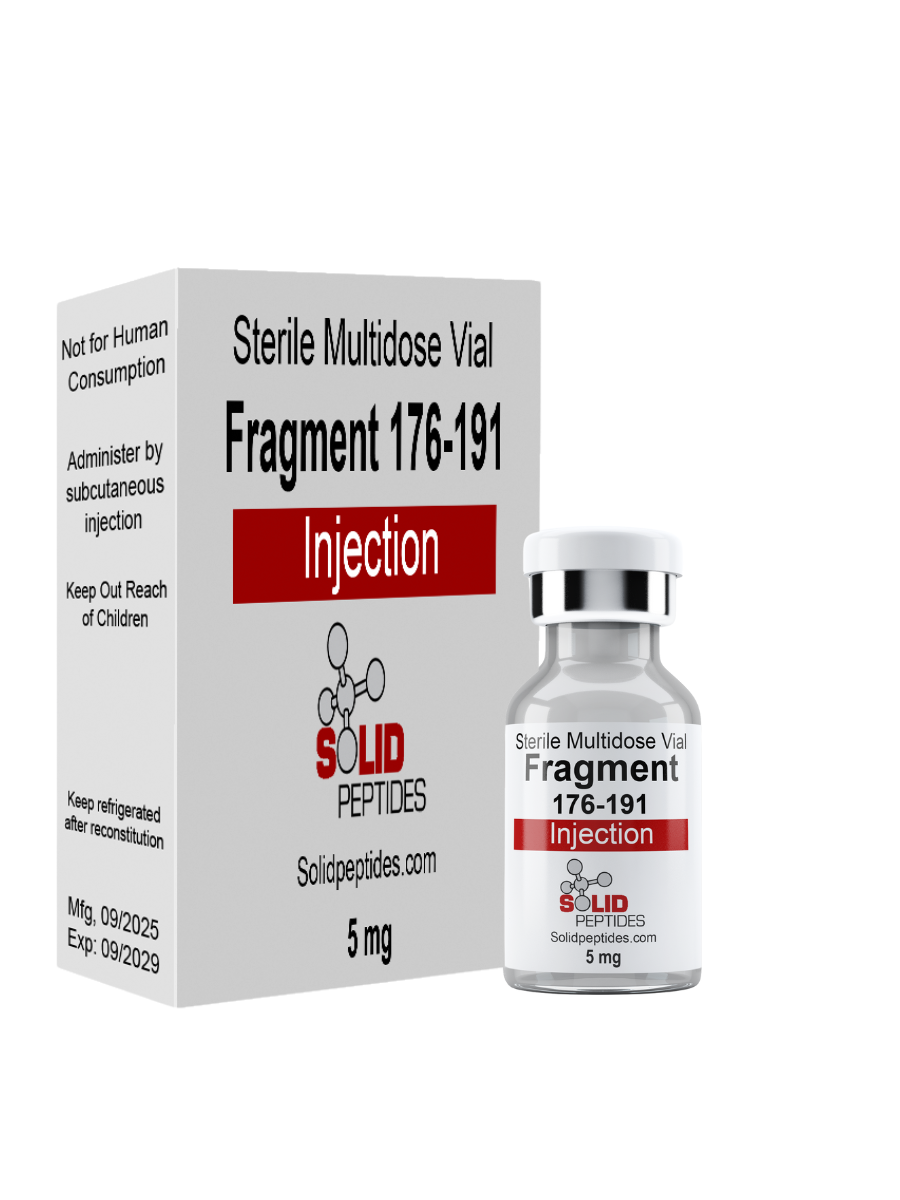
Fragment 176-191 (5mg)
- HGH C-Terminal Fragment: 16-amino acid sequence (FLRIVQCRSVEGSCGF), ≥98% purity
- β3-AR Pathway Modulation: DAG-PKC-HSL lipolytic cascade activation research
- Selective Lipolysis Studies: GHR-independent fat metabolism without IGF-1 effects
- Mechanistic pathway studies
- In vitro receptor profiling
- HPLC verified identity and purity
Ships same-day if ordered before 2PM EST
Research Overview
Fragment 176-191 (HGH Fragment 176-191, Somatotropin 176-191) is a synthetic 16-amino acid peptide derived from the C-terminal region (positions 176-191) of human growth hormone (hGH). First characterized by Ng and Bornstein in 1978 at Monash University, this peptide has been the subject of more than 30 peer-reviewed publications spanning adipocyte biology, lipid metabolism, anti-doping science, oncology, and musculoskeletal research.
The peptide operates primarily through upregulation of beta-3 adrenergic receptor (β3-AR) expression in adipose tissue and downstream activation of hormone-sensitive lipase (HSL) via diacylglycerol-mediated protein kinase C signaling. A defining characteristic of Fragment 176-191 is its complete inability to bind the growth hormone receptor, meaning it does not stimulate IGF-1 production, promote linear growth, or adversely affect carbohydrate metabolism. This selectivity has made it a valuable research tool for dissecting lipolytic mechanisms independently from the pleiotropic effects of full-length growth hormone.
Its stabilized analog AOD-9604 was evaluated in six randomized, double-blind, placebo-controlled human clinical trials involving over 900 participants. While early results showed promising weight loss effects, the largest Phase IIb trial did not demonstrate statistically significant dose-dependent weight loss, and clinical development was terminated in 2007. Fragment 176-191 continues to be investigated as a research tool for understanding fat metabolism, receptor biology, cartilage regeneration, and growth hormone structure-function relationships.
Primary Research Applications
Mechanism of Action
Beta-3 Adrenergic Receptor Upregulation
β3-AR Expression — Fragment 176-191 increases beta-3 adrenergic receptor mRNA expression in adipose tissue, restoring receptor levels in obese animals to those observed in lean controls. This was confirmed by Heffernan et al. (2001) using β3-AR knockout mice, which failed to respond to either hGH or the peptide fragment, demonstrating the receptor's essential role in mediating the lipolytic response.
DAG-PKC-HSL Lipolytic Cascade
Hormone-Sensitive Lipase Activation — The peptide triggers biphasic release of diacylglycerol (DAG) in adipocytes, which activates protein kinase C (PKC). PKC subsequently phosphorylates hormone-sensitive lipase (HSL), promoting the breakdown of stored triglycerides into free fatty acids and glycerol. This pathway operates independently of the classical cAMP-PKA signaling cascade used by catecholamines.
Anti-Lipogenic Activity
Acetyl-CoA Carboxylase Inhibition — In parallel with lipolytic activation, Fragment 176-191 inhibits acetyl-CoA carboxylase, the rate-limiting enzyme in de novo lipogenesis, and suppresses lipoprotein lipase activity. This dual action of enhancing fat breakdown while inhibiting new fat formation produces a net catabolic effect on adipose tissue stores.
Growth Hormone Receptor Independence
GHR Non-Binding — Fragment 176-191 does not bind the growth hormone receptor, as the GHR binding sites are located in the N-terminal and middle regions of hGH (approximately amino acids 1-134). Consequently, the peptide does not stimulate IGF-1 production, does not promote protein synthesis or linear growth, and does not induce hyperglycemia or insulin resistance associated with full-length hGH administration.
“Mechanistic summaries on this page are provided for laboratory reference and should be interpreted within controlled experimental settings only.”
Preclinical Research Summary
In preclinical models, Fragment 176-191 and its analog AOD-9604 have demonstrated significant effects on lipid metabolism. Ng et al. (2000) showed that oral administration of AOD-9604 at 500 micrograms/kg/day for 19 days reduced body weight gain by over 50% in obese Zucker rats, with adipose tissue demonstrating increased lipolytic activity. Heffernan et al. (2001) confirmed in a landmark study that chronic AOD-9604 treatment reduced body weight gain and increased fat oxidation in obese mice over 14 days, with beta-3 adrenergic receptor mRNA expression restored to levels comparable with lean controls. Critically, beta-3 AR knockout mice failed to respond to either hGH or AOD-9604, confirming the receptor's essential role in the lipolytic mechanism.
Beyond metabolic research, Kwon and Park (2015) demonstrated that intra-articular AOD-9604 injections enhanced cartilage regeneration in a collagenase-induced rabbit osteoarthritis model, with combination AOD-9604 plus hyaluronic acid injections proving more effective than either treatment alone. In oncology, Habibullah et al. (2022) found that dual-loaded chitosan nanoparticles containing hGH Fragment 176-191 and doxorubicin demonstrated greater anti-proliferative activity against MCF-7 breast cancer cells (IC50: 1.5 µg/mL) compared to doxorubicin-loaded chitosan alone (IC50: 1.7 µg/mL).
Comprehensive safety evaluation of AOD-9604 across six randomized clinical trials involving over 900 human participants showed a safety and tolerability profile indistinguishable from placebo, with no effect on serum IGF-1 levels, glucose metabolism, or insulin sensitivity. Non-clinical studies revealed no evidence of genotoxicological or toxicological concerns at doses up to 100 mg/kg/day in rats. However, it is important to note that Fragment 176-191 itself (without the tyrosine modification) has not been studied in human clinical trials; safety data are extrapolated from the structurally related AOD-9604 analog.
Academic References
- Heffernan M et al. (2001). The effects of human GH and its lipolytic fragment (AOD9604) on lipid metabolism following chronic treatment in obese mice and beta(3)-AR knock-out mice. Endocrinology.
- Heffernan MA et al. (2001). Increase of fat oxidation and weight loss in obese mice caused by chronic treatment with human growth hormone or a modified C-terminal fragment. International Journal of Obesity.
- Ng FM et al. (2000). Metabolic studies of a synthetic lipolytic domain (AOD9604) of human growth hormone. Hormone Research.
- Ng FM, Bornstein J (1978). Hyperglycemic action of synthetic C-terminal fragments of human growth hormone. American Journal of Physiology.
- Habibullah MM et al. (2022). Human Growth Hormone Fragment 176-191 Peptide Enhances the Toxicity of Doxorubicin-Loaded Chitosan Nanoparticles Against MCF-7 Breast Cancer Cells. Drug Design, Development and Therapy.
- Kwon DR, Park GY (2015). Effect of intra-articular injection of AOD9604 with or without hyaluronic acid in rabbit osteoarthritis model. Annals of Clinical and Laboratory Science.
- Cox HD et al. (2015). Detection and in vitro metabolism of AOD9604. Drug Testing and Analysis.
- Misra M (2013). Obesity Pharmacotherapy: Current Perspectives and Future Directions. Current Cardiology Reviews.
This product is intended exclusively for in vitro laboratory research by qualified professionals. Not for human consumption. Not approved by the FDA.