Research Use Only: This product is supplied for laboratory research and in-vitro studies. Not for human or veterinary administration.
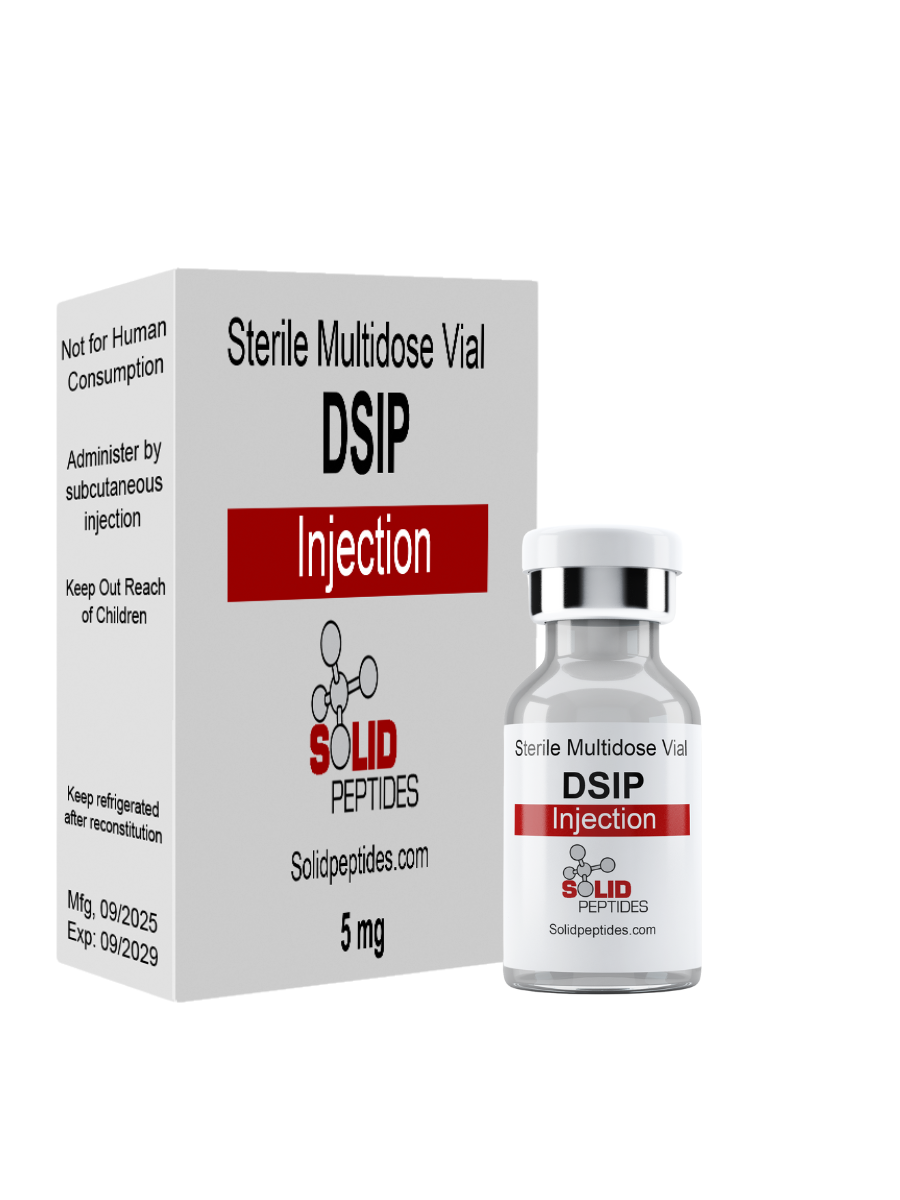
DSIP (5mg)
- Nonapeptide Neuromodulator: 9-amino acid sequence (WAGGDASGE), ≥98% purity
- Sleep Architecture: Delta-wave EEG activity induction without REM suppression or sedation
- Multisystem Research: 200+ publications (1977-2026), validated in double-blind human trials
- Mechanistic pathway studies
- In vitro receptor profiling
- HPLC verified identity and purity
Ships same-day if ordered before 2PM EST
Research Overview
Delta Sleep-Inducing Peptide (DSIP) is a naturally occurring nonapeptide first isolated in 1977 from the cerebral venous blood of rabbits following electrical stimulation of the intralaminar thalamic area. Characterized by the Swiss Schoenenberger-Monnier group after a multi-decade investigation spanning 1963-1977, DSIP was named for its ability to induce delta-wave electroencephalogram (EEG) activity characteristic of deep, restorative slow-wave sleep. Over nearly five decades, the peptide has been the subject of over 200 peer-reviewed publications spanning sleep biology, neuroendocrine regulation, neuroprotection, anticonvulsant pharmacology, stress physiology, aging research, and substance withdrawal treatment.
DSIP occupies a unique and debated position in neuroscience. While the original hypothesis that it functions as a direct sleep factor has been questioned due to the inability to identify a dedicated DSIP gene, receptor, or definitive sleep-promoting mechanism, the peptide demonstrates reproducible biological activities across multiple physiological systems. These include modulation of the hypothalamic-pituitary-adrenal (HPA) axis, interactions with GABAergic and glutamatergic neurotransmitter pathways, enhancement of mitochondrial respiration under hypoxic stress, modulation of endogenous opioid peptide systems, anticonvulsant activity through neurotransmitter ratio optimization, and potential geroprotective effects via reduced chromosomal aberration rates. The peptide has been detected endogenously in cerebrospinal fluid, plasma, urine, and milk across mammalian species and humans.
Clinical investigations in the 1980s-1990s demonstrated reproducible effects in human subjects. A double-blind study in six healthy volunteers showed that intravenous DSIP (25 nmol/kg) produced an immediate sleep pressure sensation and a 59% increase in sleep within 130 minutes, with delayed effects including shorter sleep onset and improved sleep efficiency, critically without classic pharmacologic sedation. In a more extensive double-blind study of 14 chronic insomniacs receiving DSIP injections over 7 consecutive nights, night sleep quality showed substantial improvement with sleep efficiency reaching normal control levels, and daytime alertness and performance increased significantly. While no DSIP receptor has been identified, a structurally related endogenous peptide called KND (WKGGNASGE) has been discovered within human lysine-specific histone demethylase, suggesting a potential endogenous prototype for DSIP's biological activities.
Primary Research Applications
Mechanism of Action
Sleep-Wake Regulation and Delta-Wave Induction
EEG Spectral Modulation — DSIP administration increases slow-wave and delta-wave activity by 35% in the neocortex and limbic cortex compared to controls. Electrophysiological studies demonstrate enhanced spindle and delta EEG activity without classic pharmacologic sedation. Human studies showed immediate sleep pressure sensation and 59% increase in sleep within 130 minutes, with improved sleep efficiency and shorter sleep onset. DSIP exhibits a U-shaped dose-response curve for both dose and infusion timing. Unlike sedative-hypnotics, DSIP enhances slow-wave sleep without suppressing REM sleep in most species (though cats preferentially show REM augmentation).
Circadian Rhythm and Neuroendocrine Modulation
Temporal Rhythm Integration — DSIP exhibits a distinct diurnal rhythm in human plasma, with peak levels at approximately 3:00 PM and nadirs at 1:00 AM, closely paralleling body temperature fluctuations (r-squared = 0.66; p < 0.0001). DSIP levels decrease during both REM and slow-wave sleep, suggesting participation in circadian regulation rather than simple somnogenic activity. The peptide colocalizes with GnRH in axon terminals, stimulates luteinizing hormone and growth hormone release, and acts as a potential corticotropin-release inhibiting factor under stress conditions.
Alpha-1-Adrenergic Receptor Modulation and Pineal Function
Melatonin Pathway Enhancement — DSIP and its phosphorylated analogue significantly enhance norepinephrine-induced N-acetyltransferase (NAT) activity in rat pineal tissue at 20-300 nM concentrations. NAT is the rate-limiting enzyme in melatonin synthesis. This enhancement was abolished by prazosin (alpha-1-adrenergic antagonist) but not by propranolol (beta-blocker), establishing that DSIP modulates alpha-1-adrenergic receptor responsiveness. This mechanism provides a molecular link between DSIP and circadian rhythm regulation through the pineal melatonin pathway.
Mitochondrial Protection and Antioxidant Mechanisms
Oxidative Phosphorylation Enhancement — DSIP significantly increases the rate of phosphorylated mitochondrial respiration (V3) and improves respiratory control ratios and ADP phosphorylation rates in rat brain mitochondria. Pretreatment with DSIP (120 µg/kg) completely inhibited hypoxia-induced reduction of mitochondrial respiratory activity. DSIP partially restricts hypoxia-induced changes in monoamine oxidase type A (MAO-A) activity and preserves serotonin levels in rat brain, indicating pronounced stress-protective and antioxidant action at the mitochondrial level.
“Mechanistic summaries on this page are provided for laboratory reference and should be interpreted within controlled experimental settings only.”
Preclinical Research Summary
In human clinical investigations, DSIP demonstrated reproducible sleep-promoting effects. A double-blind crossover study by Schneider-Helmert et al. (1981) in six healthy volunteers receiving 25 nmol/kg intravenous DSIP showed an acute 59% increase in sleep within 130 minutes with immediate sleep pressure sensation. Delayed effects included shorter sleep onset and improved sleep efficiency without pharmacologic sedation. A more extensive double-blind study by Schneider-Helmert (1987) in 14 chronic insomniacs receiving DSIP injections over 7 consecutive nights demonstrated substantial improvements in night sleep quality with both initial and repeated doses. Sleep efficiency reached normal control levels, and daytime alertness and performance increased significantly. A third double-blind matched-pairs study by Bes et al. (1992) in 16 chronic insomnia patients showed higher sleep efficiency and shorter sleep latency with DSIP versus placebo, though subjective sleep quality was not significantly improved.
In neuroprotection research, Khvatova et al. (2003) demonstrated that DSIP pretreatment (120 µg/kg i.p.) completely prevented hypoxia-induced loss of mitochondrial respiratory activity in rat brain, with enhanced oxidative phosphorylation efficiency, increased V3 respiration rate, and improved respiratory control ratios. In stroke recovery models, Tukhovskaya et al. (2021) showed that intranasal DSIP (120 µg/kg) accelerated motor coordination recovery by day 7 in middle cerebral artery occlusion (MCAO) stroke rats. While brain infarct volume reduction was not statistically significant, motor function recovery was clearly enhanced.
In anticonvulsant research, Stanojlovic et al. (2005) demonstrated that both DSIP and its analogue DSIP-12 significantly increased delta and theta frequency bands while decreasing the incidence, mean seizure grade, and duration of metaphit-provoked convulsions in rats (p<0.05 to p<0.01), with DSIP-12 showing superior efficacy. In aging research, Popovich et al. (2003) reported that monthly Deltaran treatment from age 3 months until natural death decreased chromosome aberrations by 22.6% and total spontaneous tumor incidence by 2.6-fold (primarily mammary carcinomas and leukemias) in female SHR mice. Maximum lifespan increased by 24.1% without significant change in mean lifespan, representing the first report of geroprotective and anticarcinogenic effects of a DSIP-containing preparation. In substance withdrawal applications, Dick et al. (1984) treated 107 patients (47 alcohol, 60 opiate) with DSIP, showing that 97% of opiate and 87% of alcohol patients experienced symptom improvement.
Academic References
- Schneider-Helmert D et al. (1981). Acute and delayed effects of DSIP (delta sleep-inducing peptide) on human sleep behavior. International Journal of Clinical Pharmacology, Therapeutics and Toxicology.
- Schneider-Helmert D (1987). Effects of delta-sleep-inducing peptide on 24-hour sleep-wake behaviour in severe chronic insomnia. European Neurology.
- Bes F et al. (1992). Effects of delta sleep-inducing peptide on sleep of chronic insomniac patients: A double-blind study. Neuropsychobiology.
- Khvatova EM et al. (2003). Delta sleep inducing peptide: effect on respiration activity in rat brain mitochondria and stress protective potency under experimental hypoxia. Peptides.
- Tukhovskaya EA et al. (2021). Delta Sleep-Inducing Peptide Recovers Motor Function in SD Rats after Focal Stroke. Molecules.
- Stanojlovic OP et al. (2005). Antiepileptic activity of delta sleep-inducing peptide and its analogue in metaphit-provoked seizures in rats. Seizure.
- Popovich IG et al. (2003). Effect of delta-sleep inducing peptide-containing preparation Deltaran on biomarkers of aging, life span and spontaneous tumor incidence in female SHR mice. Mechanisms of Ageing and Development.
- Dick P et al. (1984). DSIP in the treatment of withdrawal syndromes from alcohol and opiates. European Neurology.
- Kovalzon VM, Strekalova TV (2006). Delta sleep-inducing peptide (DSIP): a still unresolved riddle. Journal of Neurochemistry.
- Mu X et al. (2024). Pichia pastoris secreted peptides crossing the blood-brain barrier and DSIP fusion peptide efficacy in PCPA-induced insomnia mouse models. Frontiers in Pharmacology.
This product is intended exclusively for in vitro laboratory research by qualified professionals. Not for human consumption. Not approved by the FDA.