Research Use Only: This product is supplied for laboratory research and in-vitro studies. Not for human or veterinary administration.
Hover to zoom
Identity Verified: LC-MS
(0 Reviews)
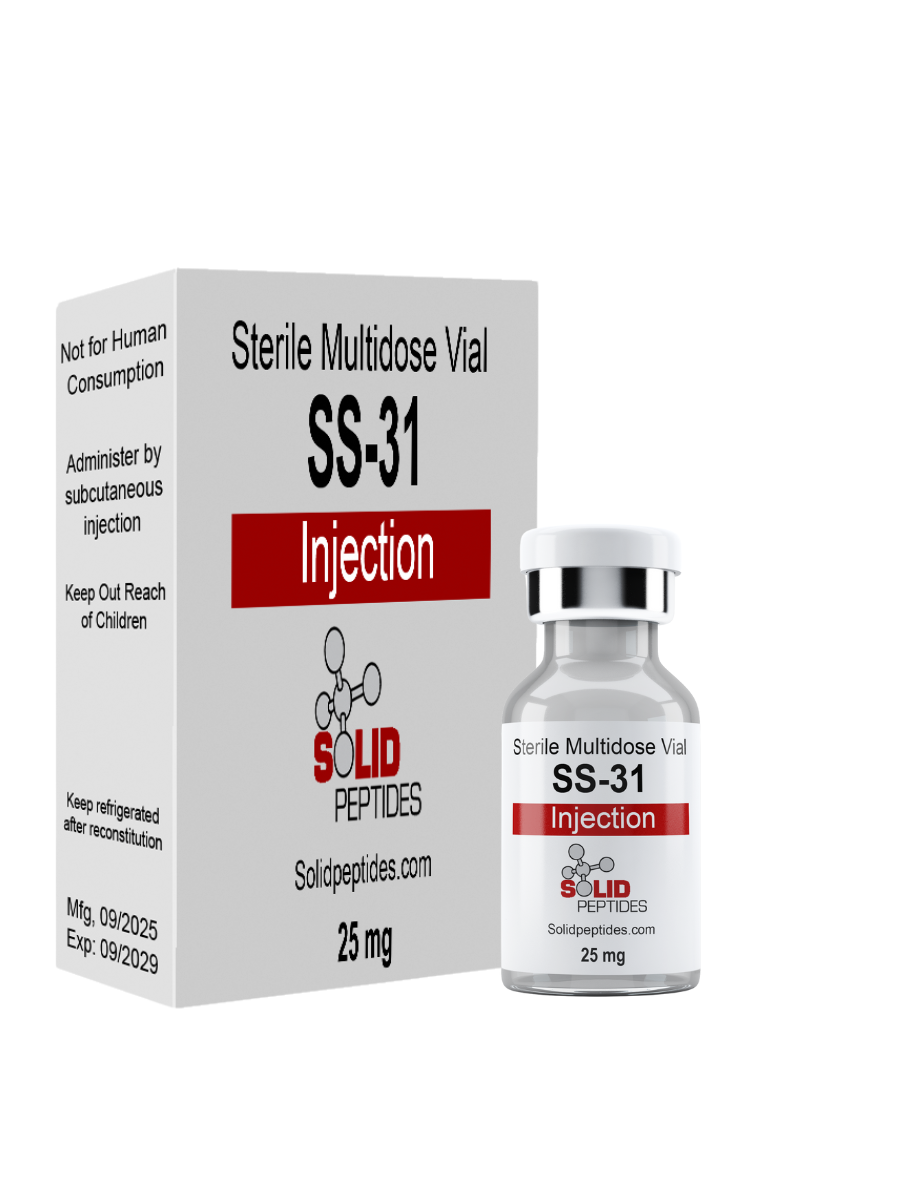
SS-31 (25mg)
- Synthetic mitochondria-targeted tetrapeptide (D-Arg-Dmt-Lys-Phe-NH₂) that selectively concentrates 5,000-fold at inner mitochondrial membrane through high-affinity cardiolipin binding
- FDA-approved September 2025 as Forzinity for Barth syndrome — first FDA-approved mitochondria-targeted therapeutic
- Extensively validated in 200+ peer-reviewed publications spanning cardiac, renal, neurological, and musculoskeletal research; multiple Phase 2/3 clinical trials completed
- Mechanistic pathway studies
- In vitro receptor profiling
- HPLC verified identity and purity
$55.00In Stock
Ships same-day if ordered before 2PM EST
1
Encrypted Checkout
Global Express
Research Overview
SS-31 has been extensively validated across multiple clinical and preclinical research domains:
- Cardiolipin Binding and Mitochondrial Targeting: SS-31 concentrates approximately 5,000-fold within mitochondria compared to surrounding cytoplasm, driven by electrostatic interactions between two basic amino acid residues (D-Arg and Lys) and cardiolipin phosphate head groups, while aromatic residues (Dmt and Phe) insert into hydrophobic acyl chains. Mitchell et al. (2020, JBC) demonstrated peptide partitions into membrane interfacial region with affinity directly related to surface charge, modulating membrane electrostatics as key component of mechanism
- Electron Transport Chain Optimization: Chavez et al. (2020, PNAS) identified 12 specific mitochondrial proteins directly interacting with SS-31 using chemical cross-linking/mass spectrometry: Complex III subunits QCR2/QCR6, Complex IV subunit NDUA4, ATP synthase subunits ATPA/ATPB, creatine kinase KCRS, ADP/ATP translocase ADT, isocitrate dehydrogenase IDHP, 2-oxoglutarate dehydrogenase components ODO1/ODO2, aspartate aminotransferase AATM, and trifunctional enzyme ECHA. Pharaoh et al. (2023, GeroScience) demonstrated direct binding to adenine nucleotide translocator (ANT) and ATP synthase, improving ADP sensitivity and increasing ATP production in aged muscle mitochondria
- Cardiac Aging Reversal: Chiao et al. (2020, eLife) 8-week SS-31 treatment substantially reversed age-related diastolic dysfunction, improved myocardial performance, and normalized heart weight in 24-month-old mice; reduced mitochondrial superoxide and hydrogen peroxide production in cardiomyocytes. Whitson et al. (2021, GeroScience) demonstrated attenuation of age-associated post-translational modifications, particularly reversing widespread S-glutathionylation of titin, cardiac myosin-binding protein C, and myotilin
- Exercise Tolerance and Skeletal Muscle: Campbell et al. (2019, Free Radical Biology and Medicine) approximately 30% increase in treadmill endurance in aged mice after 8 weeks of treatment; reversed age-related decline in maximum mitochondrial ATP production and restored glutathione redox balance. Reduced glutathione levels normalized and cysteine S-glutathionylation patterns restored to resemble young animals
- Neuroprotection and Cognitive Function: Zhao et al. (2019, Journal of Neuroinflammation) prevented spatial memory deficits in Morris Water Maze and improved fear conditioning performance in LPS-treated mice; reduced pro-inflammatory cytokines (IL-6, TNF-alpha), increased BDNF signaling, enhanced dendritic spine density. Nhu et al. (2022) systematic review identified multiple neuroprotective mechanisms across Alzheimer's, Huntington's, and Parkinson's disease models: enhanced mitochondrial biogenesis (PGC-1alpha, TFAM), promoted fusion, increased mitophagy, reduced toxic protein accumulation
- Renal Protection: Zhu et al. (2022, Oxidative Medicine and Cellular Longevity) reviewed SS-31 efficacy across 8+ renal disease models including ischemia-reperfusion AKI, diabetic nephropathy, CKD, and renal artery stenosis; described 5 key protective mechanisms: antioxidative effects, ATP restoration, structural protection, apoptosis reduction, inflammation modulation. Saad et al. (2017) Phase 2a trial demonstrated improved renal blood flow and eGFR at 3 months (P=0.003)
- Anti-Inflammatory and Anti-Fibrotic: Nie et al. (2023, Antioxidants) suppressed NLRP3 inflammasome activation in macrophages through Nrf2 upregulation in bleomycin-induced pulmonary fibrosis models; therapeutic effect abolished in Nrf2-knockout mice, confirming Nrf2-dependent mechanism
- Clinical Trial Validation: TAZPOWER (Phase 2/3, Barth Syndrome, NCT03098797): 6MWT +96.1 m at 168 weeks (P=0.003), FDA approval basis; PROGRESS-HF (Phase 2, HFrEF, NCT02788747): primary endpoint (LVESV) not met, well tolerated; EMBRACE-STEMI (Phase 2a, Acute MI, NCT01572909): infarct size primary not met, reduced HF incidence; MMPOWER-3 (Phase 3, Primary Mitochondrial Myopathy, NCT03323749): primary endpoint (6MWT) not met, fatigue reduction noted
Pharmacokinetics: Elimination half-life approximately 4 hours; linear pharmacokinetics; 100% urinary excretion (parent + metabolites M1 and M2) within 48 hours; no hepatic CYP metabolism observed in vitro; lyophilized form stable for 24 months when stored at -20 to -80 degrees C protected from light.
Primary Research Applications
Cardiolipin-dependent electron transport chain function and supercomplex assembly (cardiolipin-protein interaction mapping, Barth syndrome tafazzin deficiency studies)
Mitochondrial membrane potential regulation and ATP production efficiency (adenine nucleotide translocator function, ADP sensitivity restoration in aged mitochondria)
Cardiac aging and diastolic dysfunction reversal (age-related myocardial performance, cardiac protein S-glutathionylation studies)
Renal disease and nephroprotection (ischemia-reperfusion AKI, diabetic nephropathy, chronic kidney disease progression, drug-induced nephrotoxicity mitigation)
Neuroscience and neurodegeneration (Alzheimer's amyloid-beta accumulation, neuroinflammation-induced memory impairment, Parkinson's and Huntington's disease mitochondrial dysfunction)
Aging and geroscience (skeletal muscle aging and sarcopenia, exercise intolerance reversal, age-related redox stress and glutathione homeostasis)
Pulmonary fibrosis and inflammatory disease (Nrf2-dependent NLRP3 inflammasome modulation, bleomycin-induced fibrosis models, macrophage inflammasome studies)
Cancer cachexia and metabolic research (tumor-induced skeletal muscle wasting, chemotherapy-induced mitochondrial toxicity, succinate dehydrogenase activity restoration)
Mechanism of Action
SS-31 exerts its biological effects through selective binding to cardiolipin, a unique dimeric phospholipid found exclusively in the inner mitochondrial membrane (IMM).
1. Cardiolipin Binding and Mitochondrial Targeting:
Cardiolipin comprises 10-20 mol% of IMM lipids and is essential for electron transport chain (ETC) complex organization, cristae structure maintenance, cytochrome c anchoring, and ATP synthase function. SS-31 concentrates approximately 5,000-fold within mitochondria compared to the surrounding cytoplasm, driven by electrostatic interactions between the two basic amino acid residues (D-Arg and Lys) and the phosphate head groups of cardiolipin, while the aromatic residues (Dmt and Phe) insert into the hydrophobic acyl chains. Mitchell et al. (2020) demonstrated that this polybasic peptide partitions into the membrane interfacial region with affinity and lipid binding density directly related to surface charge, modulating membrane electrostatics as a key component of its mechanism.
2. Electron Transport Chain Optimization and ATP Production:
Binding of SS-31 to cardiolipin optimizes ETC function through several interconnected mechanisms. The peptide promotes efficient electron transfer between ETC complexes, stabilizes ETC supercomplex formation, and reduces electron leakage. Chavez et al. (2020) identified 12 specific mitochondrial proteins that directly interact with SS-31: Complex III subunits QCR2 and QCR6, Complex IV subunit NDUA4, ATP synthase subunits ATPA and ATPB, creatine kinase KCRS, ADP/ATP translocase ADT (involved in ATP production through oxidative phosphorylation), and proteins involved in 2-oxoglutarate metabolism including isocitrate dehydrogenase IDHP, 2-oxoglutarate dehydrogenase components ODO1 and ODO2, aspartate aminotransferase AATM, and trifunctional enzyme ECHA. Pharaoh et al. (2023) further demonstrated that SS-31 directly binds to the adenine nucleotide translocator (ANT) and ATP synthase, improving ADP sensitivity and increasing ATP production in aged muscle mitochondria.
3. Antioxidant and ROS Scavenging:
The dimethyltyrosine (Dmt) residue at position 2 provides intrinsic antioxidant activity by interacting with oxygen radicals to form relatively stable tyrosyl radicals. This mechanism enables scavenging of mitochondrial ROS, including superoxide and hydrogen peroxide, without disrupting normal redox signaling. SS-31 inhibits cytochrome c peroxidase activity and prevents cardiolipin peroxidation, thereby preserving mitochondrial membrane integrity. Campbell et al. (2019) demonstrated that 8 weeks of SS-31 treatment in aged mice reversed age-related redox stress, restoring reduced glutathione levels and normalizing cysteine S-glutathionylation patterns to resemble those of young animals.
4. Anti-Apoptotic and Cytoprotective Mechanisms:
SS-31 exerts cytoprotective effects by inhibiting the mitochondrial permeability transition pore (mPTP) opening, preventing cytochrome c release from the intermembrane space, and reducing calcium overload. These actions collectively suppress the intrinsic apoptotic cascade. In models of neuroinflammation, SS-31 reduced neural cell apoptosis while enhancing pro-survival pathways, including upregulation of brain-derived neurotrophic factor (BDNF) signaling. The peptide also modulates the Nrf2-dependent NLRP3 inflammasome pathway, as demonstrated by Nie et al. (2023) in pulmonary fibrosis models where SS-31 suppressed NLRP3 inflammasome activation in macrophages through Nrf2 upregulation.
Structural Features Supporting Activity:
- Alternating aromatic-cationic motif: Repeating pattern of aromatic (Dmt, Phe) and basic (D-Arg, Lys) residues creates amphipathic structure essential for selective mitochondrial membrane targeting
- D-Arginine at position 1: D-configuration confers resistance to aminopeptidase degradation, enhancing metabolic stability while providing cationic charge for cardiolipin electrostatic interaction
- 2',6'-Dimethyltyrosine (Dmt) at position 2: Non-natural amino acid provides intrinsic antioxidant activity through tyrosyl radical formation and scavenging of mitochondrial ROS
- C-terminal amidation (-NH₂): Provides additional resistance to carboxypeptidase degradation and contributes to overall peptide stability
“Mechanistic summaries on this page are provided for laboratory reference and should be interpreted within controlled experimental settings only.”
Preclinical Research Summary
SS-31 has been extensively validated through FDA accelerated approval and hundreds of peer-reviewed publications:
- FDA Approval: September 2025 accelerated approval as Forzinity for Barth syndrome, making it the first FDA-approved mitochondria-targeted therapeutic. Based on TAZPOWER Phase 2/3 trial (NCT03098797): 6-minute walk test improvement of +96.1 meters at 168 weeks (P=0.003). Thompson et al. (2024) 168-week open-label extension demonstrated sustained tolerability with no emergent safety signals
- Cardiac Aging and Function: Chiao et al. (2020, eLife) 8-week SS-31 treatment substantially reversed age-related diastolic dysfunction, improved myocardial performance, and normalized heart weight in 24-month-old mice; reduced mitochondrial superoxide and hydrogen peroxide production in cardiomyocytes. Whitson et al. (2021, GeroScience) demonstrated attenuation of age-associated post-translational modifications of cardiac proteins, particularly reversing widespread S-glutathionylation of titin, cardiac myosin-binding protein C, and myotilin; restored cardiac proteome thiol redox status to more youthful state
- Skeletal Muscle and Exercise Tolerance: Campbell et al. (2019, Free Radical Biology and Medicine) approximately 30% increase in treadmill endurance in aged mice after 8 weeks of treatment; reversed age-related decline in maximum mitochondrial ATP production and restored glutathione redox balance. Pharaoh et al. (2023, GeroScience) direct binding to adenine nucleotide translocator (ANT) and ATP synthase, improving ADP sensitivity and increasing ATP production in aged muscle mitochondria
- Neuroprotection and Cognitive Function: Zhao et al. (2019, Journal of Neuroinflammation) prevented spatial memory deficits in Morris Water Maze and improved fear conditioning performance in LPS-treated mice; reduced pro-inflammatory cytokines (IL-6, TNF-alpha), increased BDNF signaling, enhanced dendritic spine density. Nhu et al. (2022, Frontiers in Integrative Neuroscience) systematic review of 14 studies covering Alzheimer's, Huntington's, and Parkinson's disease models identified multiple neuroprotective mechanisms: enhanced mitochondrial biogenesis (PGC-1alpha, TFAM), promoted fusion, increased mitophagy, reduced toxic protein accumulation
- Renal Protection: Zhu et al. (2022, Oxidative Medicine and Cellular Longevity) reviewed SS-31 efficacy across 8+ renal disease models including ischemia-reperfusion AKI, diabetic nephropathy, CKD, and renal artery stenosis; 5 key protective mechanisms: antioxidative effects, ATP restoration, structural protection, apoptosis reduction, inflammation modulation. Saad et al. (2017, Circulation: Cardiovascular Interventions) Phase 2a trial in atherosclerotic renal artery stenosis patients demonstrated improved renal blood flow and eGFR at 3 months (P=0.003)
- Mitochondrial Protein Interactions: Chavez et al. (2020, PNAS) chemical cross-linking/mass spectrometry identified 12 specific mitochondrial proteins directly interacting with SS-31: Complex III subunits QCR2/QCR6, Complex IV subunit NDUA4, ATP synthase subunits ATPA/ATPB, creatine kinase KCRS, ADP/ATP translocase ADT, isocitrate dehydrogenase IDHP, 2-oxoglutarate dehydrogenase ODO1/ODO2, aspartate aminotransferase AATM, trifunctional enzyme ECHA. All identified interactors are known cardiolipin-binding proteins
- Anti-Inflammatory and Anti-Fibrotic: Nie et al. (2023, Antioxidants) suppressed NLRP3 inflammasome activation in macrophages through Nrf2 upregulation in bleomycin-induced pulmonary fibrosis models; therapeutic effect abolished in Nrf2-knockout mice. Ballaro et al. (2021, Cancers) targeting mitochondria by SS-31 ameliorated whole body energy status in cancer- and chemotherapy-induced cachexia
- Clinical Trials: PROGRESS-HF (Phase 2, HFrEF, NCT02788747): primary endpoint (LVESV) not met, well tolerated; EMBRACE-STEMI (Phase 2a, Acute MI, NCT01572909): infarct size primary not met, reduced HF incidence; MMPOWER-3 (Phase 3, Primary Mitochondrial Myopathy, NCT03323749): primary endpoint (6MWT) not met, fatigue reduction noted; ReCLAIM (Phase 2, Age-Related Macular Degeneration, NCT02653391): primary not met, slowed ellipsoid zone degradation
- Safety Profile: Most common adverse event: injection site reactions (pain, swelling, redness) in ~1 in 6 patients. Other reported events: headache, dizziness, nausea, abdominal pain, fatigue (each <1%). No clinically significant differences in vital signs, laboratory values, physical examination, or ECG parameters compared to placebo. No hepatic CYP metabolism; does not inhibit major transporters except MATE1 (IC50 3.53 micromolar). Reproductive toxicology: subcutaneous doses up to 20 mg/kg/day in rats (approximately 5x clinical exposure) did not adversely affect fertility or reproductive performance
Pharmacokinetics: Elimination half-life approximately 4 hours; linear pharmacokinetics; 100% urinary excretion (parent + metabolites M1 and M2) within 48 hours; no hepatic metabolism; lyophilized form stable 24 months at -20 to -80 degrees C protected from light.
Academic References
- Chavez, J. D., Tang, X., Campbell, M. D., Reyes, G., Kramer, P. A., Stuppard, R., ... & Bruce, J. E. (2020). Mitochondrial protein interaction landscape of SS-31. Proceedings of the National Academy of Sciences, 117(26), 15363-15373. PMC7334473
- Mitchell, W., Ng, E. A., Tamucci, J. D., Boyd, K. J., Sathappa, M., Coscia, A., ... & Alder, N. N. (2020). The mitochondria-targeted peptide SS-31 binds lipid bilayers and modulates surface electrostatics as a key component of its mechanism of action. Journal of Biological Chemistry, 295(21), 7452-7469. PMID: 32273339
- Chiao, Y. A., Zhang, H., Sweetwyne, M., Whitson, J., Ting, Y. S., Basisty, N., ... & Rabinovitch, P. S. (2020). Late-life restoration of mitochondrial function reverses cardiac dysfunction in old mice. eLife, 9, e55513.
- Campbell, M. D., Duan, J., Samber, A. T., Steiner, R. D., Kerns, K. A., & Darvas, M. (2019). Improving mitochondrial function with SS-31 reverses age-related redox stress and improves exercise tolerance in aged mice. Free Radical Biology and Medicine, 134, 268-281. PMC6588449
- Zhao, W., Xu, Z., Cao, J., Fu, Q., Sui, Y., Li, Q., & Wang, D. (2019). Elamipretide (SS-31) improves mitochondrial dysfunction, synaptic and memory impairment induced by lipopolysaccharide in mice. Journal of Neuroinflammation, 16, 230. PMC6865061
- Pharaoh, G., Kamat, V., Kannan, S., Stuppard, R. S., Whitson, J., Martín-Pérez, M., ... & Campbell, M. D. (2023). The mitochondrially targeted peptide elamipretide (SS-31) improves ADP sensitivity in aged mitochondria by increasing uptake through the adenine nucleotide translocator (ANT). GeroScience, 45(6), 3529-3548. PMC10643647
This product is intended exclusively for in vitro laboratory research by qualified professionals. Not for human consumption. Not approved by the FDA.
Published Research Briefs
Our research team has published evidence-checked briefs covering the science behind this compound. Each brief reviews primary sources and grades claims independently.