Research Use Only: This product is supplied for laboratory research and in-vitro studies. Not for human or veterinary administration.
Hover to zoom
Identity Verified: LC-MS
(0 Reviews)
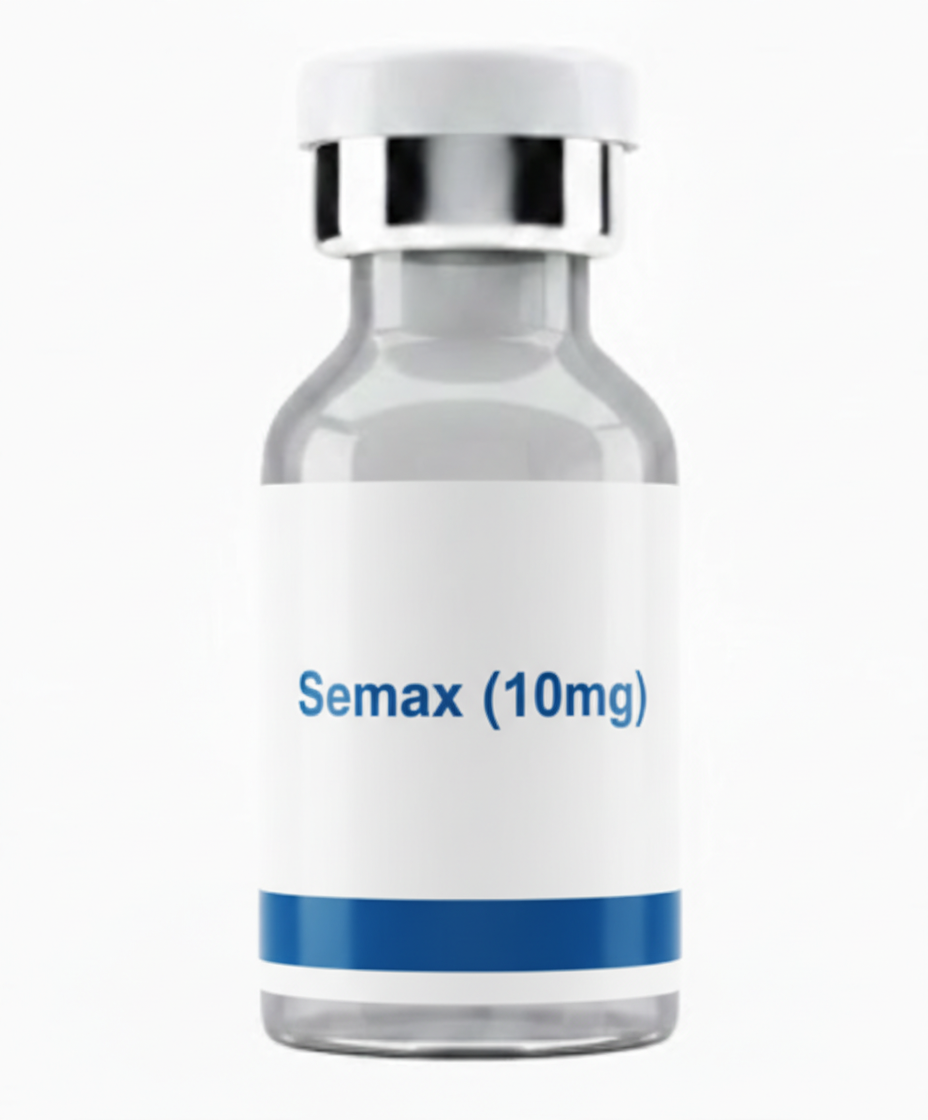
Semax (10 mg)
- ACTH(4-10) Heptapeptide Analogue: Met-Glu-His-Phe-Pro-Gly-Pro (MEHFPGP); ≥98% purity by HPLC; Pro-Gly-Pro C-terminal extension confers enhanced metabolic stability vs. native ACTH(4-10)
- Multi-Pathway Neurotrophin Research: BDNF upregulation (1.4× protein, 3× mRNA in hippocampus at 50 μg/kg), serotonergic modulation (180% extracellular 5-HIAA), copper chelation (K_D 1.3×10⁻¹⁵ M), anti-amyloid activity
- 800+ Peer-Reviewed Publications: Neuroprotection, cerebrovascular, neurotrophic factor, and transcriptomic ischemia research; registered pharmaceutical in Russia since 2011
- Mechanistic pathway studies
- In vitro receptor profiling
- HPLC verified identity and purity
$35.00In Stock
Ships same-day if ordered before 2PM EST
1
Encrypted Checkout
Global Express
Research Overview
Semax (MEHFPGP; ACTH(4-7)-Pro-Gly-Pro) (CAS 80714-61-0) is a synthetic heptapeptide analogue of adrenocorticotropic hormone (ACTH) fragment 4-10, developed at the Institute of Molecular Genetics of the Russian Academy of Sciences beginning in 1982. The peptide incorporates the ACTH(4-7) tetrapeptide pharmacophore (Met-Glu-His-Phe) responsible for melanocortin receptor interactions, extended with a Pro-Gly-Pro tripeptide that confers resistance to aminopeptidase and carboxypeptidase degradation, substantially extending biological half-life relative to the native ACTH fragment. Unlike full-length ACTH, Semax exhibits no hormonal corticotropic activity. Supplied as a lyophilized powder for in vitro research, intended strictly for qualified researchers. Certificate of Analysis (CoA) provided with every lot.
Primary investigational domains include neurotrophin signaling (BDNF/TrkB and NGF upregulation), monoaminergic neurotransmitter modulation (serotonergic and dopaminergic systems), copper(II) chelation and amyloid-beta aggregation inhibition, transcriptomic neuroprotection in cerebral ischemia models, and stress-related gene expression correction. Dolotov et al. (2006) characterized specific calcium-dependent neuronal membrane binding (K_D = 2.4 nM) and demonstrated a single 50 μg/kg intranasal dose produced 1.4-fold BDNF protein increase, 3-fold exon III BDNF mRNA increase, and 2-fold trkB mRNA increase in rat hippocampus. In glial cell cultures, Semax induced 8-fold BDNF mRNA and 5-fold NGF mRNA within 30 minutes. Sciacca et al. (2022) characterized the Met-Glu-His copper chelation site (conditional K_D 1.3×10⁻¹⁵ M at pH 7.4) and demonstrated inhibition of Cu²⁺-induced amyloid-beta fibrillation with 90% cytoprotection of SH-SY5Y neuronal cells from Aβ₁₋₄₂ oligomers.
Over 800 peer-reviewed publications reference Semax. Semax completed Phase I clinical trials (1990–1994) and Phase II trials (1994–1996) in Russia and has been registered on the Russian List of Vital and Essential Drugs since December 2011 as a pharmaceutical agent. It is not approved by the FDA or EMA for human use outside Russia and Eastern Europe. Research published in BMC Genomics, Genes (Basel), ACS Chemical Neuroscience, Journal of Neurochemistry, and International Journal of Molecular Sciences spans neuroprotection, cerebrovascular biology, neurodegenerative disease models, and stress-pathway research.
Primary Research Applications
Neurotrophic Factor Biology (BDNF/TrkB, NGF signaling, CREB pathway activation)
Cerebral Ischemia and Neuroprotection Research (ischemia-reperfusion transcriptomics, inflammatory gene suppression)
Neurodegenerative Disease Models (amyloid-beta aggregation, copper chelation, ROS reduction)
Monoaminergic Neurotransmitter Research (serotonergic 5-HIAA dynamics, dopaminergic modulation)
Stress Biology and Mood Disorder Research (hippocampal gene expression, chronic stress models)
Ophthalmic Neuroprotection Research (optic nerve, retinal neurotrophin expression)
Melanocortin Receptor Pharmacology (MC4R/MC5R antagonism, non-corticotropic melanocortin signaling)
Conditioned Response and Synaptic Plasticity Research (hippocampal LTP, pyramidal neuron calcium dynamics)
Enkephalinase Inhibition Research (IC50 = 10 μM; endogenous peptide regulation)
ACTH Fragment Structure-Activity Relationship Studies
Mechanism of Action
BDNF/TrkB and Neurotrophin Signaling
Neurotrophic Factor Upregulation — Tritium-labeled Semax binds specifically to neuronal tissue membranes with a dissociation constant (K_D) of 2.4 nM; calcium ions are required for binding activity (Dolotov et al., 2006). A single 50 μg/kg intranasal dose produces 1.4-fold BDNF protein increase, 3-fold exon III BDNF mRNA increase, and 2-fold trkB mRNA increase in rat hippocampus, accompanied by 1.6-fold TrkB tyrosine phosphorylation. In rat glial cell cultures, Semax induces 8-fold BDNF mRNA and 5-fold NGF mRNA within 30 minutes. The neurotrophin response is region-specific and time-dependent: expression initially decreases in hippocampus and retina at 20 minutes but increases in frontal cortex, with significant retinal BDNF elevation at 90 minutes.
Monoaminergic Neurotransmitter Modulation
Serotonergic and Dopaminergic System Activation — Semax rapidly activates monoaminergic systems in rodent models. Striatal 5-HIAA content increases ~25% within 2 hours; extracellular 5-HIAA rises to ~180% at 1–4 hours post-administration, indicating robust serotonergic activation (Eremin et al., 2005). Semax amplifies D-amphetamine-evoked dopamine release and locomotor activity when co-administered but does not alter basal dopamine or metabolite concentrations alone, indicating modulatory rather than direct dopaminergic action.
Melanocortin Receptor Interactions (MC4R/MC5R)
Competitive Antagonism at Melanocortin Receptors — Semax interacts with MC4R and MC5R, where it competitively antagonizes alpha-melanocyte-stimulating hormone (α-MSH). In HEK293 cells expressing human MC4R, Semax at 1 μM does not independently stimulate cAMP production but antagonizes α-MSH-induced cAMP accumulation. Despite acting at melanocortin receptors, Semax does not exhibit hormonal corticotropic activity characteristic of full-length ACTH.
Copper Chelation and Anti-Amyloid Activity
Cu²⁺ Sequestration and Aβ Fibrillation Inhibition — The Met-Glu-His N-terminal motif forms a high-affinity Cu²⁺ coordination site (conditional K_D = 1.3×10⁻¹⁵ M at pH 7.4). Semax prevents Aβ:Cu²⁺ complex formation, inhibits copper-induced amyloid-beta fibrillation concentration-dependently, extracts Cu(II) from Cu(II)-Aβ species by metal-ion stripping, and reduces ROS production through redox silencing of the Cu(II)/Cu(I) cycle. In membrane disruption assays, Semax reduced mature fibril interaction with phospholipid bilayers by up to 85%; SH-SY5Y neuronal cytoprotection against Aβ₁₋₄₂ oligomer toxicity reached ~90% (Sciacca et al., 2022; Tomasello et al., 2025).
Transcriptomic Neuroprotection in Ischemia
Inflammatory Gene Suppression and Neurotransmission Gene Activation — Filippenkov et al. (2020) identified 394 differentially expressed genes in Semax-treated ischemic rat brains at 24 hours post-ischemia-reperfusion. Semax suppressed inflammatory gene expression (Il1a, Il1b, Il6, Ccl3, Cxcl2) while activating neurotransmission-related genes, compensating for mRNA patterns disrupted during ischemia. Genome-wide RNA-Seq analysis (Medvedeva et al., 2014) showed immune response genes comprising over 50% of all affected transcripts at 24 hours, with immunoglobulin gene fold-changes exceeding 15-fold. At the protein level, Semax upregulated active CREB in subcortical structures while downregulating MMP-9, c-Fos, and active JNK in affected cortical tissue (Sudarkina et al., 2021).
Antistress Gene Expression Correction
Hippocampal Transcriptomic Restoration — In acute restraint stress models, Semax pretreatment produced over 1,500 differentially expressed genes in hippocampal tissue, correcting stress-induced transcriptomic disruptions (Filippenkov et al., 2021). In chronic unpredictable stress models, chronic Semax treatment reversed stress-induced anhedonia, body-weight gain suppression, adrenal hypertrophy, and hippocampal BDNF decreases (Inozemtseva et al., 2024).
“Mechanistic summaries on this page are provided for laboratory reference and should be interpreted within controlled experimental settings only.”
Preclinical Research Summary
Semax is supplied as a lyophilized powder for in vitro research and is studied in cell culture, rodent models, and limited clinical research. Over 800 peer-reviewed publications reference the compound. Intended strictly for qualified researchers.
Neurotrophin Signaling Research: Dolotov et al. (2006) demonstrated specific, calcium-dependent binding to basal forebrain membranes (K_D = 2.4 nM, B_MAX = 33.5 fmol/mg). A single 50 μg/kg intranasal dose produced 1.4-fold BDNF protein, 3-fold exon III BDNF mRNA, and 2-fold trkB mRNA in rat hippocampus; conditioned avoidance reaction scores increased in treated animals. Shadrina et al. (2001) showed 8-fold BDNF mRNA and 5-fold NGF mRNA in glial cultures within 30 minutes.
Monoaminergic Research: Eremin et al. (2005) documented ~25% striatal 5-HIAA increase at 2 hours and extracellular 5-HIAA at 180% of baseline at 1–4 hours. Semax amplified D-amphetamine-evoked dopamine release without altering basal dopamine concentrations.
Cerebral Ischemia Transcriptomics: Filippenkov et al. (2020) identified 394 differentially expressed genes at 24 hours post-ischemia-reperfusion: suppressed Il1a, Il1b, Il6, Ccl3, Cxcl2; activated neurotransmission genes. Dmitrieva et al. (2009) showed selective BDNF, TrkC, and TrkA transcription activation in damaged brain regions within 3 hours of occlusion. Medvedeva et al. (2014) genome-wide RNA-Seq: 96 genes affected at 3 hours, 68 at 24 hours; immune genes over 50% at 24 hours; immunoglobulin gene fold-changes exceeding 15-fold; CXCL13, CXCL9, CXCL10, CCL5 significantly upregulated. Sudarkina et al. (2021) proteomic analysis: upregulated active CREB subcortically; downregulated MMP-9, c-Fos, and active JNK cortically.
Amyloid-Beta and Copper Research: Sciacca et al. (2022) characterized Cu²⁺ K_D = 1.3×10⁻¹⁵ M; concentration-dependent Aβ fibrillation inhibition; 85% reduction in membrane disruption by dye leakage assay; 90% SH-SY5Y cytoprotection from Aβ₁₋₄₂ oligomers. Tomasello et al. (2025) confirmed Cu(II) extraction from Cu(II)-Aβ species and ROS reduction via redox silencing.
Stress Research: Filippenkov et al. (2021): over 1,500 differentially expressed hippocampal genes under acute stress; transcriptomic correction of stress-disrupted pathways. Inozemtseva et al. (2024): chronic Semax reversed stress-induced anhedonia, adrenal hypertrophy, and hippocampal BDNF decreases in chronic unpredictable stress model.
Pharmacokinetics: Shevchenko et al. (2006): 0.093% total radioactivity per gram detected in rat brain at 2 minutes post-intranasal administration; 80% represented intact Semax; Pro-Gly-Pro tripeptide was the predominant metabolite; renal excretion.
Safety: Semax has been characterized as low toxicity with no adverse effects on CNS or cardiovascular systems at investigated doses. No LD50 values published; no mutagenic or genotoxic effects reported. Common documented adverse events in clinical research: nasal mucosa discoloration (~10% of patients with intranasal administration) and increased blood glucose in individuals with diabetes. Semax is reported non-habit-forming with no tolerance development. Not for human or veterinary consumption, diagnosis, treatment, prevention, or cure of any condition.
Academic References
- Dolotov OV et al. (2006). Semax, an analogue of ACTH(4-10), binds specifically and increases BDNF protein in rat basal forebrain. J Neurochem. 97 Suppl 1:82–6.
- Dolotov OV et al. (2006). Semax, an analog of ACTH(4-10) with cognitive effects, regulates BDNF and trkB expression in the rat hippocampus. Brain Res. 1117(1):54–60.
- Eremin KO et al. (2005). Semax, an ACTH(4-10) analogue with nootropic properties, activates dopaminergic and serotoninergic brain systems in rodents. Neurochem Res. 30(12):1493–1500.
- Shadrina MI et al. (2001). Rapid induction of neurotrophin mRNAs in rat glial cell cultures by Semax. Neurosci Lett. 308(2):115–118.
- Filippenkov IB et al. (2020). Novel insights into the protective properties of ACTH(4-7)PGP (Semax) at the transcriptome level following cerebral ischaemia-reperfusion in rats. Genes (Basel). 11(6):681.
- Medvedeva EV et al. (2014). The peptide Semax affects the expression of genes related to the immune and vascular systems in rat brain focal ischemia: genome-wide transcriptional analysis. BMC Genomics. 15:228.
- Sudarkina OY et al. (2021). Brain protein expression profile confirms the protective effect of Semax in cerebral ischemia-reperfusion. Int J Mol Sci. 22(12):6179.
- Sciacca MFM et al. (2022). Semax, a synthetic regulatory peptide, affects copper-induced Aβ aggregation and amyloid formation in artificial membrane models. ACS Chem Neurosci. 13(4):486–496.
- Tomasello MF et al. (2025). Semax decreases Cu(II)-catalyzed ROS production and cytotoxicity of Aβ by metal ion stripping and redox silencing. Bioinorg Chem Appl. 2025:4226220.
- Inozemtseva LS et al. (2024). Antidepressant-like and antistress effects of Semax and Melanotan II in chronic unpredictable stress. Eur J Pharmacol. 984:177068.
This product is intended exclusively for in vitro laboratory research by qualified professionals. Not for human consumption. Not approved by the FDA.
Published Research Briefs
Our research team has published evidence-checked briefs covering the science behind this compound. Each brief reviews primary sources and grades claims independently.