Research Use Only: This product is supplied for laboratory research and in-vitro studies. Not for human or veterinary administration.
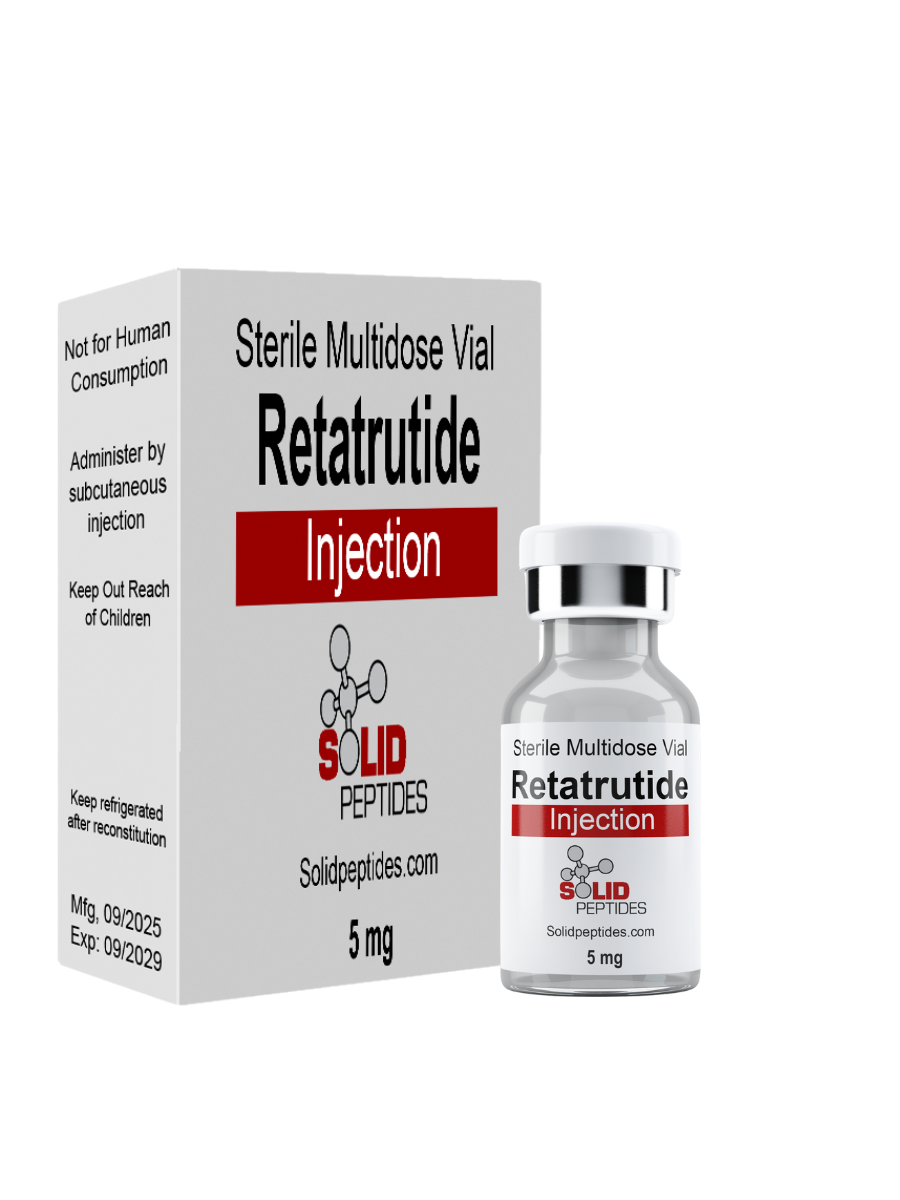
Hover to zoom
Identity Verified: LC-MS
(0 Reviews)
Retatrutide (5mg)
- Triple-Receptor Agonist: 39-amino acid synthetic peptide, 4,731.33 Da, ≥95% purity by HPLC
- GIPR / GLP-1R / GCGR Signaling: EC₅₀ 0.064 / 0.775 / 5.79 nM at human receptors (cAMP)
- Energy-Homeostasis Research: 5 mg lyophilized peptide for in vitro and animal-model investigation
- Mechanistic pathway studies
- In vitro receptor profiling
- HPLC verified identity and purity
$69.00In Stock
Ships same-day if ordered before 2PM EST
1
Encrypted Checkout
Global Express
Research Overview
Retatrutide (LY3437943) is a first-in-class 39-amino acid synthetic peptide that functions as a triple agonist of the glucose-dependent insulinotropic polypeptide receptor (GIPR), the glucagon-like peptide-1 receptor (GLP-1R), and the glucagon receptor (GCGR). Developed as an Eli Lilly investigational compound, retatrutide was designed on a GIP peptide backbone conjugated to a C20 fatty diacid moiety, with Aib substitutions at positions 2, 20, and 23 conferring resistance to dipeptidyl peptidase-4 (DPP-4) cleavage. Since its initial clinical characterization in 2022, retatrutide has been the subject of more than 100 peer-reviewed publications spanning structural biology, receptor pharmacology, and clinical investigation.
The compound is supplied as a lyophilized powder for in vitro research, with ≥95% HPLC purity and a Certificate of Analysis (CoA) provided with every lot. Research interest spans class B1 GPCR structural biology, energy-balance research, hepatic lipid-metabolism investigation, and beta-cell biology. The triple-agonism mechanism distinguishes retatrutide from single-receptor agonists (e.g., semaglutide) and dual GIPR/GLP-1R agonists (e.g., tirzepatide) by adding GCGR engagement.
Retatrutide is an investigational compound currently in Phase 3 clinical development under the TRIUMPH registrational program. It is intended strictly for qualified researchers and is not for human or veterinary consumption, diagnosis, or treatment.
Primary Research Applications
Triple Incretin Receptor Pharmacology
Class B1 GPCR Structural Biology
Body-Composition Research Models
MASLD and Hepatic Lipid-Metabolism Studies
Thermogenic Gene-Expression Research
Beta-Cell Function Investigation
Cryo-EM and Biased-Agonism Studies
Receptor Desensitization Research
Mechanism of Action
GLP-1 Receptor Activation
GLP-1R Binding (EC₅₀ 0.775 nM) — Retatrutide engages the GLP-1 receptor with high affinity, triggering Gs-protein-coupled cAMP/PKA signaling. In pancreatic beta-cell and hypothalamic cell models, this activates glucose-dependent insulin signaling and central feeding-pathway transcription. The Aib2 substitution prevents DPP-4 cleavage, extending receptor engagement.
GIP Receptor Activation
GIPR Binding (EC₅₀ 0.064 nM) — GIPR agonism represents the most potent component of retatrutide's receptor profile. Coskun et al. (2022) characterized receptor potency in cell-based cAMP assays. GIPR activation engages adenylyl cyclase coupling synergistically with GLP-1R signaling and is studied in nutrient-partitioning research.
Glucagon Receptor Activation
GCGR Coupling (EC₅₀ 5.79 nM) — Inclusion of GCGR agonism is the defining innovation that distinguishes retatrutide from dual agonists. GCGR activation engages thermogenic gene expression including brown adipose tissue UCP1, hepatic fatty acid oxidation pathway research, and mitochondrial biogenesis investigation.
Synergistic Triple Integration
Balanced Multi-Receptor Profile — Jakubowska et al. (2024) describe how the three receptor pathways produce effects that exceed the sum of individual receptor contributions. Both GLP-1R and GIPR activation are glucose-dependent, and the engineered receptor potency profile (GIPR ≫ GLP-1R ≫ GCGR) was characterized to balance metabolic activity with tolerability.
Structural Basis (Cryo-EM)
Single Continuous α-Helix — Li et al. (2024) determined cryo-EM structures of retatrutide bound to all three receptors at 2.68–3.26 Å resolution. The peptide adopts a single continuous α-helical conformation when receptor-bound; the N-terminal segment penetrates the receptor transmembrane core while the C-terminal segment interacts with the extracellular domain. Receptor-specific conformations in extracellular loop 1 (ECL1) enable selective engagement across all three targets.
“Mechanistic summaries on this page are provided for laboratory reference and should be interpreted within controlled experimental settings only.”
Preclinical Research Summary
In preclinical and clinical investigation, retatrutide has been characterized as a balanced triple agonist with receptor potencies of EC₅₀ 0.064 nM (GIPR), 0.775 nM (GLP-1R), and 5.79 nM (GCGR) in cell-based cAMP assays (Coskun et al., 2022). Phase 1b pharmacokinetic studies (Urva et al., 2022) demonstrated dose-proportional pharmacokinetics with an elimination half-life of approximately 6 days, attributed to fatty-acid-mediated albumin binding via the C20 diacid moiety at lysine-17. Cryo-EM structures of all three receptor complexes were published by Li et al. (2024). The compound is supplied as ≥95% purity material for in vitro research only.
Phase 2 and Phase 3 clinical investigation has characterized metabolic effects in energy-balance research populations (Jastreboff et al., 2023; Rosenstock et al., 2023). Phase 2a MASLD investigation has been published (Sanyal et al., 2024), and preclinical cancer immunobiology research in diet-induced murine models has been described (Marathe et al., 2025). Meta-analyses have summarized the safety database across multiple RCTs (Abouelmagd et al., 2025; Pasqualotto et al., 2024). All material supplied is intended strictly for in vitro laboratory investigation; the compound is an investigational developmental peptide and is not approved by the FDA for human use.
Academic References
- Jastreboff AM et al. (2023). Triple-Hormone-Receptor Agonist Retatrutide — A Phase 2 Trial. New England Journal of Medicine.
- Rosenstock J et al. (2023). Retatrutide for people with type 2 diabetes: a phase 2 trial. The Lancet.
- Sanyal AJ et al. (2024). Triple hormone receptor agonist retatrutide for MASLD: a phase 2a trial. Nature Medicine.
- Urva S et al. (2022). LY3437943 in people with type 2 diabetes: a phase 1b multiple-ascending-dose trial. The Lancet.
- Li W et al. (2024). Structural insights into the triple agonism at GLP-1R, GIPR and GCGR manifested by retatrutide. Cell Discovery.
- Abouelmagd AA et al. (2025). Efficacy and safety of retatrutide: a systematic review and meta-analysis. Proceedings (Baylor University Medical Center).
- Pasqualotto et al. (2024). Once-weekly retatrutide on weight and metabolic markers: meta-analysis. Metabolism Open.
- Katsi V et al. (2025). Retatrutide — A Review in Metabolic Pharmacotherapy. Biomolecules.
- Marathe SJ et al. (2025). Retatrutide (LY3437943) in incretin agonism and cancer biology investigation. NPJ Metabolic Health and Disease.
- Giblin K et al. (2026). TRIUMPH registrational clinical trial rationale and design. Diabetes Obes. Metab..
This product is intended exclusively for in vitro laboratory research by qualified professionals. Not for human consumption. Not approved by the FDA.
Published Research Briefs
Our research team has published evidence-checked briefs covering the science behind this compound. Each brief reviews primary sources and grades claims independently.