Research Use Only: This product is supplied for laboratory research and in-vitro studies. Not for human or veterinary administration.
Hover to zoom
Identity Verified: LC-MS
(0 Reviews)
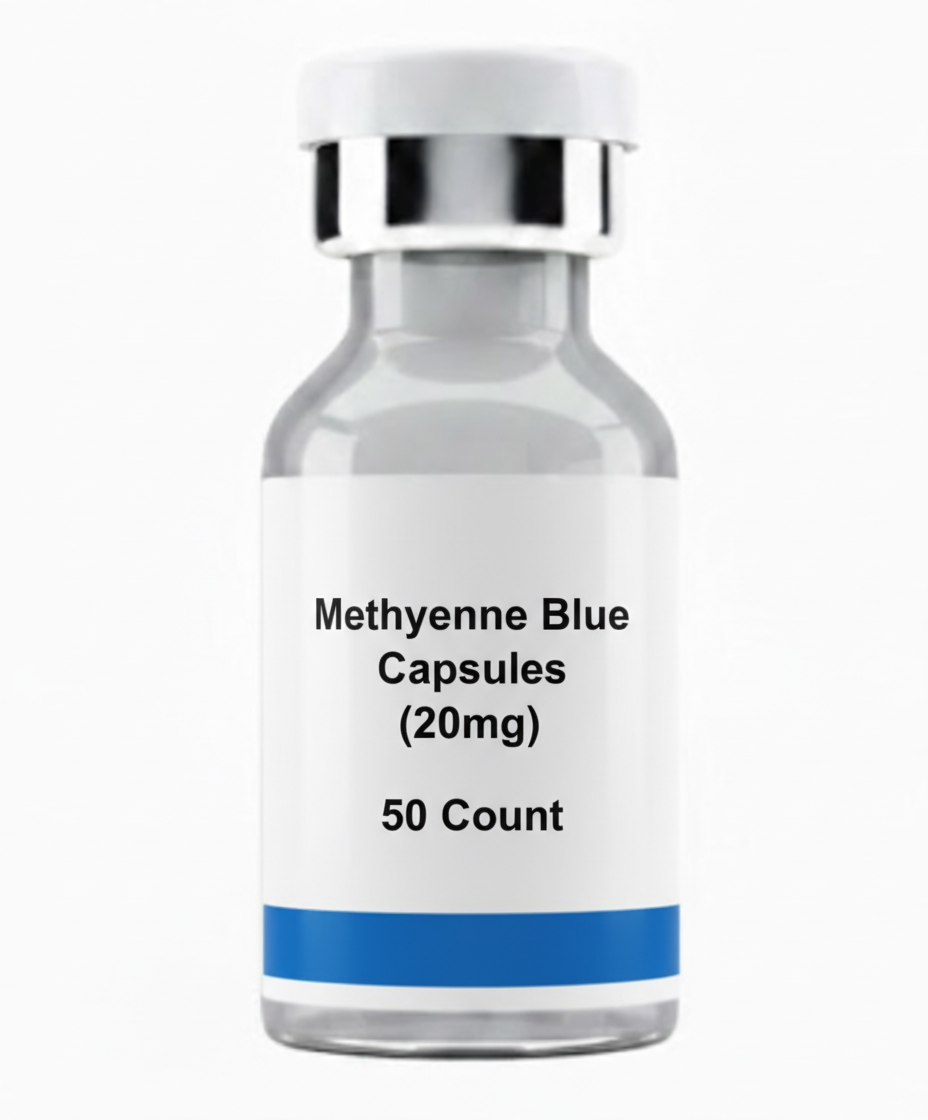
Methylene Blue (20mg) (50 caps)
- Phenothiazine Compound: Synthetic small-molecule (319.85 Da), ≥98% purity by HPLC
- Mitochondrial Electron Carrier: Complex IV stimulation and Nrf2/AKT signaling research
- Neuroprotection Models: Tau aggregation, NLRP3 inflammasome, and mitophagy investigation
- Mechanistic pathway studies
- In vitro receptor profiling
- HPLC verified identity and purity
$55.00In Stock
Ships same-day if ordered before 2PM EST
1
Encrypted Checkout
Global Express
Research Overview
Methylene Blue (methylthioninium chloride; MB) is a synthetic phenothiazine compound first prepared in 1876 by Heinrich Caro at BASF, making it among the oldest fully synthetic molecules in continuous scientific investigation. With more than 140 years of peer-reviewed literature spanning thousands of publications, MB occupies a unique position in pharmacology as both a classical biological stain and a contemporary research tool for mitochondrial bioenergetics.
The compound is supplied as a crystalline powder encapsulated for in vitro research, with ≥98% HPLC purity and a full Certificate of Analysis (CoA) provided with every lot. Modern research focuses on its function as an alternative electron carrier in the mitochondrial electron transport chain, where it routes electrons from NADH directly to cytochrome c, effectively bypassing Complexes I and III. Investigations also span Nrf2/AKT cytoprotective signaling, NLRP3 inflammasome inhibition, tau aggregation, and mitophagy induction.
Contemporary research domains include neurodegenerative disease models (Alzheimer's, Parkinson's, Huntington's), cerebral ischemia, traumatic brain injury models, senescence-pathway investigation, and antimicrobial photodynamic therapy. The compound is intended strictly for qualified researchers and is not for human or veterinary consumption, diagnosis, or treatment.
Primary Research Applications
Mitochondrial Bioenergetics Research
Neurodegenerative Disease Models
NLRP3 Inflammasome Pathway Studies
Tau Aggregation In Vitro Assays
Cerebral Ischemia Investigation
Senescence-Pathway Research
Antimicrobial Photodynamic Therapy
Mitophagy Signaling Studies
Mechanism of Action
Alternative Electron Transfer Pathway
NADH–Cytochrome c Shuttle — Methylene blue functions as an electron cycler with a low redox potential (~+11 mV at pH 7), accepting electrons from NADH and transferring them to cytochrome c. This pathway bypasses Complexes I and III of the mitochondrial electron transport chain. Atamna et al. (2008) reported that methylene blue can increase Complex IV activity by approximately 30% and enhance cellular oxygen consumption in cell-based assays, while attenuating reactive oxygen species generation.
Nrf2/AKT Cytoprotective Signaling
AKT-Mediated ARE Activation — Beyond direct electron transfer, methylene blue activates the Nrf2 (nuclear factor erythroid 2-related factor 2) pathway through AKT phosphorylation, driving antioxidant response element (ARE) gene expression. Bhurtel et al. (2021) demonstrated this mechanism is independent of its electron carrier function in dopaminergic cell-model investigations.
Multi-Inflammasome Inhibition
NLRP3 / NLRC4 / AIM2 Suppression — Methylene blue inhibits multiple inflammasome platforms. Lin et al. (2017) demonstrated suppression of NLRP3 activation in microglia, with downstream reductions of IL-1β and IL-18. The mechanism is associated with reduced intracellular ROS, linking the anti-inflammatory action to the compound's redox chemistry.
Tau Aggregation Inhibition
Methylthioninium Cation (MT+) — In vitro studies (Congdon et al., 2012) demonstrate that the oxidized MT+ form inhibits tau–tau binding interactions, hindering fibril formation in cell-free assays. The complex redox equilibrium between MT+ and the reduced leucomethylthioninium form determines aggregation-inhibition activity in tissue.
Mitophagy Induction
Mitochondrial Quality Control — Jiang et al. (2015) demonstrated that methylene blue activates selective mitochondrial autophagy in acute cerebral ischemia models, preserving mitochondrial membrane potential and attenuating caspase-3/-8/-9 activation in animal-model investigation.
“Mechanistic summaries on this page are provided for laboratory reference and should be interpreted within controlled experimental settings only.”
Preclinical Research Summary
In preclinical models, methylene blue has been characterized as an alternative mitochondrial electron carrier with broad cytoprotective signaling. Atamna et al. (2008) documented Complex IV activity increases of approximately 30% and enhanced cellular oxygen consumption in cell systems, with attenuation of mitochondrial DNA oxidative damage. Tucker et al. (2018) reviewed neuroprotective profiles across multiple cell and animal models of Alzheimer's, Parkinson's, Huntington's, traumatic brain injury, and ALS biology. The compound is supplied as ≥98% purity material for in vitro investigation.
Phase 2/3 clinical investigation has characterized cognitive endpoints with methylthioninium derivatives in Alzheimer's disease populations (Wischik et al., 2015; Gauthier et al., 2016). Meta-analytic work by Pruna et al. (2024) examined perioperative outcomes across 11 randomized trials. A 2023 Cureus review (Hashmi et al.) summarized cognitive endpoints across six RCTs. As with all preclinical literature, most mechanistic data derive from rodent and cell-based investigation; the compound is supplied here strictly as a research material for in vitro laboratory use and is not for human or veterinary consumption.
Academic References
- Tucker D et al. (2018). From Mitochondrial Function to Neuroprotection — An Emerging Role for Methylene Blue. Molecular Neurobiology.
- Rojas JC et al. (2012). Neuroprotective Actions of Methylene Blue and Its Derivatives. Molecular Neurobiology.
- Bhurtel S et al. (2021). Activation of Nrf2 by methylene blue is associated with neuroprotection against MPP+ induced toxicity. Biochemical Pharmacology.
- Lin ZH et al. (2017). Methylene Blue Mitigates Acute Neuroinflammation after Spinal Cord Injury through NLRP3 Inflammasome Inhibition. Frontiers in Cellular Neuroscience.
- Congdon EE et al. (2012). Methylene Blue Reduced Abnormal Tau Accumulation in P301L Tau Transgenic Mice. PLoS ONE.
- Atamna H et al. (2008). Methylene blue delays cellular senescence and enhances key mitochondrial biochemical pathways. FASEB Journal.
- Jiang Z et al. (2015). Methylene Blue Reduces Acute Cerebral Ischemic Injury via Induction of Mitophagy. Molecular Medicine.
- Gureev AP et al. (2022). Molecular Mechanisms of the Neuroprotective Effect of Methylene Blue. Biochemistry (Moscow).
- Hashmi MU et al. (2023). Exploring Methylene Blue and Its Derivatives in Alzheimer's Treatment: A Comprehensive Review of RCTs. Cureus.
- Buzga M et al. (2022). Methylene blue: a controversial diagnostic acid and medication? Toxicology Research.
This product is intended exclusively for in vitro laboratory research by qualified professionals. Not for human consumption. Not approved by the FDA.