Research Use Only: This product is supplied for laboratory research and in-vitro studies. Not for human or veterinary administration.
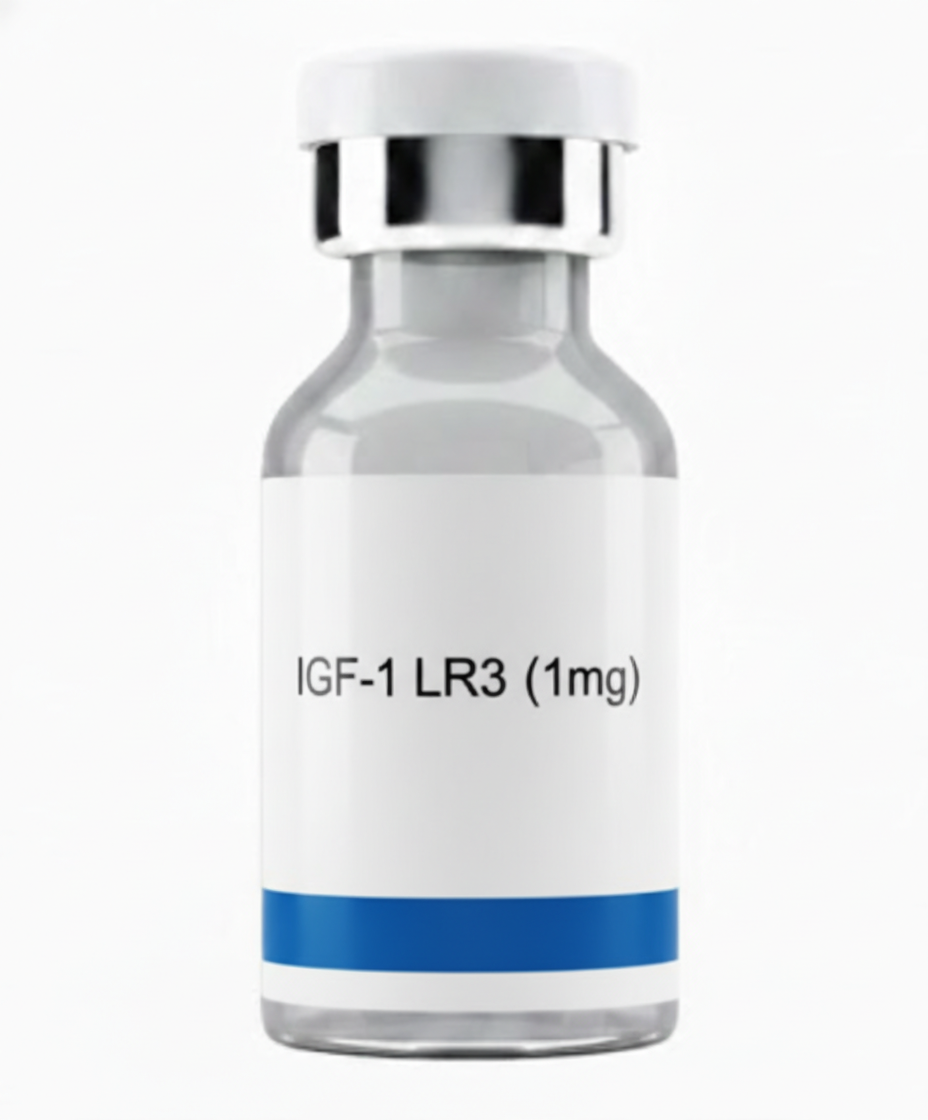
Hover to zoom
Identity Verified: LC-MS
(0 Reviews)
IGF-1 LR3 (1 mg)
- 83-AA Recombinant IGF-1 Analog: Long R3 modifications confer ~3× potency vs. native IGF-1 and 20-30h half-life, ≥98% purity
- Reduced IGFBP Binding / Dual Signaling: Bypasses IGFBP sequestration; activates IGF-1R via PI3K/Akt/mTOR and MAPK/ERK cascades
- Cell Culture & Preclinical Research: Replaces insulin at 200-fold lower concentrations; validated in 22+ peer-reviewed publications
- Mechanistic pathway studies
- In vitro receptor profiling
- HPLC verified identity and purity
$64.00In Stock
Ships same-day if ordered before 2PM EST
1
Encrypted Checkout
Global Express
Research Overview
IGF-1 LR3 (Long R3 Insulin-like Growth Factor-1) is a synthetic 83-amino acid recombinant analog of human IGF-1, engineered at GroPep Limited (Adelaide, Australia) through CSIRO and University of Adelaide collaborations in the early 1990s. Two structural modifications distinguish it from native IGF-1: an arginine substitution at position 3 and a 13-amino acid N-terminal extension (MFPAMPLSSLFVN). These confer markedly reduced affinity for all six IGF-binding proteins (IGFBPs), approximately three-fold greater potency at the IGF-1 receptor (IGF-1R), and an extended half-life of approximately 20-30 hours versus minutes for free native IGF-1. Supplied as a lyophilized powder for in vitro research, this compound is intended strictly for qualified researchers and has been validated in over 22 peer-reviewed publications spanning cardiovascular biology, fetal development physiology, gastrointestinal research, and cell culture bioprocessing.
The pharmacological value of IGF-1 LR3 lies in its ability to bypass the IGFBP regulatory network. Under physiological conditions, approximately 70-80% of circulating native IGF-1 is sequestered in 150-kDa ternary complexes with IGFBP-3 and the acid-labile subunit (ALS), leaving less than 5% in free, biologically active form. By largely escaping IGFBP sequestration, IGF-1 LR3 enables researchers to study sustained, unconfounded IGF-1R activation in both in vitro cell systems and in vivo animal models. The compound was originally developed as a cell culture supplement — it maintains CHO and HEK293 cell viability and productivity at concentrations approximately 200-fold lower than insulin, making it a standard reagent in mammalian serum-free bioproduction systems.
Published research has documented IGF-1 LR3 activity in cardiovascular biology (atherosclerotic plaque stabilization via vascular smooth muscle cell phenotype modulation), fetal organ development (selective cardiac, adrenal, and splenic growth in sheep models), gastrointestinal trophic signaling (intestinal mucosal proliferation, crypt cell growth), and neurodegenerative disease models (amyloid plaque remodeling in 5XFAD mice). Certificate of Analysis (CoA) provided with every lot. IGF-1 LR3 is classified under Section S2 of the WADA Prohibited List and has never been approved for human therapeutic use.
Primary Research Applications
Serum-Free Cell Culture Bioprocessing Research
IGF-1R Signaling Pathway Investigation
Cardiovascular Biology and Plaque Stabilization Studies
Fetal Developmental Physiology Research
Gastrointestinal Epithelial Proliferation Models
Neuroscience and Amyloid Biology Research
GH-IGF-1 Axis Feedback Studies
Anti-Doping Analytical Science
Mechanism of Action
IGF-1R Agonism with Reduced IGFBP Sequestration
IGF-1R / IGFBP Bypass — IGF-1 LR3 binds the type 1 insulin-like growth factor receptor (IGF-1R), a transmembrane receptor tyrosine kinase, with affinity comparable to native IGF-1. The critical pharmacological distinction is near-elimination of IGFBP binding: native IGF-1 bioavailability is tightly controlled by six IGFBPs whose affinity for IGF-1 exceeds that of IGF-1R itself — less than 5% of circulating native IGF-1 is free. The 13-AA N-terminal extension and Arg-3 substitution in LR3 dramatically reduce binding to all six IGFBPs, resulting in sustained, unsequestered IGF-1R activation at the target site. Studies in atherosclerotic plaque-derived vascular smooth muscle cells confirmed that while native IGF-1 had reduced efficacy due to elevated local IGFBP concentrations, LR3 maintained potent anti-apoptotic activity via PI3K (von der Thusen et al., 2011).
PI3K/Akt/mTOR Signaling Cascade
IRS-1 / Akt / mTORC1 — IGF-1R autophosphorylation recruits insulin receptor substrate-1 (IRS-1), activating PI3K → PIP3 → PDK1/mTORC2 → Akt. Activated Akt phosphorylates: (a) mTORC1, stimulating p70S6K and 4E-BP1 to promote protein synthesis; (b) GSK3-β, inhibiting protein degradation; (c) FOXO transcription factors, suppressing E3 ubiquitin ligases (atrogin-1/MuRF1) involved in proteasomal degradation; (d) BAD/Caspase-9, providing anti-apoptotic signaling. Studies in fetal sheep cardiomyocytes established that blocking PI3K completely abolished LR3-stimulated cell division, confirming PI3K pathway is non-redundant for the proliferative response (Sundgren et al., 2003).
MAPK/ERK Proliferative Signaling
SHC/Grb2/Ras → ERK Cascade — IGF-1R phosphorylates the SHC adapter protein, recruiting Grb2/SOS and activating the Ras-Raf-MEK-ERK kinase cascade. This pathway regulates cell proliferation, differentiation, and gene expression. LR3 increased fetal cardiomyocyte BrdU uptake 3-5 fold (hyperplastic response); pharmacological blockade of ERK (UO-126) or PI3K (LY-294002) each completely abolished this proliferative response, establishing dual-pathway requirement for cell division. LR3 also increased EdU-positive skeletal muscle myoblasts by 11% (p=0.01) in fetal sheep in vivo (Stremming et al., 2021).
Metabolic and GH-Axis Feedback
Negative Feedback on GH Secretion — LR3 IGF-1 reproduces and amplifies the metabolic feedback of native IGF-1 on the hypothalamic-pituitary axis. In porcine models, infusion at 180 µg/kg/day suppressed plasma GH concentrations by 23% (mean) with a 60% reduction in GH secretory peak area, and reduced endogenous IGF-1, IGFBP-3, and insulin concentrations (Dunaiski et al., 1997). In fetal sheep, acute 90-minute infusion reduced plasma insulin by 48% and attenuated glucose-stimulated insulin secretion by 66%, reflecting acute paracrine suppression of pancreatic beta-cell function (White et al., 2023).
“Mechanistic summaries on this page are provided for laboratory reference and should be interpreted within controlled experimental settings only.”
Preclinical Research Summary
IGF-1 LR3 is supplied as a lyophilized powder for in vitro research and has been investigated across multiple in vivo animal model systems. In cardiovascular research, von der Thusen et al. (2011) demonstrated that 4-week subcutaneous LR3 infusion (0.25 µg/hour) in ApoE-knockout mice reduced atherosclerotic stenosis, doubled the cap-to-core ratio in early plaques, increased vascular smooth muscle cell content 2-fold in advanced plaques, and reduced intraplaque hemorrhage from 16% to 4%. In fetal sheep, Stremming et al. (2021) showed that 1-week intravenous LR3 infusion selectively increased fetal heart, adrenal, and splenic organ mass without a proportional increase in overall fetal mass or evidence of increased placental nutrient transfer — indicating direct IGF-1R-mediated organ growth. Skeletal muscle myoblast proliferation was elevated (EdU-positive myoblasts 11% higher, p=0.01), though myofiber hypertrophy was absent, identifying LR3 as a hyperplastic rather than hypertrophic stimulus.
Gastrointestinal trophic studies by Steeb et al. (1997) demonstrated that systemic LR3 infusion in suckling rats for 6.5 days produced gut weight increases up to 60%, gut length up to 32%, kidney weight increases up to 85%, and spleen increases up to 76%, with LR3 more potent than native IGF-1 for all parameters. In neuroscience, Engel et al. (2025) reported that intranasal LR3 reduced filamentous amyloid plaques in 5XFAD mouse cortex (significant cortical D54D2+ fluorescence reduction, p<0.01), though behavioral outcomes in Y-maze, box maze, and open field tests were not improved. Safety data from tumor-bearing rat models (Tomas et al., 1994) showed that LR3 alone increased tumor growth and reduced host muscle protein synthesis, while also decreasing carcass adipose tissue. Comprehensive formal toxicology, including LD50 and chronic-exposure studies, has not been published for IGF-1 LR3; all available evidence derives from short-term (days to weeks) animal infusion experiments. No human clinical trials have been conducted.
Academic References
- Sundgren NC, Giraud GD, Schultz JM, et al. (2003). Extracellular signal-regulated kinase and phosphoinositol-3 kinase mediate IGF-1 induced proliferation of fetal sheep cardiomyocytes. American Journal of Physiology - Regulatory, Integrative and Comparative Physiology.
- von der Thusen JH, Borensztajn KS, Moimas S, et al. (2011). IGF-1 has plaque-stabilizing effects in atherosclerosis by altering vascular smooth muscle cell phenotype. American Journal of Pathology.
- Stremming J, Heard S, White A, et al. (2021). IGF-1 infusion to fetal sheep increases organ growth but not by stimulating nutrient transfer to the fetus. American Journal of Physiology - Endocrinology and Metabolism.
- Engel MG, Narayan S, Cui MH, et al. (2025). Intranasal long R3 IGF-1 treatment promotes amyloid plaque remodeling in cerebral cortex but fails to preserve cognitive function in male 5XFAD mice. Journal of Alzheimer's Disease.
- Steeb CB, Shoubridge CA, Tivey DR, Read LC (1997). Systemic infusion of IGF-I or LR(3)IGF-I stimulates visceral organ growth and proliferation of gut tissues in suckling rats. American Journal of Physiology - Gastrointestinal and Liver Physiology.
- Bailes J, Soloviev M (2021). Insulin-Like Growth Factor-1 (IGF-1) and Its Monitoring in Medical Diagnostic and in Sports. Biomolecules.
- Dunaiski V, Dunshea FR, Clarke IJ, Walton PE (1997). Effects of infusion of insulin-like growth factor-I and Long(R3)IGF-I on metabolic parameters and pituitary release of growth hormone in the pig. Journal of Endocrinology.
This product is intended exclusively for in vitro laboratory research by qualified professionals. Not for human consumption. Not approved by the FDA.