Research Use Only: This product is supplied for laboratory research and in-vitro studies. Not for human or veterinary administration.
Hover to zoom
Identity Verified: LC-MS
(0 Reviews)
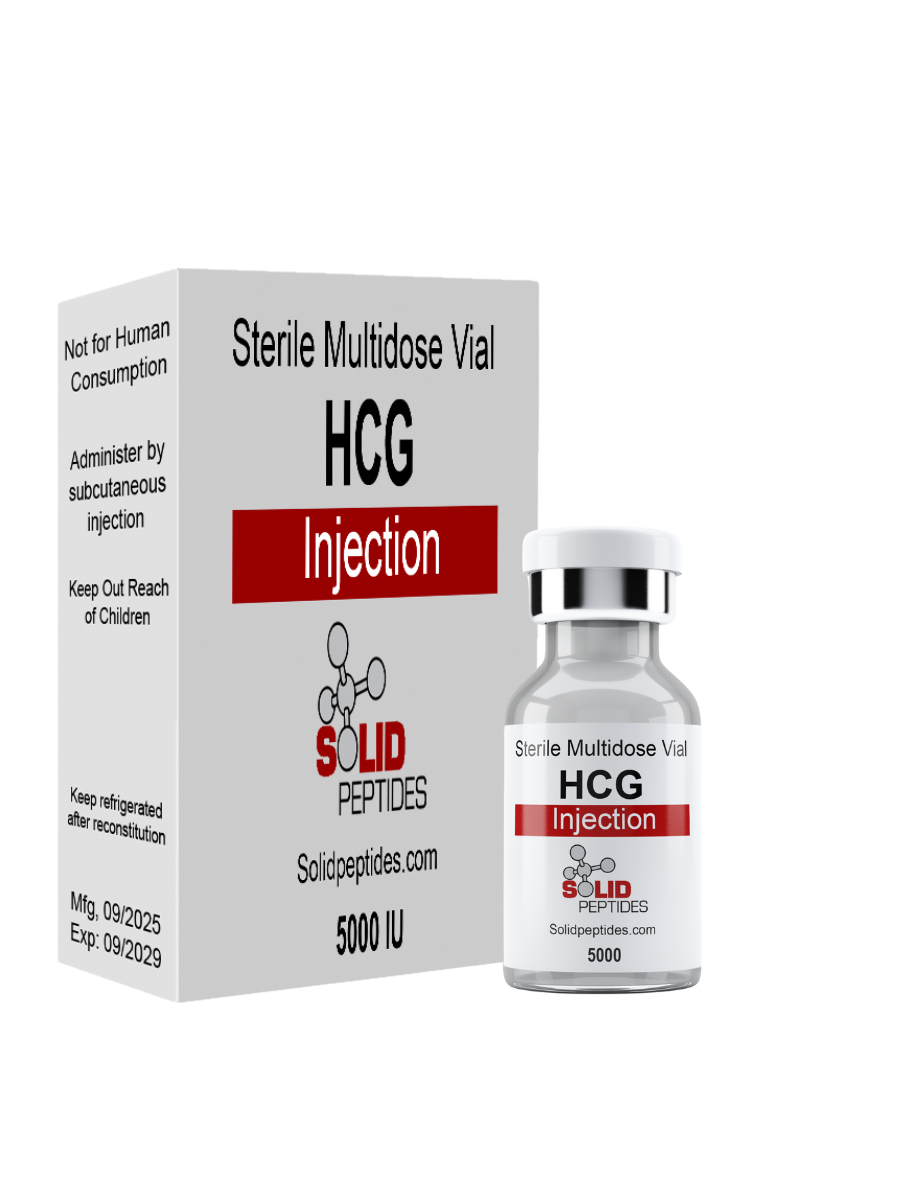
HCG (5000)
- Glycoprotein Hormone (hCG): 237-amino acid heterodimer (α-subunit 92 aa + β-subunit 145 aa), ≥95% purity by SDS-PAGE, 5,000 IU per vial
- LHCGR Biased Agonism: cAMP/PKA steroidogenic signaling, EC₅₀ 107 pM — 5-fold more potent than LH for cAMP production
- Reproductive Endocrinology Research: GPCR signaling, steroidogenesis, and endometrial biology investigation
- Mechanistic pathway studies
- In vitro receptor profiling
- HPLC verified identity and purity
$54.00In Stock
Ships same-day if ordered before 2PM EST
1
Encrypted Checkout
Global Express
Research Overview
Human chorionic gonadotropin (hCG) is a heterodimeric glycoprotein hormone comprising 237 amino acids (α-subunit 92 aa + β-subunit 145 aa) with a molecular mass of approximately 36,700 Da inclusive of glycan moieties. Supplied as a lyophilized powder for in vitro research and intended strictly for qualified researchers, hCG is produced endogenously by trophoblastic cells and encoded by a cluster of six CGB genes on chromosome 19q13.3 (β-subunit) and the CGA gene shared with LH, FSH, and TSH (α-subunit). The compound has been the subject of thousands of peer-reviewed publications spanning reproductive endocrinology, GPCR pharmacology, steroidogenesis, immunomodulation, angiogenesis, and endometrial biology.
The hormone's unique carboxy-terminal peptide (CTP) extension on the β-subunit — a 24-amino acid segment bearing four O-linked glycosylation sites — distinguishes hCG from LH and confers a prolonged serum half-life of 24–36 hours versus ~90 minutes for LH. A landmark 2021 cryo-electron microscopy study in Nature (Duan et al.) resolved the first full-length LHCGR-hCG-Gs signaling complex, revealing a "push-and-pull" receptor activation mechanism mediated by a conserved 10-residue tethered agonist peptide. Active research continues through 2025 in GPCR biased agonism, endometrial epigenetic regulation, spermatogenesis biology, and cancer immunobiology.
Certificate of Analysis (CoA) provided with every lot. Key research domains include LHCGR biased agonism investigation (cAMP/PKA steroidogenic pathway vs. ERK1/2/AKT proliferative pathway), Gs/Gq/11/beta-arrestin signaling dissection, StAR-mediated steroidogenic cascade studies, endometrial stromal cell biology, and immunomodulatory Treg/Th2 pathway research at tissue interfaces.
Primary Research Applications
LHCGR Biased Agonism Research
Steroidogenesis and StAR Pathway Studies
GPCR Signaling Dissection
Spermatogenesis Biology Investigation
Endometrial Receptivity Research
Maternal-Fetal Immune Tolerance Studies
Angiogenesis and EG-VEGF Pathway Research
Cancer Immunobiology and Beta-hCG Biomarker Studies
Mechanism of Action
LHCGR Binding and "Push-and-Pull" Activation
Cryo-EM Structure / Tethered Agonist P10 — hCG binds the leucine-rich repeat extracellular domain of LHCGR with EC₅₀ ~107 pM (5-fold higher potency than LH for cAMP, EC₅₀ ~530 pM). Duan et al. (2021, Nature) resolved four cryo-EM structures of the full-length LHCGR-hCG-Gs complex, revealing that hormone binding pushes the extracellular domain while a conserved 10-residue hinge-loop peptide (P10) acts as a tethered agonist pulling the transmembrane domain, inducing Gs coupling.
Canonical Gs/cAMP/PKA/StAR Steroidogenic Pathway
StAR / CYP11A1 Cascade — LHCGR couples to Gs-alpha, activating adenylyl cyclase to elevate intracellular cAMP, which activates PKA. PKA phosphorylates CREB, driving transcription of steroidogenic acute regulatory protein (StAR) — the rate-limiting step for cholesterol transfer from outer to inner mitochondrial membrane, where CYP11A1 initiates steroidogenesis. In Leydig cell research models, subsequent steps via 3β-HSD, CYP17A1, and 17β-HSD complete the steroidogenic cascade. hCG produces sustained oscillating cAMP elevation over 36 hours, while LH kinetics are faster and transient (Casarini et al., 2012).
Biased Agonism: hCG vs. LH Pathway Selectivity
cAMP/PKA vs. ERK1/2/AKT Divergence — hCG exhibits biased agonism at LHCGR, preferentially engaging cAMP/PKA steroidogenic signaling, while LH more potently activates ERK1/2 and AKT proliferative cascades. BRET and FRET studies (Riccetti et al., 2017) confirmed differential G-protein vs. beta-arrestin engagement. At higher concentrations, LHCGR couples to Gq/11, activating PLC, IP₃-mediated calcium release from ER stores, and PKC — enabling concentration-dependent pathway switching.
Immunomodulatory Signaling at Tissue Interfaces
IDO / Treg / HO-1 Pathways — hCG promotes tolerogenic dendritic cell phenotypes via indoleamine 2,3-dioxygenase (IDO) activation (tryptophan depletion, T-cell anergy induction), expands regulatory T cells (Tregs) at fetal-maternal interfaces, upregulates heme oxygenase-1 (HO-1), and shifts immune responses toward Th2/Treg phenotypes. On endometrial cells, LHCGR activation stimulates LIF secretion while suppressing IL-6.
Endometrial Epigenetic and Autophagy Regulation
ERK1/2 / mTOR / H3K27Ac — Wang et al. (2024) demonstrated that hCG-activated LHCGR increases HOXA10, ITGB3, FOXO1, LIF, and L-selectin expression while enhancing autophagy through ERK1/2 and mTOR phosphorylation in endometrial stromal cells. Žukauskaite et al. (2025) documented altered histone acetylation (H3K27Ac) at decidualization-associated genes and changes in extracellular vesicle microRNA profiles following hCG treatment.
“Mechanistic summaries on this page are provided for laboratory reference and should be interpreted within controlled experimental settings only.”
Preclinical Research Summary
hCG is supplied as a lyophilized powder for in vitro research and is studied in cell and animal models. The 2021 cryo-EM study by Duan et al. in Nature resolved four structures of the full-length LHCGR-hCG-Gs complex, establishing the structural basis for the "push-and-pull" receptor activation mechanism and providing a framework for glycoprotein hormone receptor biology. Casarini et al. (2012, PLOS ONE) demonstrated that hCG is approximately 5-fold more potent than LH for cAMP production (ED₅₀: 107 pM vs. 530 pM) and produces sustained cAMP oscillations over 36 hours, while LH preferentially activates ERK1/2 and AKT pathways — establishing biased agonism at LHCGR.
Endometrial biology research by Wang et al. (2024) demonstrated that hCG activation of LHCGR increases implantation-associated markers (HOXA10, ITGB3, FOXO1, LIF) and enhances autophagy via ERK1/2/mTOR phosphorylation in stromal cell models. Žukauskaite et al. (2025) further characterized epigenetic modifications including H3K27Ac changes at decidualization genes and microRNA profile shifts in extracellular vesicles from hCG-treated cells. Spermatogenesis biology has been characterized in hypogonadotropic hypogonadism research models; the 2023 Alexander et al. meta-analysis (103 studies, 5,328 patients, European Journal of Endocrinology) and 2025 Muir et al. meta-analysis (41 studies, 1,673 patients, Clinical Endocrinology) provide systematic evidence on gonadotropin biology in this research domain. Large-scale GPCR structural studies and endometrial biology models continue to advance mechanistic understanding.
Academic References
- Duan J et al. (2021). Structures of Full-Length Glycoprotein Hormone Receptor Signalling Complexes. Nature.
- Casarini L et al. (2012). LH and hCG Action on the Same Receptor Results in Quantitatively and Qualitatively Different Intracellular Signalling. PLOS ONE.
- Riccetti L et al. (2017). Human Luteinizing Hormone and Chorionic Gonadotropin Display Biased Agonism at the LH and LH/CG Receptors. Sci Rep.
- Casarini L et al. (2018). Two Hormones for One Receptor: Evolution, Biochemistry, Actions, and Pathophysiology of LH and hCG. Endocr Rev.
- Alexander EC et al. (2023). Gonadotropins for Pubertal Induction in Males with Hypogonadotropic Hypogonadism: Systematic Review and Meta-Analysis. Eur J Endocrinol.
- Muir CA et al. (2025). Efficacy of Gonadotropin Treatment for Induction of Spermatogenesis in Men With Pathologic Gonadotropin Deficiency: A Meta-Analysis. Clin Endocrinol.
- Wang X et al. (2024). Enhancing Endometrial Receptivity: The Roles of Human Chorionic Gonadotropin in Autophagy and Apoptosis Regulation in Endometrial Stromal Cells. Reprod Biol Endocrinol.
- Stocks JM et al. (2025). Optimal Restoration of Spermatogenesis After Testosterone Therapy Using Human Chorionic Gonadotropin and Follicle-Stimulating Hormone. Fertil Steril.
This product is intended exclusively for in vitro laboratory research by qualified professionals. Not for human consumption. Not approved by the FDA.