Research Use Only: This product is supplied for laboratory research and in-vitro studies. Not for human or veterinary administration.
Hover to zoom
Identity Verified: LC-MS
(0 Reviews)
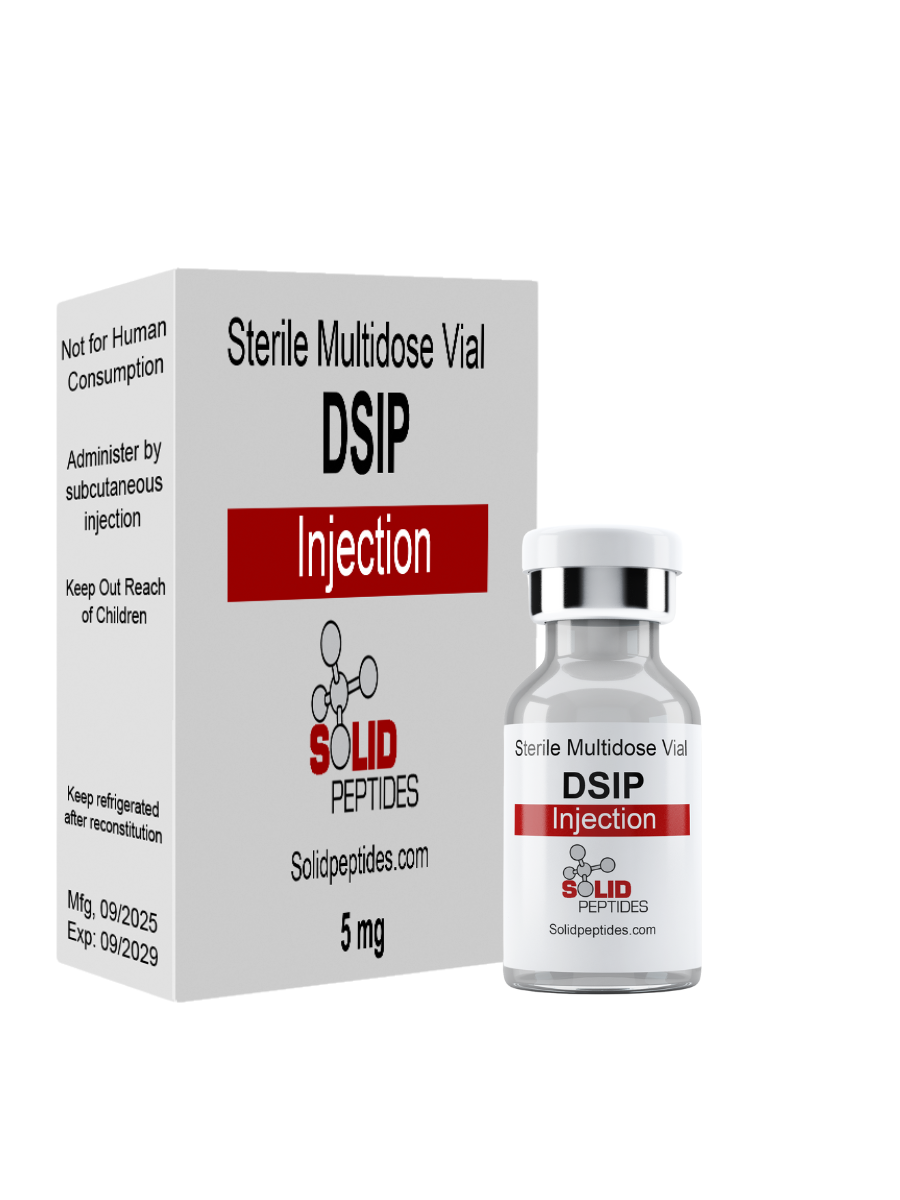
DSIP (5mg)
- Nonapeptide (DSIP): 9-amino acid sequence (WAGGDASGE), ≥98% purity by HPLC
- Slow-Wave EEG Modulator: Delta-band activity research in neocortex and limbic cortex
- Mitochondrial Studies: Hypoxia-stress respiration research in rat brain models
- Mechanistic pathway studies
- In vitro receptor profiling
- HPLC verified identity and purity
$35.00In Stock
Ships same-day if ordered before 2PM EST
1
Encrypted Checkout
Global Express
Research Overview
Delta Sleep-Inducing Peptide (DSIP) is a 9-amino acid nonapeptide (sequence WAGGDASGE) first isolated in 1977 from rabbit cerebral venous blood. Supplied as a lyophilized powder for in vitro research, intended strictly for qualified researchers, DSIP has been the subject of over 200 peer-reviewed publications since the 1980s spanning slow-wave EEG biology, neuroendocrine signaling, mitochondrial respiration, anticonvulsant pharmacology, and stress-physiology research.
The peptide occupies a debated position in neuroscience. While the original somnogen hypothesis remains contested due to the absence of an identified gene or dedicated receptor, DSIP demonstrates reproducible activity across multiple in vitro and animal model systems. Reported activities include modulation of hypothalamic-pituitary-adrenal axis signaling, interaction with GABAergic and glutamatergic neurotransmitter pathways, preservation of mitochondrial respiration under hypoxic stress, and modulation of endogenous opioid peptide systems.
Current investigation continues across delta-EEG mechanism research, alpha-1-adrenergic and pineal N-acetyltransferase pathway studies, and structure-activity work on DSIP analogues such as DSIP-12 and blood-brain-barrier-penetrating fusion variants (Mu et al., 2024).
Primary Research Applications
Slow-Wave EEG Research
Chronobiology and Circadian Studies
HPA Axis Investigation
Mitochondrial Respiration Studies
Anticonvulsant Pathway Research
Pineal N-Acetyltransferase Studies
Endogenous Opioid System Research
Stress-Resilience Mechanism Research
Mechanism of Action
Delta-Band Cortical Activity
Slow-Wave EEG Modulation — In rabbit mesodiencephalic infusion studies, DSIP administration is associated with increases in spindle and delta-band EEG activity. Graf and Kastin (1984) documented a U-shaped dose-response curve for both dose and infusion timing across rabbit, rat, mouse, and cat electrophysiology studies.
Alpha-1-Adrenergic Pineal Pathway
N-Acetyltransferase Enhancement — Graf and Schoenenberger (1987) demonstrated that DSIP and its phosphorylated analogue enhance norepinephrine-induced N-acetyltransferase activity in rat pineal tissue at 20–300 nM. The effect is abolished by prazosin (alpha-1 antagonist) but not by propranolol (beta-blocker), establishing a molecular link to circadian-pathway research via pineal signaling.
Mitochondrial Respiration
V3 Phosphorylated Respiration — Khvatova et al. (2003) reported that DSIP pretreatment (120 μg/kg intraperitoneal in rats) preserved the rate of phosphorylated mitochondrial respiration and improved respiratory control ratios under hypoxic challenge. Complementary work documented preservation of MAO-A activity and serotonin levels under oxidative stress.
Anticonvulsant Neurotransmitter Balance
Inhibitory-Excitatory Ratio — Stanojlovic et al. (2005) demonstrated that DSIP and the analogue DSIP-12 increased delta and theta frequency bands and reduced incidence, mean grade, and duration of metaphit-provoked convulsions in rats. The proposed mechanism involves optimization of the ratio between inhibitory and excitatory amino-acid neurotransmitters via GABA-A, glycine, and NMDA receptor systems.
MAPK / GILZ Signaling Homology
Raf-1 / ERK Pathway — DSIP shares sequence homology with glucocorticoid-induced leucine zipper (GILZ), an inhibitor of Raf-1 activation. This homology suggests potential downstream involvement in anti-inflammatory and anti-apoptotic MAPK/ERK signaling — a focus of current cellular-signaling research.
“Mechanistic summaries on this page are provided for laboratory reference and should be interpreted within controlled experimental settings only.”
Preclinical Research Summary
DSIP is supplied as a lyophilized powder for in vitro research and is studied in cell and animal models. In Khvatova et al. (2003), DSIP pretreatment of rats prior to hypoxic challenge was investigated for preservation of mitochondrial respiratory control ratios and V3 phosphorylated respiration rates in brain tissue. Tukhovskaya et al. (2021) reported that intranasal DSIP (120 μg/kg) was associated with accelerated motor-coordination recovery in a middle cerebral artery occlusion rat stroke model by day 7, although the brain infarct volume difference did not reach statistical significance.
Anticonvulsant investigation by Stanojlovic et al. (2005) showed that DSIP and DSIP-12 increased delta/theta EEG band activity and reduced the incidence, mean grade, and duration of metaphit-provoked seizures in rats (p<0.05 to p<0.01), with DSIP-12 showing greater effect magnitude. Geroprotective animal research by Popovich et al. (2003) documented reduced chromosomal aberration rates (−22.6%) and reduced spontaneous tumor incidence in female SHR mice. Most DSIP data remain in animal and in-vitro model systems; large modern human clinical trials are limited.
Academic References
- Khvatova EM et al. (2003). Delta sleep inducing peptide: effect on respiration activity in rat brain mitochondria and stress protective potency under experimental hypoxia. Peptides.
- Tukhovskaya EA et al. (2021). Delta Sleep-Inducing Peptide Recovers Motor Function in SD Rats after Focal Stroke. Molecules.
- Stanojlovic OP et al. (2005). Antiepileptic activity of delta sleep-inducing peptide and its analogue in metaphit-provoked seizures in rats. Seizure.
- Graf MV, Schoenenberger GA (1987). Delta sleep-inducing peptide modulates rat pineal N-acetyltransferase activity via alpha-1-adrenergic receptor. J Neurochem.
- Popovich IG et al. (2003). Effect of delta-sleep inducing peptide-containing preparation Deltaran on biomarkers of aging and tumor incidence in SHR mice. Mech Ageing Dev.
- Kovalzon VM, Strekalova TV (2006). Delta sleep-inducing peptide (DSIP): a still unresolved riddle. J Neurochem.
- Friedman TC et al. (1994). Diurnal rhythm of plasma delta-sleep-inducing peptide in humans. J Clin Endocrinol Metab.
- Mu X et al. (2024). Pichia pastoris secreted peptides crossing the blood-brain barrier and DSIP fusion peptide efficacy in PCPA-induced insomnia mouse models. Front Pharmacol.
This product is intended exclusively for in vitro laboratory research by qualified professionals. Not for human consumption. Not approved by the FDA.